
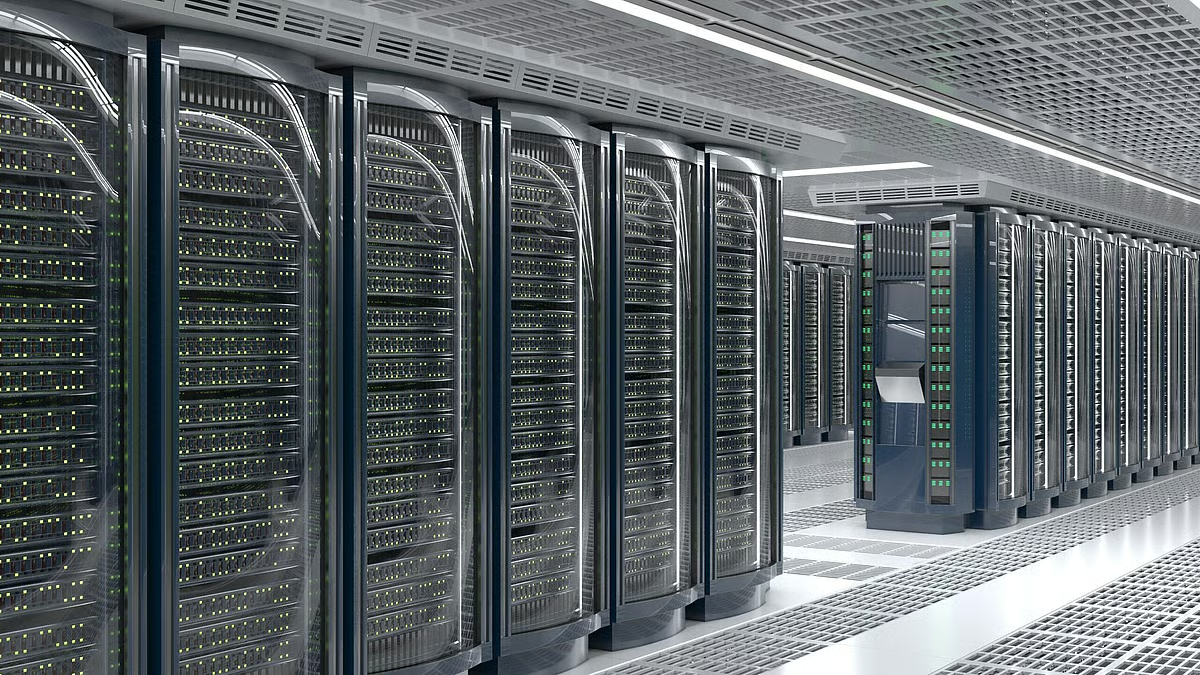

India’s one hundred billion dollar data centre boom is reshaping national digital infrastructure and the main keyword data centre boom fits naturally because this expansion will strongly influence internet speed, reliability and service quality in smaller cities. As investments rise, users outside metro regions can expect major improvements across connectivity, latency and access to cloud based services.
Understanding the scale and urgency behind the data centre boom
India is witnessing exponential growth in data consumption, AI workloads, streaming demand and digital public services. This surge requires massive storage and computing capacity. Many global and domestic firms are investing in large data centre parks, edge facilities and regional clusters to support this growth. Secondary keywords like internet infrastructure and regional connectivity support this section. Earlier, data centres were concentrated in Mumbai, Chennai, Hyderabad and Bengaluru. These hubs are now nearing capacity as enterprises modernise operations and government services shift online. The new investment wave aims to decentralise capacity and deliver better digital performance nationwide, especially in cities that have historically faced slower connectivity.
Why smaller cities have become priority locations for expansion
Smaller cities offer several strategic advantages for data centre developers. Land is more affordable, power infrastructure is easier to scale and local governments provide supportive policies to attract digital investment. Cities like Nagpur, Indore, Jaipur, Kochi, Noida, Vijayawada and Coimbatore are emerging as preferred destinations. Proximity to industrial clusters and educational institutions strengthens the case for locating new infrastructure outside metros. By placing data centres closer to users, operators can lower latency and reduce dependence on overloaded metro networks. This localisation ensures faster access to apps, cloud tools and digital platforms that shape daily usage patterns across smaller cities.
How the boom will affect everyday internet performance
Users in smaller cities can expect noticeable improvements in internet speed and stability. When data is processed within nearby data centres, download times decrease and streaming becomes smoother. Activities like online classes, remote work, gaming, telemedicine and digital payments run with fewer interruptions. Cloud based apps load faster because routing distances reduce significantly. Many services that earlier depended on metro based servers will perform better thanks to local caching and distributed compute setups. Over time, this reduces congestion on long haul fibre routes and limits service disruptions caused by national network outages. These improvements directly impact how families, students and small businesses interact with digital platforms.
Why businesses in smaller cities benefit the most
Local businesses rely increasingly on cloud systems for billing, customer management, online storefronts and logistics integration. With regional data centres, they gain faster access to enterprise tools and more reliable service uptime. Manufacturing firms operating out of industrial corridors near Tier 2 cities can use real time monitoring and automation more effectively. Startups gain access to faster compute for analytics, AI and app development. Small retailers offering digital payments or social commerce services experience improved transaction reliability. This enables greater digital adoption and reduces the technology gap between metro and non metro regions.
The role of edge computing in transforming regional connectivity
Edge data centres will form a crucial part of the next phase of expansion. These smaller facilities process data close to the source, reducing delays. Edge computing is essential for AI driven applications, logistics planning, real time surveillance, smart city systems and IoT deployment. Smaller cities will see deployment of micro edge nodes integrated with larger central clusters. This layered architecture provides stability and ensures that essential services remain functional even if major metros face network congestion. For users, this translates into more consistent digital performance across applications that depend on real time decision making.
Challenges smaller cities must overcome to maximise benefits
Despite the opportunities, several challenges require careful planning. Stable power supply remains a critical issue for data centres, which need uninterrupted electricity. Many smaller cities must upgrade substations, grid capacity and renewable energy integration to support these facilities. Fibre connectivity must also expand to ensure redundancy and avoid choke points. Workforce readiness is another factor. Data centres require technicians, engineers, cybersecurity professionals and operations staff. Training institutions in smaller cities must build programs to support these needs. Without these upgrades, smaller cities may benefit at a slower pace than intended.
User expectations and long term digital impact
As data centre presence increases, users can expect lower downtime, higher peak hour performance and faster access to emerging digital services. AI driven platforms, advanced gaming experiences, high resolution streaming, telehealth diagnostics and remote work ecosystems will become more feasible in Tier 2 and Tier 3 cities. Students will gain smoother access to edtech platforms and cloud classrooms. Local governments will adopt more digital-first governance tools. In the long run, strong internet infrastructure positions smaller cities as competitive economic hubs, attracting startups, IT parks and remote teams. This reduces migration pressure and encourages balanced regional development.
Takeaways
Regional data centres will significantly improve internet speed and reliability
Businesses in smaller cities will benefit from better cloud access and uptime
Edge computing will strengthen real time applications and smart city systems
Power, fibre and workforce upgrades are essential for long term impact
FAQ
Will internet speeds increase in smaller cities due to data centres
Yes. Localised data processing reduces latency and improves speeds across streaming, gaming and cloud applications.
Do businesses gain direct benefits from regional data centres
They gain faster access to cloud tools, improved uptime and more stable digital operations, especially in logistics and retail.
Are edge data centres important for Tier 2 cities
Yes. They ensure real time responsiveness for AI, IoT and smart city systems, strengthening overall service quality.
Will these improvements reduce dependence on metro networks
Yes. Distributed infrastructure reduces congestion and decentralises digital capacity across the country.