
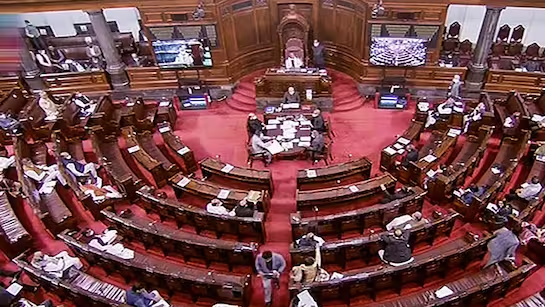

The India EC announcement of Rajya Sabha polls on 37 seats has triggered fresh political calculations across multiple states. With voting scheduled in March, parties are reassessing legislative strength, alliances and candidate strategies that could influence regional and national power equations.
The Election Commission’s decision to conduct Rajya Sabha polls on 37 seats is a time sensitive political development. These seats are falling vacant due to the completion of six year terms of sitting members. Since Rajya Sabha members are elected by state legislators, the outcome depends heavily on current Assembly arithmetic rather than public voting trends.
Understanding the Rajya Sabha Election Process
Rajya Sabha elections are indirect. Members of Legislative Assemblies vote using a proportional representation system through the single transferable vote method. Each state has a fixed number of seats based on population.
When multiple seats from a state fall vacant at the same time, parties calculate how many candidates they can safely elect based on their MLA strength. The required vote quota is determined by dividing the total number of valid votes by the number of seats plus one, and then adding one to the result.
Because of this formula, even small shifts in legislative numbers can influence outcomes. In closely contested states, cross voting or abstentions may alter final results.
Which States Could See Competitive Contests
The 37 Rajya Sabha seats are spread across several states where members are retiring this cycle. In states where a single party or alliance has a clear majority in the Assembly, outcomes are usually predictable.
However, competitive contests are likely in states with fractured mandates or coalition governments. Regional parties that hold a decisive number of MLAs may negotiate for seat sharing in exchange for alliance support.
States with recent Assembly elections may see fresh alignments reflected in Rajya Sabha nominations. This round of polls becomes a test of coalition stability in such regions.
Impact on Regional Political Parties
Regional parties stand to gain significant leverage in Rajya Sabha elections. Since Upper House representation affects legislative influence at the national level, securing additional seats strengthens bargaining power.
For example, a regional party that cannot win Lok Sabha seats in large numbers may still maintain influence through Rajya Sabha representation. This is particularly relevant for parties concentrated in specific states.
Rajya Sabha members play roles in parliamentary committees, legislative debates and bill scrutiny. Therefore, even a single additional seat can enhance a party’s voice in national policymaking.
In states where no single party meets the quota independently, alliances become crucial. Smaller parties may extract strategic concessions during candidate selection.
National Political Arithmetic and Policy Implications
While Rajya Sabha elections are state based, their cumulative impact is national. The strength of parties in the Upper House affects the passage of key legislation, especially when the ruling party does not hold a clear majority there.
If the current ruling alliance improves its tally through these 37 seats, it could ease the path for pending legislative reforms. Conversely, if opposition parties gain ground, policy negotiations may intensify.
Rajya Sabha numbers matter particularly for constitutional amendments and controversial bills that require broader consensus. Even incremental seat changes can shift committee compositions and floor strategies.
Political observers will closely track whether this election cycle alters the balance between the ruling coalition and opposition blocs.
Candidate Selection Strategy and Internal Party Dynamics
The announcement has also triggered internal discussions within parties regarding candidate selection. Rajya Sabha nominations are often used to reward senior leaders, technocrats, former ministers or allies who may not contest direct elections.
In some states, parties may nominate subject experts in law, economics or public policy to strengthen parliamentary debate. In others, political loyalists may be prioritized to consolidate internal unity.
Candidate selection can also reflect caste, regional and gender considerations, especially in states where social representation is politically sensitive.
If the number of candidates equals the number of available seats in a state, elections may be uncontested. However, in competitive states, parties must ensure full MLA attendance to avoid surprises.
Possibility of Cross Voting and Political Signals
Cross voting has historically influenced certain Rajya Sabha contests, particularly in states with slim majorities. When MLAs vote contrary to party direction, it signals internal dissatisfaction or strategic realignment.
Although anti defection laws apply in many legislative contexts, Rajya Sabha voting through open ballots reduces secrecy and discourages large scale defiance. Still, close contests often generate speculation.
The outcome of these 37 seats will serve as an indicator of political cohesion within alliances ahead of upcoming electoral cycles.
Takeaways
• Rajya Sabha polls on 37 seats will reflect current Assembly arithmetic across states
• Regional parties could gain leverage in closely contested states
• Upper House strength influences national legislative outcomes
• Candidate selection may signal internal party strategy and alliance stability
FAQ
Q1: Who votes in the Rajya Sabha elections announced by the EC?
Members of Legislative Assemblies in the respective states vote using a proportional representation system.
Q2: Why are 37 seats being contested now?
These seats are falling vacant as the six year terms of sitting Rajya Sabha members are ending.
Q3: Can these elections change national politics?
Yes, changes in Upper House strength can affect the passage of legislation and the balance between ruling and opposition parties.
Q4: Are Rajya Sabha elections always competitive?
Not always. In states where one party has sufficient MLAs to meet the quota, candidates may be elected unopposed.