
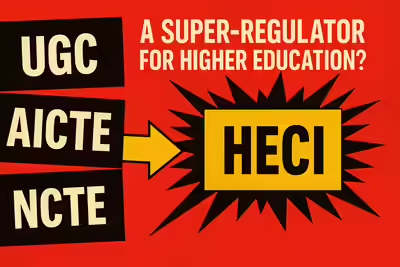

India’s education system reset is gaining attention as policymakers push for curriculum changes aligned with the National Education Policy. The reforms aim to make learning more flexible, skill-focused, and relevant to modern careers, affecting students across schools and universities.
The education system reset in India reflects a time-sensitive transition driven by NEP implementation, university reforms, and curriculum restructuring. These changes are expected to reshape how students learn, choose subjects, and prepare for careers in a rapidly evolving economy.
Education System Reset in India and Policy-Driven Curriculum Changes
The education system reset in India is largely guided by the National Education Policy 2020, which continues to roll out in phases. The focus is on reducing rote learning and encouraging conceptual understanding.
One of the key changes is the introduction of multidisciplinary learning. Students are no longer restricted to rigid streams like science, commerce, or arts. This allows flexibility in choosing subjects based on interest and career goals.
Universities are also being pushed to update outdated syllabi. Regulatory bodies have emphasized aligning courses with industry requirements, ensuring that graduates are job-ready.
This shift is not just structural but also philosophical, moving from memorization to application-based learning.
School Curriculum Changes and Holistic Learning Approach
At the school level, curriculum changes are focusing on holistic development. The traditional 10+2 structure is being reworked into a more flexible format that emphasizes foundational, preparatory, middle, and secondary stages.
Students are being encouraged to develop critical thinking, problem-solving, and communication skills. Subjects like coding, vocational training, and environmental education are being introduced earlier in the learning cycle.
Assessment methods are also evolving. Instead of relying solely on final exams, schools are adopting continuous evaluation models. This reduces exam pressure and provides a more accurate measure of student performance.
The aim is to create a balanced system where academic learning is complemented by practical skills.
Higher Education Reforms and University Curriculum Updates
Higher education institutions are undergoing significant curriculum reforms. Universities are introducing multiple entry and exit options, allowing students to earn certificates, diplomas, or degrees based on the duration of study.
The Academic Bank of Credits system enables students to store and transfer credits across institutions. This provides flexibility and reduces the risk of losing academic progress.
Courses are being redesigned to include internships, research projects, and industry exposure. This is particularly important in fields like engineering, management, and healthcare.
The push for autonomy among universities is also encouraging innovation in course design and teaching methods.
Skill Development and Industry Alignment in New Curriculum
A major focus of the new curriculum changes is skill development. The gap between academic education and industry requirements has been a long-standing issue in India.
The revised approach integrates vocational training with formal education. Students can learn practical skills alongside theoretical knowledge, improving employability.
Partnerships between educational institutions and industries are increasing. Companies are collaborating with colleges to design courses, offer internships, and provide real-world exposure.
This alignment is expected to produce graduates who are better prepared for the workforce, reducing the need for additional training after hiring.
Challenges in Implementing Education Reforms Across India
Despite the benefits, implementing the education system reset comes with challenges. Infrastructure gaps in many schools, especially in rural and Tier 2 regions, can slow down adoption.
Teacher training is another critical issue. Educators need to adapt to new teaching methods and technologies, which requires time and resources.
There is also resistance to change from institutions accustomed to traditional systems. Updating curricula, assessment methods, and administrative processes can be complex.
Digital access remains uneven across regions. While urban schools may adopt new tools quickly, others may struggle due to limited resources.
What These Changes Mean for Students and Parents
For students, the new curriculum offers greater flexibility and choice. They can explore multiple interests and build diverse skill sets, which is important in a dynamic job market.
Parents need to understand that success is no longer defined by marks alone. Skills, creativity, and adaptability are becoming equally important.
Career planning will also change. Students may follow non-linear paths, combining different disciplines and gaining varied experiences.
Overall, the education system reset aims to create a more inclusive and future-ready learning environment, though its success will depend on effective implementation.
Takeaways
• Curriculum changes focus on flexibility and multidisciplinary learning
• Skill development and industry alignment are key priorities
• Assessment methods are shifting beyond traditional exams
• Implementation challenges remain in infrastructure and training
FAQs
What is the education system reset in India?
It refers to ongoing reforms in curriculum and teaching methods driven by the National Education Policy.
How will the new curriculum benefit students?
It provides flexibility, promotes skill development, and aligns education with career needs.
Are board exams being removed?
Board exams are not being removed but are being redesigned to reduce pressure and focus on understanding.
What is the Academic Bank of Credits?
It is a system that allows students to store and transfer academic credits across institutions.