
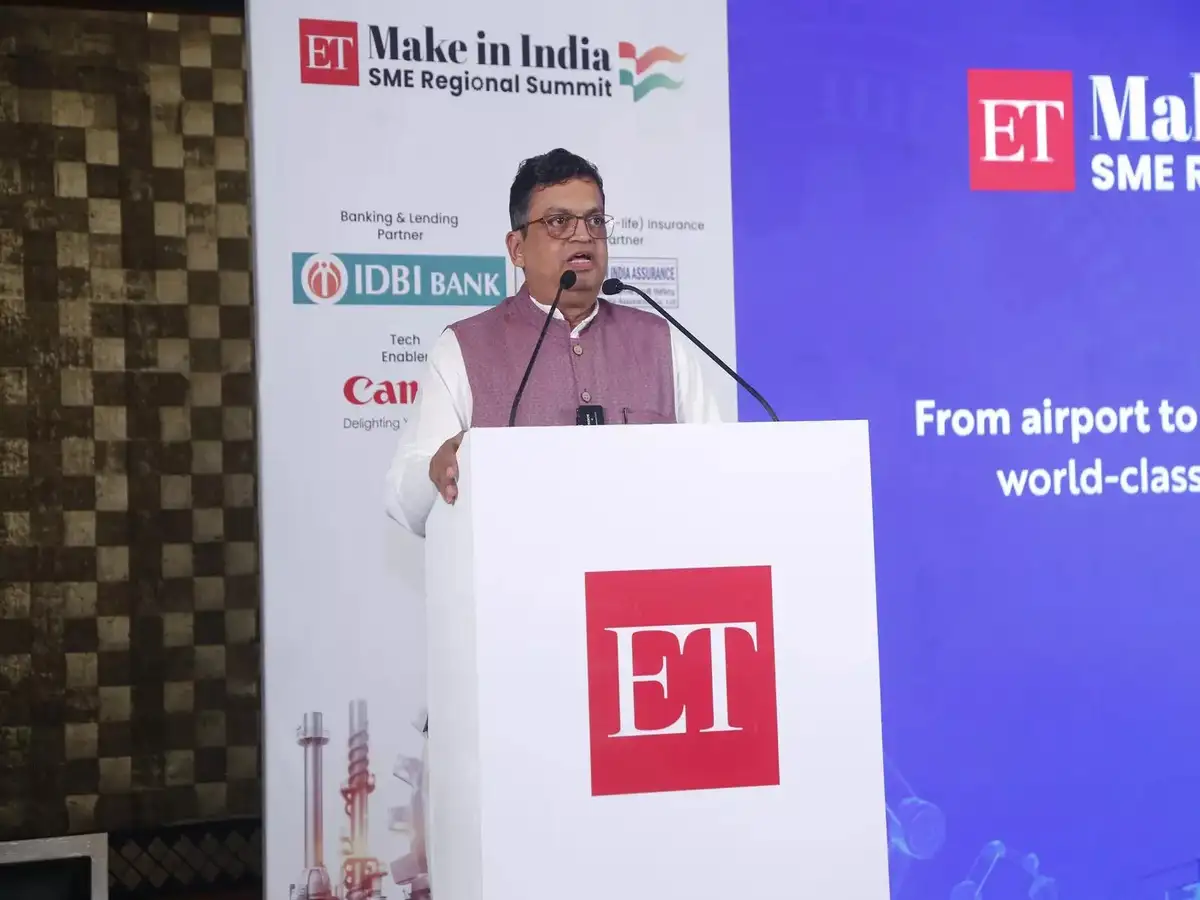

The ET Make in India SME Summit in Chhatrapati Sambhajinagar has brought the spotlight to Tier 2 industrial growth, policy support, and manufacturing expansion. For local firms, the event signals renewed focus on regional entrepreneurship and supply chain development.
The Chhatrapati Sambhajinagar SME Summit is not just another business conference. It reflects a broader shift in India’s industrial strategy toward strengthening Tier 2 cities as manufacturing and MSME hubs. With discussions centered on financing, technology adoption, export readiness, and policy reforms, the summit carries practical implications for local small and medium enterprises.
Why Chhatrapati Sambhajinagar Matters in India’s Industrial Map
Chhatrapati Sambhajinagar, historically known for its industrial clusters, plays a key role in Maharashtra’s manufacturing ecosystem. The city hosts auto component manufacturers, pharmaceuticals, engineering units, and agro processing industries.
Its strategic location, connectivity to major highways, and proximity to industrial corridors have positioned it as a strong Tier 2 industrial center. Over the years, MIDC industrial estates in the region have attracted domestic and international investments.
By hosting the ET Make in India SME Summit, the city reinforces its relevance in national manufacturing conversations. For local firms, visibility at such events improves networking access and investor engagement.
Access to Finance and Credit for MSMEs
One of the central themes of the SME Summit revolves around financing for small and medium enterprises. Access to working capital remains one of the biggest constraints for local firms in Tier 2 cities.
MSMEs often struggle with delayed payments, high interest rates, and collateral requirements. Discussions at such summits typically focus on credit guarantee schemes, digital lending platforms, and public sector bank initiatives.
For businesses in Chhatrapati Sambhajinagar, understanding new financing models such as invoice discounting platforms and supply chain finance tools is critical. Government backed credit programs and MSME registration benefits can reduce borrowing costs and improve cash flow stability.
Local firms must align documentation, compliance, and credit ratings to take advantage of these evolving financial instruments.
Technology Adoption and Digital Transformation
The ET Make in India SME Summit places emphasis on technology adoption as a growth multiplier. Many Tier 2 manufacturing units still operate with limited automation and manual processes.
Industry discussions highlight Industry 4.0 tools such as IoT based monitoring, data driven production planning, and digital inventory management. For small firms, adopting even partial automation can improve efficiency and reduce wastage.
Digital transformation also extends to marketing and exports. MSMEs can leverage e commerce platforms and B2B marketplaces to access national and global buyers. Export readiness training and compliance awareness are particularly relevant for firms seeking to scale beyond domestic markets.
For Chhatrapati Sambhajinagar enterprises, gradual technology integration rather than large scale overhaul may be the practical path forward.
Policy Support and Ease of Doing Business
Government policy frameworks under the Make in India initiative continue to support manufacturing growth. Simplified compliance systems, online approvals, and digitized registrations aim to reduce bureaucratic delays.
At the SME Summit, conversations often include GST compliance simplification, labor law updates, and state level industrial incentives. Maharashtra has industrial policies that offer benefits in specific sectors including EV components and pharmaceuticals.
Local firms should actively track policy updates announced during such summits. Even small regulatory changes can significantly impact cost structures and expansion planning.
Proactive engagement with industry associations also helps SMEs represent their concerns in policy dialogues.
Export Opportunities and Global Supply Chains
Global supply chain realignment has created opportunities for Indian MSMEs. As multinational companies diversify sourcing, Tier 2 manufacturing clusters gain strategic importance.
The SME Summit platform allows exporters to understand certification requirements, quality standards, and trade documentation processes. For Chhatrapati Sambhajinagar firms, sectors such as auto components and precision engineering have export potential.
Participation in global exhibitions and integration into larger vendor networks can expand revenue streams. However, maintaining quality consistency and timely delivery remains critical for international competitiveness.
Training in export documentation, logistics planning, and foreign market research is increasingly important for regional manufacturers.
What Local Firms Should Focus On Next
Hosting the ET Make in India SME Summit in a Tier 2 city signals decentralization of economic opportunity. However, real impact depends on how local firms respond after the event.
Businesses should audit their operational efficiency, financial health, and technology readiness. Investing in skill development for employees enhances productivity. Exploring collaborations within local industrial clusters can also reduce costs through shared services.
Most importantly, MSMEs must shift from survival mode to growth planning. Structured business strategies aligned with national manufacturing priorities can position them for long term resilience.
Chhatrapati Sambhajinagar’s industrial base is strong, but scaling requires disciplined execution and awareness of evolving economic frameworks.
Takeaways
• Chhatrapati Sambhajinagar remains a key Tier 2 manufacturing hub
• Access to credit and working capital is central for MSME growth
• Technology adoption and digital transformation drive competitiveness
• Policy awareness and export readiness create long term expansion opportunities
FAQs
Q1: What is the significance of the ET Make in India SME Summit?
It highlights manufacturing growth, financing access, and policy support for small and medium enterprises, especially in Tier 2 cities.
Q2: How can local firms benefit from such summits?
They gain exposure to financing options, technology insights, policy updates, and networking opportunities with investors and industry leaders.
Q3: Are there export opportunities for Tier 2 MSMEs?
Yes. With proper quality standards and certifications, MSMEs can integrate into global supply chains and expand beyond domestic markets.
Q4: What should SMEs prioritize after the summit?
They should focus on improving financial discipline, adopting gradual technology upgrades, and aligning with government industrial policies.