
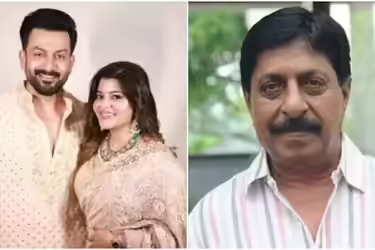

The Indian entertainment space is seeing multiple conversations peak at the same time, from the Sreenanda Shankar divorce drawing public attention to Ranveer Singh’s Kantara-related controversy and a wave of social media driven viral trends reshaping celebrity narratives. This brief breaks down what is confirmed, what is noise, and why these stories matter right now.
Sreenanda Shankar Divorce Brings Personal Lives Into Public Debate
The divorce involving Sreenanda Shankar has become a talking point not because of sensational claims but due to the way personal matters increasingly spill into public discourse. What is notable is the absence of dramatic allegations or prolonged legal theatrics so far. Instead, the focus has stayed on statements, timing, and how audiences interpret silence versus clarification.
Divorce stories involving public figures often trigger polarized reactions. Some sections of the audience demand transparency, while others argue for privacy. In this case, speculation has largely been driven by social media commentary rather than verified developments. This reflects a larger pattern in Indian entertainment coverage where personal milestones such as marriage or separation are treated as public property, especially when one or both individuals have a strong online following.
For editors and readers alike, the key takeaway is restraint. Until formal legal or personal statements add clarity, most circulating narratives remain opinion-driven rather than fact-based.
Ranveer Singh Kantara Controversy Explained
Ranveer Singh found himself trending after remarks and social media chatter linked him to the legacy of Kantara. The controversy is less about direct criticism and more about audience sensitivity around culturally rooted cinema.
Kantara holds strong emotional value, especially in Karnataka and among audiences who view it as more than a commercial success. Any perceived misinterpretation, casual remark, or comparison involving the film quickly becomes amplified. In Ranveer’s case, online discourse escalated rapidly, despite no confirmed intent to undermine the film or its cultural context.
This episode highlights a recurring issue in Indian cinema conversations. National-level celebrities commenting on region-specific cultural works often face scrutiny. Context, phrasing, and timing matter. What might pass as casual admiration or creative curiosity can be read as appropriation or dilution by passionate fan bases.
Viral Trends Driving Entertainment Narratives
Beyond individual controversies, viral trends are now the primary accelerant of entertainment news. Short clips, meme edits, reaction reels, and stitched commentary dominate platforms like Instagram and X. These trends rarely wait for full context and often prioritize emotion over accuracy.
A single line from an interview, a cropped video, or an old quote resurfaced at the right moment can shift public perception within hours. This is evident in how both the Sreenanda Shankar divorce discussion and the Ranveer Kantara debate gained traction. Neither relied on breaking revelations. Both were powered by algorithm-driven amplification.
For celebrities, this means reputation management is no longer limited to press statements. Silence can fuel speculation, while over-clarification can prolong cycles. For audiences, it blurs the line between verified entertainment news and performative outrage.
What This Means for Indian Entertainment Media
These parallel stories underline a shift in how entertainment news functions in India. The industry is no longer driven only by film releases or official announcements. Personal lives, cultural sensitivities, and social media sentiment now dictate headlines.
Editors are under pressure to move fast without crossing into misinformation. Audiences are becoming both consumers and distributors of narratives. This makes responsible framing crucial. Context, verified facts, and measured language are now differentiators between credible entertainment reporting and viral noise.
As 2025 closes, entertainment coverage is less about star power alone and more about how stories travel, mutate, and settle in the public imagination.
Takeaways
Personal lives of public figures increasingly become public debates driven by social media rather than facts
Culturally significant films like Kantara invite heightened sensitivity in national conversations
Viral trends now shape entertainment narratives faster than official statements
Context and restraint are becoming critical in credible entertainment reporting
FAQs
Why is Sreenanda Shankar’s divorce in the news?
It gained attention due to online speculation and public interest rather than any confirmed dramatic developments.
What exactly is the Ranveer Kantara controversy?
It revolves around audience reactions to perceived comments or associations with the film Kantara, amplified by social media discourse.
Are these controversies based on verified information?
Most circulating narratives are driven by reactions and interpretations, not new verified facts.
Why do such stories trend so quickly now?
Short-form content and algorithm-driven platforms amplify emotion-heavy narratives faster than traditional news cycles.