
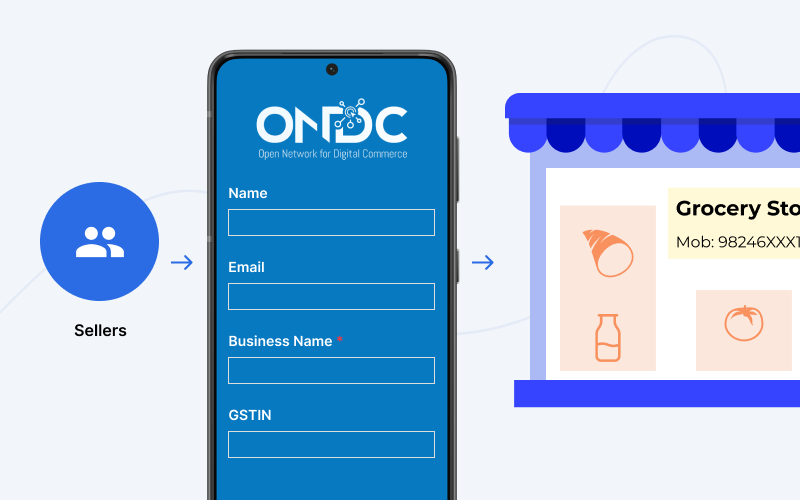

Small businesses in Tier 2 cities can now register on ONDC to access digital marketplaces without depending solely on large e commerce platforms. This guide explains eligibility, registration steps, required documents, costs, and how sellers can start receiving orders through ONDC networks.
The ONDC seller registration process is designed to help small businesses in Tier 2 cities join the Open Network for Digital Commerce and expand their digital presence. Unlike traditional marketplaces, ONDC operates as an open protocol that connects buyers and sellers across multiple apps. For retailers, manufacturers, and service providers in cities like Nagpur, Indore, Surat, Coimbatore, and Lucknow, this creates a level playing field with lower dependency on a single platform.
Understanding how ONDC works is the first step before registering.
What Is ONDC and How It Supports Small Businesses
The Open Network for Digital Commerce is an initiative aimed at democratizing digital commerce in India. Instead of functioning as a single marketplace, ONDC connects sellers to buyer apps through a network model. Sellers register through a seller application or technology partner, and their products become discoverable across multiple buyer platforms.
For small businesses in Tier 2 and Tier 3 cities, this reduces entry barriers associated with high commissions, strict exclusivity contracts, and algorithm dependency. Sellers retain control over inventory, pricing, and fulfillment.
ONDC supports various categories including grocery, food and beverage, fashion, electronics, home essentials, and mobility services. Businesses with a valid GST registration and bank account can typically participate, depending on category requirements.
Eligibility and Documents Required for ONDC Seller Registration
Before beginning the ONDC seller registration process, businesses should ensure compliance with standard documentation norms.
Basic requirements include:
GST registration for applicable categories
PAN card of the business entity
Active bank account in the business name
Mobile number and email ID
Business address proof
FSSAI license for food related businesses
Micro sellers operating under composition schemes can also explore participation depending on the category and transaction thresholds.
Businesses should also ensure they can manage digital catalog uploads and order fulfillment, either independently or through a logistics partner.
Step by Step ONDC Seller Registration Process
The ONDC onboarding process is completed through an approved seller app or technology service provider integrated with the ONDC network.
Step 1 Select a seller app that supports ONDC onboarding. These are officially integrated network participants.
Step 2 Create a seller account using business details and verify mobile number and email.
Step 3 Upload required documents such as GST certificate, PAN, and bank details.
Step 4 Add business profile information including store name, operating hours, and serviceable areas.
Step 5 Upload product catalog with pricing, images, stock availability, and tax details.
Once documents are verified, the seller account becomes active on the ONDC network. Products then become discoverable across buyer applications connected to the network.
Businesses should test the ordering process and ensure accurate pricing and inventory synchronization before scaling.
Commission Structure and Cost Considerations
One key difference between ONDC and traditional e commerce marketplaces is its open network model. ONDC itself does not operate as a marketplace charging direct commissions. However, sellers may pay fees to their chosen seller app or service provider.
These costs may include:
Technology platform subscription
Transaction processing fees
Logistics and delivery charges
Payment gateway charges
The overall cost structure is often competitive compared to large centralized marketplaces, but sellers must evaluate service provider terms carefully.
For Tier 2 businesses, lower digital marketing costs and network wide discoverability can improve margins if managed efficiently.
How Tier 2 Businesses Can Maximize ONDC Benefits
Simply registering is not enough. To benefit from ONDC seller advantages, businesses should focus on operational readiness.
Maintain accurate inventory levels to avoid order cancellations.
Offer competitive pricing based on local demand.
Provide clear product descriptions and high quality images.
Ensure timely dispatch and customer communication.
Local retailers in smaller cities can use ONDC to expand beyond physical footfall limitations. For example, a home essentials store in Nagpur can receive orders through multiple buyer apps without creating separate storefronts on each platform.
Businesses can also explore hyperlocal delivery partnerships to strengthen last mile fulfillment.
Common Challenges and How to Avoid Them
New sellers may face initial technical challenges while uploading catalogs or integrating inventory systems. Partnering with experienced seller apps or consultants can ease onboarding.
Inconsistent stock updates and delayed fulfillment can lead to poor ratings. Since ONDC connects multiple buyer platforms, service quality impacts visibility across the network.
Understanding tax compliance and maintaining proper invoicing is also essential to avoid penalties.
Takeaways
• ONDC enables small businesses in Tier 2 cities to sell digitally without depending on a single marketplace
• Registration requires GST, PAN, bank details, and category specific licenses
• Sellers onboard through approved ONDC integrated seller apps
• Operational efficiency and inventory accuracy determine long term success
FAQs
Q1. Is ONDC a marketplace like other e commerce platforms?
No. ONDC is an open network that connects buyers and sellers through multiple apps rather than functioning as a single centralized marketplace.
Q2. Can small retailers without technical knowledge join ONDC?
Yes, but they may need support from a seller app or technology partner to manage catalog uploads and order processing.
Q3. Does ONDC charge commission directly from sellers?
ONDC as a network does not function like a traditional marketplace. However, seller apps and service providers may charge platform or transaction fees.
Q4. Is GST mandatory for ONDC seller registration?
For most categories, GST registration is required. Some exemptions may apply depending on turnover and category type.