
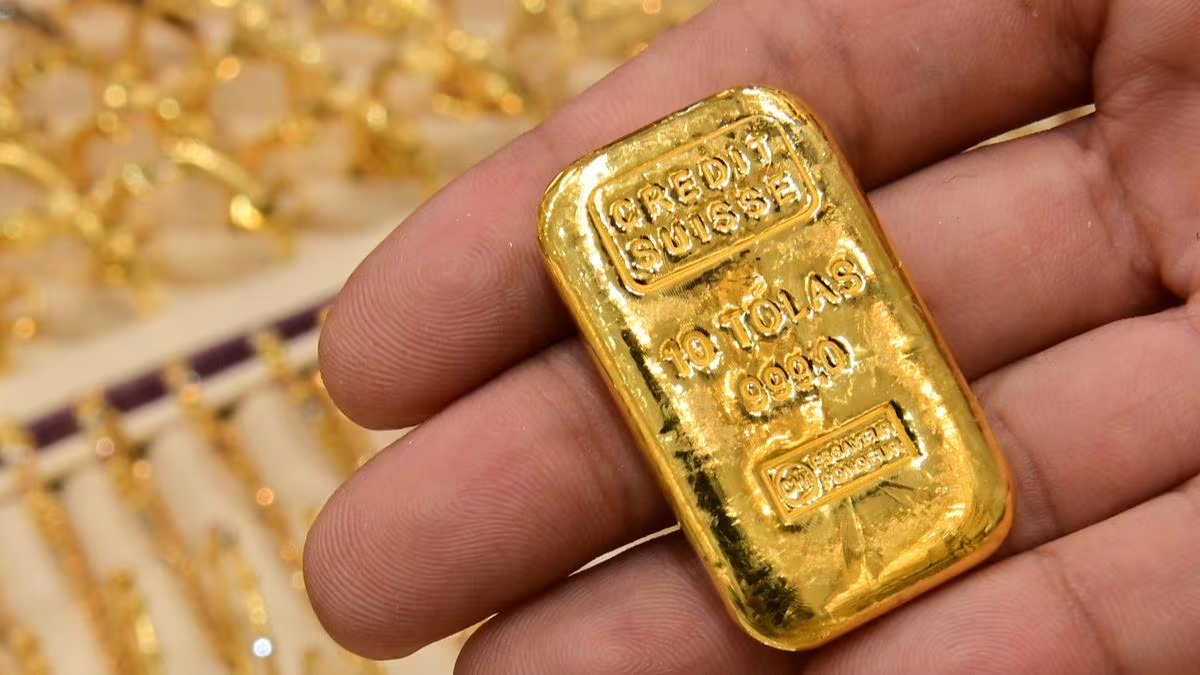

MCX gold rates are the benchmark for gold pricing in India and directly influence city wise retail prices. Understanding how to check MCX gold rates and interpret price movements helps buyers, investors, and local jewellers make informed decisions in a volatile market.
MCX gold rates refer to the gold futures prices traded on the Multi Commodity Exchange of India. These rates reflect the per 10 gram price of gold contracts and act as a base reference for wholesale traders and jewellers across cities. While retail gold prices vary slightly from city to city due to taxes, logistics, and local demand, the MCX price remains the primary benchmark.
What Is MCX Gold and Why It Matters
MCX gold is traded in futures contracts, typically in standardized lot sizes such as 1 kilogram, 100 grams, or mini contracts. The quoted price usually reflects the per 10 gram value derived from these contracts. Unlike local jewellery shop rates, MCX prices change continuously during trading hours based on global gold prices, currency movements, and domestic demand.
Since India imports a large portion of its gold, the international gold rate and the USD to INR exchange rate significantly influence MCX prices. When global gold prices rise or the rupee weakens against the dollar, MCX gold rates generally increase.
Jewellers in cities such as Jaipur, Nagpur, Lucknow, Coimbatore, and Indore use MCX prices as a starting point. They then add import duty, GST, transportation cost, and their margin to determine the final retail rate.
How to Check MCX Gold Rates Online Step by Step
Checking MCX gold rates is straightforward if you know where to look. Follow these steps for accurate and real time data.
First, visit the official website of the Multi Commodity Exchange or open a reputed financial market app that provides commodity prices. Look for the commodities section and select gold futures. Ensure you are checking the correct contract month, as prices can vary slightly between near month and far month contracts.
Second, confirm the contract unit. Many platforms display the price for 1 kilogram contracts. Divide the total by 100 to get the per 10 gram equivalent. This is the figure most commonly compared with city wise gold rates.
Third, check the live price, previous close, and percentage change. This helps you understand whether gold is rising or falling during the trading session.
Finally, compare the MCX gold rate with your city’s 22 carat and 24 carat retail gold rate. The difference represents taxes, making charges, and local premiums.
Understanding City Wise Gold Rate Differences
City wise gold rates differ due to several factors. These include local demand, transportation cost, state level logistics, and competition among jewellers. For example, metro cities with higher trading volumes may show slightly tighter spreads compared to smaller cities.
Retail gold prices also differ based on purity. MCX gold contracts are typically based on 24 carat gold of 999 purity. However, jewellery is often sold in 22 carat purity. This means you cannot directly compare MCX gold rates with 22 carat retail prices without adjusting for purity.
To calculate, if MCX shows 60000 per 10 grams for 24 carat gold, the equivalent 22 carat value would be proportionally lower because 22 carat contains less pure gold. Jewellers then add GST and making charges on top of this base value.
What Gold Price Movements Mean for Local Jewellers
When MCX gold prices rise sharply, jewellers face working capital pressure. They must buy inventory at higher rates, which increases their risk if demand slows. In such situations, some jewellers may reduce margins or introduce exchange offers to maintain sales volumes.
If MCX gold rates fall, jewellers holding old inventory purchased at higher prices may delay fresh buying. However, lower prices often increase footfall as customers see it as a buying opportunity, especially during wedding seasons or festivals.
In Tier 2 and Tier 3 cities, demand patterns are closely tied to agricultural income cycles and local events. A stable or gradually rising gold price often supports steady demand. Sudden spikes, however, may temporarily slow purchases.
Practical Example for Buyers and Investors
Suppose MCX gold is trading at 62000 per 10 grams. In your city, the 24 carat retail rate is 63000 per 10 grams. The difference of 1000 reflects GST and local premiums. If MCX increases by 1000 during the day, retail prices are likely to rise soon after.
For investors, tracking MCX gold futures helps in timing purchases of gold ETFs or sovereign gold bonds. For jewellery buyers, checking MCX rates before visiting a store strengthens negotiation and price awareness.
Monitoring intraday trends also helps. If gold prices are falling during the day, waiting until the evening may result in a slightly lower purchase rate, depending on how quickly local jewellers update prices.
Takeaways
• MCX gold rates serve as the benchmark for city wise retail gold prices in India
• Always check contract month and convert kilogram prices to per 10 gram values
• Retail gold rates differ due to purity, GST, logistics, and jeweller margins
• Gold price movements affect inventory decisions and margins of local jewellers
FAQs
Q1. Are MCX gold rates the same as jewellery shop prices?
No. MCX rates reflect futures prices for high purity gold, while jewellery shop prices include GST, making charges, and local margins.
Q2. Why do gold prices differ between cities?
Differences arise due to transportation cost, local demand, competition, and minor logistical variations.
Q3. How often do MCX gold rates change?
They change continuously during trading hours based on market activity, global prices, and currency movements.
Q4. Can I use MCX gold rates to decide when to buy jewellery?
Yes. Tracking MCX rates helps you understand price trends and negotiate better, but final retail pricing will include additional charges.