
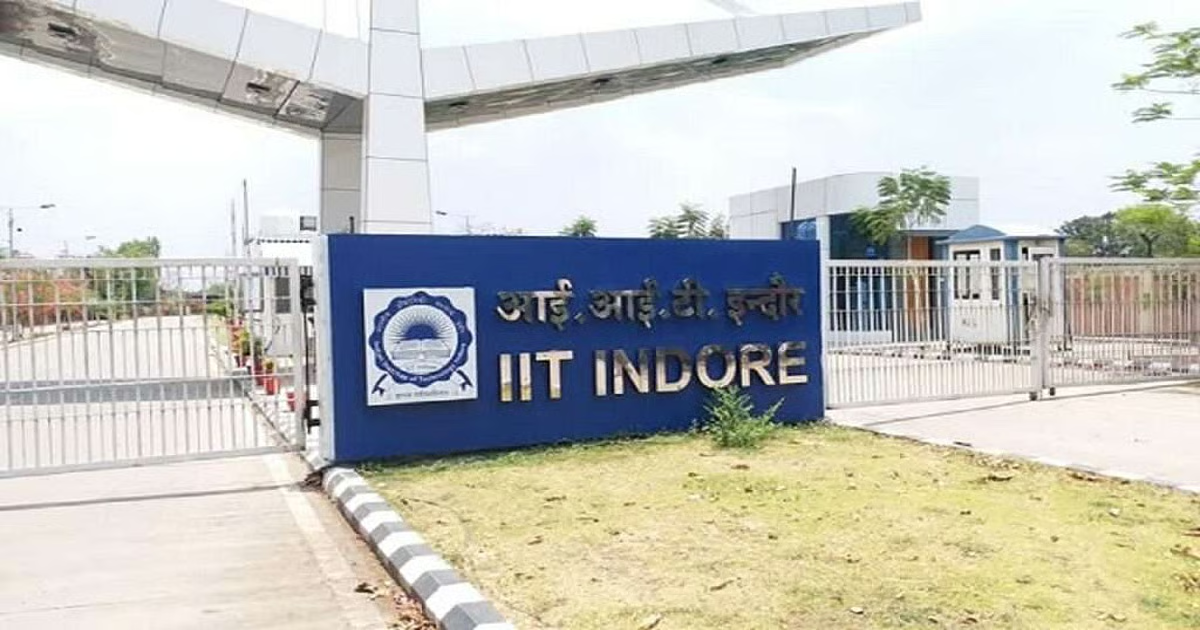

If you are founding a deep-tech startup in a Tier-2 city, registering your company is the essential first step. This article walks you through how to do it — using the new innovation and incubation centre at IIT Indore as a regional case study for infrastructure, schemes and process. It covers legal setup, ecosystem access, specific programmes and practical actions.
Understand what “deep-tech startup registration” means
When you’re building a deep-tech venture — e.g., hardware, IoT, AI, robotics — registration means both formally establishing your legal entity (private limited, LLP or partnership) plus entering into institutional frameworks (incubator, tech-park, government scheme) so you can access labs, grants and prototyping space. In Tier-2 cities such as Indore, the ecosystem is now ready to support these steps thanks to initiatives from IIT Indore’s incubation arm.
Choose the right legal entity and location
First decide your entity type. Most deep-tech firms in India adopt a Private Limited (Pvt Ltd) company because it supports equity investment, liability protection and growth-oriented structures. In a Tier-2 city you’ll need to pick your registered address — this could be your incubator address, coworking facility or lab space within a tech park (for example the 10,000 sq ft incubation facility at IIT Indore’s Sinhasa IT Park). You will need: director(s), minimum share capital (which can be minimal under versus actual operations), Digital Signature Certificates (DSC) for directors, and DIN numbers. Ensure you pick the state jurisdiction correctly (Madhya Pradesh, in this case).
Register with the Registrar of Companies (ROC)
Next step is company registration. You prepare application via the SPICe+ form, submit required documents (identity/address of directors, company address, MOA/AOA or LLP agreement). Once approved, you receive a Certificate of Incorporation. At this point you get a Corporate Identity Number (CIN). After that you will apply for Permanent Account Number (PAN), Tax Deduction and Collection Account Number (TAN), and open a bank account under the company name. Keep in mind: because your startup is deep-tech oriented and will seek R&D grants, you should declare the object clause in MOA to reflect “research & development, design, prototyping and manufacture of deep-technology systems” or similar wording.
Opt into deep-tech-startup ecosystem via IIT Indore’s incubator
Now that you’re legally formed, plug into the ecosystem. At IIT Indore the incubation arm is IITI Drishti CPS Foundation which works under programmes such as the MeitY GENESIS scheme offering support to deep-tech innovators in Tier-2 and Tier-3 cities. The facility includes access to prototyping laboratory, manufacturing/validation labs, technical mentoring, IP filing assistance. For example the new Incubation & Innovation Centre at Sinhasa IT Park offers space, infrastructure and plans funding of about ₹20 crore for product development in this fiscal year. By registering your startup and applying to the incubator you unlock access to labs, funding, validation.
Leverage government incentives for Tier-2 deep-tech ventures
Being in a Tier-2 city gives you cost advantages (lower rent, salaries) but also specific policy support. Within Madhya Pradesh and nationally there are schemes targeted at DPIIT-recognized startups, MeitY supported deep-tech hubs, matching grants, early-stage funding and R&D support. Being incubated at IIT Indore counts for such recognition. For example you can apply for the Startup India recognition, claim income-tax benefits (80-IAC deduction) once eligible, access the Startup India Seed Fund Scheme. Make sure within your registration and business plan you emphasise “deep-tech product development, prototyping, manufacture” rather than just software services, as this aligns with the Tier-2 policy push.
Comply with IP, export controls, prototyping labs
Because you focus on deep-tech, you will deal with hardware, embedded systems, perhaps defence or aerospace applications. Register your IP early (patent, design, trademark). The incubator at IIT Indore offers IP-filing support. Ensure your setup meets any licence or import-export controls if your product uses sensitive components. Use the prototyping lab to validate your concept (for example the intelligent manufacturing lab at the new centre is built for real-world product fabrication). By demonstrating proof-of-concept you raise your credibility for funding and grants.
Plan for growth and registration-related nuances
Once you are registered and incubated, remember: your company constitution should allow for future investment rounds (include appropriate share-capital clause, convertible instruments, founders’ vesting). Also ensure your registered location remains valid as you scale — you may move to your own facility but maintain the registered address. Maintain statutory compliance (annual filings, board meetings, auditor appointment) no matter how early-stage you are. In a Tier-2 city ecosystem you may also benefit from local state incentives (subsidised space, electricity rates, training grants) – track those via the incubator network.
Takeaways
- Legal setup first: register as a Pvt Ltd entity with MOA/AOA reflecting deep-tech objects.
- Plug into ecosystem early: apply to IIT Indore’s incubator (Drishti CPS Foundation) to access labs, funding, mentorship.
- Leverage Tier-2 advantages: lower operational cost + state/national policy incentives for deep-tech hubs.
- Plan for scale: include provisions for investment, IP protection, compliance from Day 1.
FAQs
Q1: Do I need to be DPIIT-recognized before applying to the incubator at IIT Indore?
A1: Not necessarily. Many incubators accept startups at idea or prototype stage. You can get DPIIT recognition later once you have proof-of-concept and meet criteria (less than certain age, DPIIT policy). Doing incubator admission early helps you build that proof-point.
Q2: What entity type is best for a deep-tech startup in a Tier-2 city?
A2: A Private Limited company is generally best because it enables equity investment, has limited liability and is well-understood by investors and grant agencies. An LLP may be simpler but may not suit venture funding or major grants.
Q3: What costs should I expect for registration and incubation in a city like Indore?
A3: Registration cost is modest: DSC, DIN, ROC filing. Incubator membership may require rent or minimal space fee depending on the programme; some grants cover space. In Tier-2 cities you’ll have lower rent and lower salaries, which improves your runway.
Q4: How soon can I apply for government grants or subsidies after registration?
A4: After incorporation, once you have the proof-of-concept or prototype (often within an incubator), you can apply for schemes such as Startup India seed fund, MeitY Genesis, state R&D grants. Ensure your documents, business plan and registration are in place.