
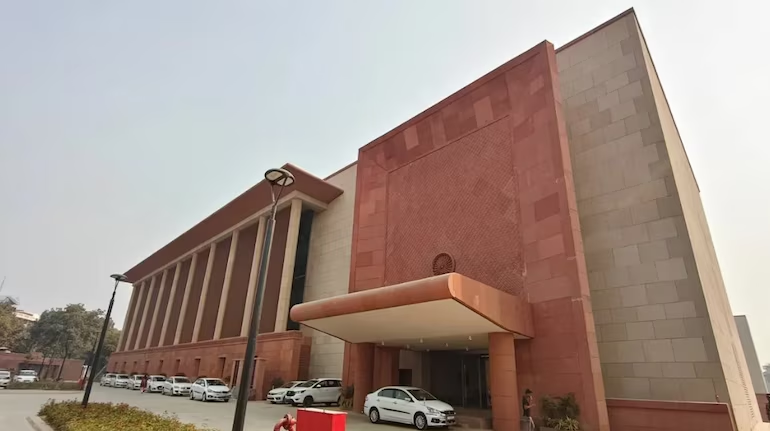

The new PMO campus at Seva Teerth marks a significant administrative development with implications that extend beyond Delhi. The project is expected to influence governance efficiency, coordination among ministries, and delivery of public services across states and districts.
The new PMO campus at Seva Teerth is being positioned as a modern administrative hub designed to improve coordination, security, and operational capacity of the Prime Minister’s Office. While physically located in the national capital region, its impact is not limited to central administration. Governance reforms at the top level often cascade down to ministries, state governments, and district level offices.
Administrative Centralisation and Faster Decision Making
One of the primary objectives of a consolidated PMO campus is administrative efficiency. When senior officials, advisors, and coordination units function within an integrated campus, decision making timelines can reduce. Physical proximity supports quicker inter department consultations and real time monitoring of schemes.
In practical terms, faster approvals at the central level can influence project clearances, fund releases, and inter ministerial coordination. For example, infrastructure projects in Tier 2 and Tier 3 cities that require multiple ministry approvals may benefit from streamlined communication channels.
Centralisation does not necessarily mean concentration of power, but it can mean improved workflow. With digitised file movement and centralised data systems, governance becomes less dependent on fragmented physical offices.
Impact on Digital Governance and E Governance Platforms
The Seva Teerth PMO campus is expected to integrate advanced digital infrastructure. Modern government campuses increasingly rely on secure data networks, real time dashboards, and integrated grievance redress systems. This has implications for digital governance nationwide.
If central monitoring systems are strengthened, state level schemes linked to centrally sponsored programmes can be tracked more effectively. For citizens, this may translate into quicker responses on platforms such as public grievance portals and direct benefit transfer systems.
Improved data integration at the central level can also reduce duplication in welfare schemes. When beneficiary databases are aligned more efficiently, leakages decrease and delivery becomes more targeted.
Security and Continuity of Governance
A new purpose built campus typically enhances security architecture. In the context of national governance, secure premises protect sensitive communications and strategic planning.
Beyond physical security, continuity of governance becomes more robust. Modern campuses often incorporate backup systems, disaster resilience mechanisms, and secure communication facilities. This ensures that governance functions continue smoothly during emergencies.
For states and districts, continuity at the central level ensures uninterrupted fund flows and policy communication. During crises such as natural disasters or health emergencies, seamless coordination between the centre and states becomes critical.
Influence on Public Service Delivery Beyond Delhi
The practical implications of the new PMO campus extend to public services across India. When policy formulation, monitoring, and evaluation processes are centralised and technologically strengthened, implementation efficiency improves at ground level.
For example, centrally sponsored schemes in housing, sanitation, rural roads, and digital connectivity rely on coordination between central ministries and state administrations. Faster central approvals and monitoring can reduce delays in project rollout in smaller cities.
Tier 2 cities that depend heavily on central grants for infrastructure upgrades may see quicker project reviews and administrative clearances. While execution remains the responsibility of state and local authorities, improved central coordination can remove bottlenecks.
Administrative Culture and Bureaucratic Workflow
A new campus also influences administrative culture. Modern workspaces encourage collaborative functioning across departments. This can reshape bureaucratic workflow by promoting data driven decision making and structured review mechanisms.
Performance monitoring dashboards, periodic review meetings, and digital file tracking systems are easier to implement in integrated campuses. Over time, such systems may standardise reporting formats across ministries.
For citizens, this may not be immediately visible. However, over months and years, improved administrative discipline can reflect in reduced pendency of files, faster approvals, and more transparent communication.
Economic and Urban Impact Around the Campus
Large administrative campuses often generate local economic activity. Construction, maintenance, and support services create employment opportunities. Over time, ancillary services such as transport, hospitality, and small businesses may benefit.
However, the broader governance impact remains the primary focus. The objective is not merely infrastructural expansion but administrative strengthening.
Long Term Governance Outlook
The long term significance of the Seva Teerth PMO campus lies in institutional capacity building. As governance becomes more complex with expanding digital systems and growing population demands, infrastructure must adapt.
A modern campus equipped with integrated digital systems, secure communication networks, and centralised coordination frameworks positions the administration to respond faster to emerging challenges.
The true measure of impact will be seen in policy implementation speed, responsiveness to citizen grievances, and inter government coordination efficiency over time.
Takeaways
• The new PMO campus aims to improve coordination and administrative efficiency
• Stronger digital infrastructure may enhance monitoring of central schemes
• Security and continuity systems strengthen governance stability
• Faster central decision making can indirectly benefit Tier 2 and Tier 3 cities
FAQs
Q1. Does the new PMO campus change how citizens access government services?
There is no direct change in access points, but improved coordination may enhance service delivery speed.
Q2. Will states lose autonomy because of centralisation?
Administrative centralisation at the PMO level focuses on coordination, while states continue to implement and manage their own schemes.
Q3. How can Tier 2 cities benefit from this development?
Quicker approvals, improved monitoring, and faster fund releases for central schemes can support local projects.
Q4. Is this primarily an infrastructure project or a governance reform?
While it involves new infrastructure, its broader purpose is to strengthen governance systems and administrative efficiency.