
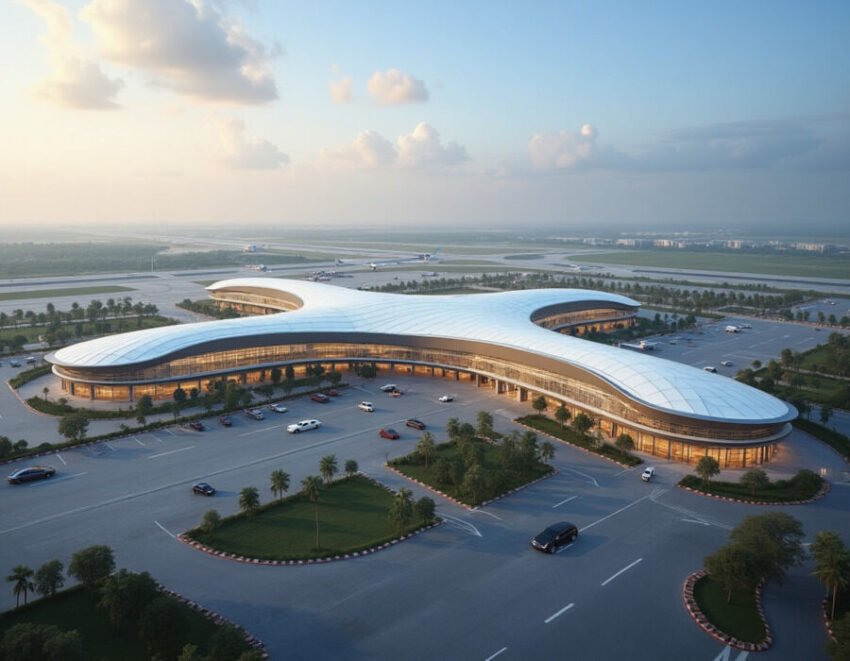

The Noida International Airport inauguration is set to transform connectivity, employment, and economic activity across western Uttar Pradesh and nearby regions. The project is expected to influence travel patterns, boost jobs, and accelerate development in surrounding Tier-2 cities.
The topic is time-sensitive and news-driven, as the airport inauguration and related developments are currently in focus.
Noida International Airport Project Overview and Timeline
The Noida International Airport, located in Jewar, Uttar Pradesh, is one of India’s largest greenfield airport projects. It has been developed to ease congestion at Delhi’s Indira Gandhi International Airport and improve regional connectivity.
The first phase of the airport is designed to handle millions of passengers annually, with future expansion plans already in place. Authorities have positioned the airport as a major aviation hub for northern India.
The project has gained attention due to its scale and strategic location, connecting the National Capital Region with western Uttar Pradesh and parts of Rajasthan.
Its phased development model ensures that infrastructure can scale with demand over the coming years.
Impact on Jobs and Local Employment Opportunities
The Noida International Airport inauguration is expected to create significant employment opportunities across multiple sectors. During the construction phase, thousands of workers were engaged in infrastructure development.
Once operational, the airport will generate jobs in aviation services, ground handling, security, retail, hospitality, and logistics. Indirect employment is also expected to grow in nearby areas due to increased economic activity.
Local residents from districts like Gautam Buddh Nagar, Bulandshahr, and Aligarh are likely to benefit the most. Skill development programs are also being introduced to prepare the workforce for aviation-related roles.
This job creation is particularly important for Tier-2 and Tier-3 regions, where large-scale employment opportunities are often limited.
Travel and Connectivity Benefits for North India
The airport is expected to significantly improve travel options for passengers in northern India. It will reduce dependency on Delhi’s main airport and offer an alternative for domestic and international travel.
Cities like Noida, Greater Noida, Agra, Mathura, and even parts of Rajasthan will see improved connectivity. Travel time to the airport will be shorter for many residents compared to reaching Delhi.
The project is also integrated with planned expressways and transport corridors, making access more efficient. This includes connectivity through the Yamuna Expressway and upcoming regional infrastructure projects.
For frequent travelers and businesses, this translates into reduced travel time and better logistical efficiency.
Boost to Real Estate and Infrastructure Development
The inauguration of Noida International Airport is already influencing real estate activity in nearby regions. Land prices in areas surrounding Jewar and Greater Noida have seen increased interest from investors and developers.
Residential and commercial projects are being planned to cater to the expected rise in population and business activity. Improved infrastructure, including roads and public transport, is also being developed alongside the airport.
Industrial corridors and logistics parks are likely to emerge in the region, further strengthening the economic ecosystem.
Such developments can transform the area into a major growth hub similar to other airport-driven urban expansions seen in India.
Economic Impact on Nearby Tier-2 Cities
The airport’s influence will extend beyond Noida and Greater Noida, impacting nearby Tier-2 cities as well. Cities like Aligarh, Mathura, and even parts of Haryana are expected to benefit from improved connectivity and business opportunities.
Small and medium enterprises in these regions may see increased demand due to better access to national and international markets. Tourism is also expected to grow, particularly for destinations like Agra and Mathura.
The airport can act as a catalyst for regional development, reducing the economic gap between metro cities and smaller urban centers.
This aligns with broader national goals of balanced regional growth.
Challenges and Expectations Going Forward
While the Noida International Airport project offers significant benefits, certain challenges remain. Ensuring timely completion of all phases and maintaining operational efficiency will be critical.
Traffic management, environmental concerns, and infrastructure readiness in surrounding areas will need continuous monitoring. Coordination between multiple agencies is essential for smooth functioning.
There is also a need to ensure that job opportunities reach local populations effectively through training and awareness programs.
Long-term success will depend on how well the airport integrates with the broader economic and transport ecosystem.
Takeaways
• Noida International Airport is a major infrastructure project with regional impact
• It will create large-scale employment opportunities in aviation and related sectors
• Connectivity improvements will benefit multiple Tier-2 cities in North India
• Real estate and economic activity in nearby regions are expected to grow significantly
FAQs
Where is Noida International Airport located?
It is located in Jewar, Uttar Pradesh, near Greater Noida.
How will the airport impact jobs?
It will create direct and indirect employment in aviation, logistics, retail, and hospitality sectors.
Which cities will benefit from the airport?
Cities like Noida, Agra, Mathura, Aligarh, and nearby regions will see improved connectivity.
Will the airport reduce congestion at Delhi airport?
Yes, it is designed to ease passenger load at Indira Gandhi International Airport.