
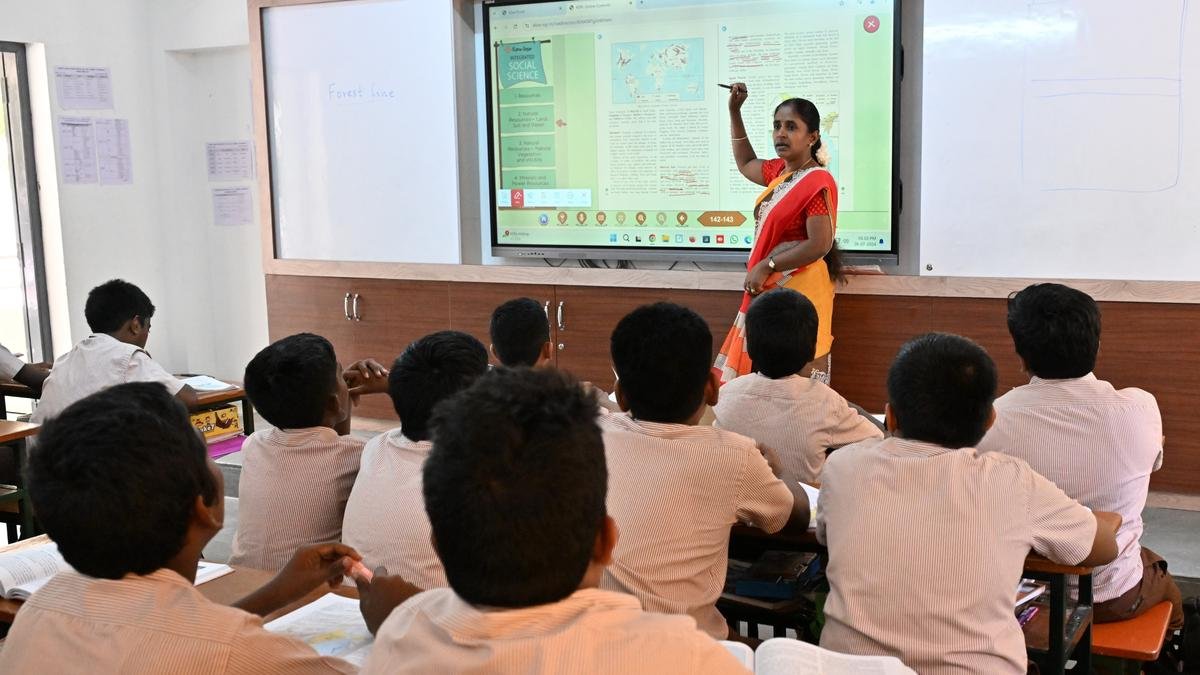

Government schools rolling out smart classrooms in semi-urban regions marks a significant shift in India’s education system. The move aims to bridge the digital gap, improve learning outcomes, and bring technology-enabled teaching to students in Tier-2 and Tier-3 areas.
This expansion is part of a broader push to modernize public education and make digital tools accessible beyond metro cities.
Government Push for Smart Classrooms in Public Education
The rollout of smart classrooms in government schools is being driven under national initiatives such as Samagra Shiksha, which focuses on improving school infrastructure and learning quality.
The Ministry of Education has been supporting states with funding and guidelines to integrate digital tools into classrooms. State governments are implementing these changes based on local requirements.
Semi-urban regions are a key focus because they often fall between urban and rural infrastructure levels. Expanding smart classrooms in these areas ensures wider coverage and balanced development.
The initiative includes installing digital boards, projectors, and internet-enabled devices in classrooms.
What Smart Classrooms Include and How They Work
Smart classrooms are equipped with digital teaching tools that enhance traditional methods. These typically include interactive flat panels or projectors, preloaded educational content, and access to online learning platforms.
Teachers can use multimedia content such as videos, animations, and simulations to explain concepts more effectively. This improves student engagement and helps simplify complex topics.
In many schools, content is aligned with state and national curricula, ensuring consistency with textbooks. Some systems also allow real-time assessments and feedback.
These classrooms are designed to function even with limited internet connectivity by using offline content stored on local devices.
Impact on Students in Semi-Urban Areas
The introduction of smart classrooms has a noticeable impact on student learning, especially in semi-urban regions where access to quality educational resources has been limited.
Students benefit from visual and interactive learning methods, which improve understanding and retention. Subjects like science and mathematics become easier to grasp through demonstrations and animations.
Exposure to digital tools also builds basic technological skills, which are increasingly important for higher education and employment.
For many students in Tier-2 cities, smart classrooms provide their first structured interaction with digital learning.
Training Teachers and Adapting to Digital Teaching
Successful implementation depends heavily on teacher training. Many educators in government schools are being trained to use digital tools effectively.
Training programs focus on operating smart classroom equipment, integrating digital content into lesson plans, and managing interactive sessions.
Adapting to new teaching methods can be challenging initially, but continuous support and practice help teachers become comfortable with technology.
This shift also encourages a more student-centric approach to education, moving away from rote learning.
Challenges in Implementation and Infrastructure
Despite the progress, several challenges remain in rolling out smart classrooms in semi-urban regions.
Infrastructure issues such as inconsistent electricity supply and internet connectivity can affect usage. Maintenance of equipment is another concern, especially in schools with limited technical support.
Budget constraints and delays in procurement can slow down implementation in some areas.
Ensuring uniform quality across schools is also a challenge, as resources and execution vary between states and districts.
Long-Term Benefits for Education System
The expansion of smart classrooms is expected to have long-term benefits for India’s education system. It reduces the gap between private and government school learning environments.
Digital classrooms enable standardized content delivery, which improves consistency in teaching quality.
They also open up possibilities for remote learning and hybrid education models, which became more relevant after recent disruptions in traditional schooling.
Over time, this initiative can contribute to better academic performance and increased digital literacy among students.
What Parents and Students Should Know
Parents in semi-urban areas should understand that smart classrooms are meant to supplement, not replace, traditional teaching methods.
Students are encouraged to actively participate in digital lessons and make use of available resources.
Awareness about these facilities can also help communities demand better implementation and accountability from local authorities.
Engagement from parents and teachers plays a key role in maximizing the benefits of this initiative.
Takeaways
• Smart classrooms are expanding in government schools across semi-urban India
• Digital tools improve student engagement and learning outcomes
• Teacher training is essential for effective implementation
• Infrastructure challenges still affect consistent usage
FAQs
Q1. What is a smart classroom in government schools
It is a classroom equipped with digital tools like projectors and interactive content for teaching.
Q2. Which areas are benefiting from this rollout
Semi-urban and Tier-2 regions are a major focus of the expansion.
Q3. Do smart classrooms require internet all the time
No, many systems work with offline content as well.
Q4. How do smart classrooms help students
They improve understanding through visual learning and interactive teaching methods.