
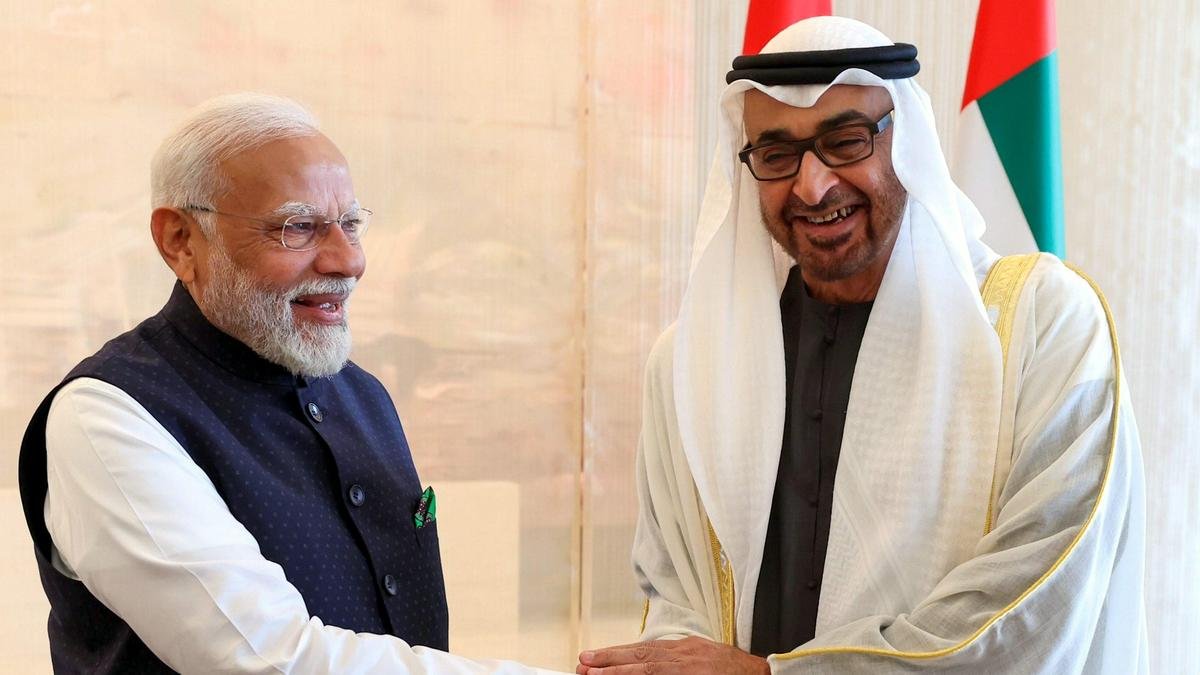

The UAE President’s official visit to India is a time sensitive diplomatic and economic event with implications that extend beyond metro cities. The visit focuses on trade expansion, investment flows, and job creation, with growing attention on Tier 2 and Tier 3 regions across multiple sectors.
Why the UAE President’s visit matters right now
The UAE President’s visit to India comes at a phase when both countries are deepening economic cooperation beyond traditional oil and infrastructure ties. India and the UAE already share strong trade volumes, but the current focus is on diversification. Manufacturing, food processing, logistics, renewable energy, and digital services are emerging as priority areas.
This visit signals intent to convert policy agreements into on ground execution. With supply chains shifting and global trade patterns evolving, India is positioning itself as a long term partner for UAE investment. The emphasis is not limited to Mumbai, Delhi, or Bengaluru. Smaller industrial cities and regional hubs are now central to bilateral planning.
Trade expansion and regional manufacturing opportunities
Trade discussions during the visit highlight increased movement of goods across agriculture, processed foods, textiles, engineering products, and pharmaceuticals. Tier 2 manufacturing clusters stand to gain as UAE companies look for scalable, cost efficient production bases.
Cities with established industrial corridors but lower operational costs are becoming attractive. These regions offer land availability, skilled semi technical labour, and improving logistics connectivity. For local manufacturers, this opens doors to export oriented growth rather than dependence on domestic demand alone.
The focus on faster customs clearance, simplified trade procedures, and dedicated logistics channels directly benefits businesses operating outside metro ports.
Job creation across non metro sectors
One of the most significant outcomes of the visit is the employment potential beyond major cities. Investment driven projects generate both direct and indirect jobs. Manufacturing units create demand for technicians, supervisors, logistics staff, and quality control professionals. Ancillary services such as transport, packaging, and maintenance also expand.
Service sector employment is another area of impact. IT enabled services, fintech support, and back office operations increasingly operate from Tier 2 cities due to lower costs and talent availability. UAE linked projects provide steady contract based work, reducing migration pressure on metros.
This shift supports local economies by keeping skilled workers closer to home while maintaining income stability.
Infrastructure and logistics as key enablers
Infrastructure cooperation is a major pillar of the visit. UAE investment interest includes ports, warehousing, cold chains, and multimodal logistics hubs. These projects are rarely located in city centres and instead benefit peripheral and regional zones.
Improved logistics directly impact farmers, small manufacturers, and exporters in smaller cities. Reduced transit time and lower spoilage rates increase competitiveness. For regions dependent on agriculture and food processing, this translates into better price realisation and market access.
Logistics jobs tend to be stable and scalable, making them valuable for regional employment growth.
Renewable energy and sustainability projects
Renewable energy cooperation is another area with strong regional impact. Solar and wind projects require large land parcels, which are typically available outside metro areas. UAE backed investments in clean energy support India’s transition goals while generating local employment.
These projects create jobs during construction, operations, and maintenance phases. They also attract related industries such as equipment supply, electrical services, and training institutes. Smaller towns near renewable energy parks often see improved infrastructure and ancillary economic activity as a result.
Skill development and workforce alignment
The visit also highlights the need for skill alignment between Indian workers and UAE driven projects. Vocational training, certification programmes, and industry linked skill centres are increasingly being set up in non metro regions.
This approach improves employability without requiring relocation. Skilled manpower availability further encourages investors to move beyond traditional business hubs. Over time, this creates self sustaining regional ecosystems rather than isolated projects.
Skill focused growth ensures that employment benefits are not limited to short term construction phases but extend into long term operations.
Impact on MSMEs and local suppliers
Micro, small, and medium enterprises are critical beneficiaries of expanded India UAE trade ties. Large investments rely heavily on local supplier networks for components, services, and maintenance. MSMEs in Tier 2 cities gain access to larger contracts and exposure to international quality standards.
This integration improves productivity and financial stability for smaller firms. It also encourages formalisation and technology adoption. For many regional businesses, association with UAE linked projects enhances credibility and opens doors to future exports.
Long term regional economic implications
Beyond immediate trade and jobs, the visit strengthens India’s regional economic positioning. Diversified foreign investment reduces dependence on a few urban centres and spreads risk more evenly. States with proactive industrial policies and infrastructure readiness are likely to benefit the most.
Over time, this decentralised growth model supports balanced urbanisation, reduces pressure on metro infrastructure, and improves quality of life in smaller cities. The visit reinforces a trend where global partnerships increasingly recognise the value of India’s regional strengths.
Takeaways
The UAE President’s visit signals deeper trade and investment cooperation
Tier 2 and Tier 3 cities are central to manufacturing and logistics growth
Job creation extends beyond metros into services, energy, and MSMEs
Skill development and infrastructure are key to sustaining regional benefits
FAQs
Does the visit benefit only large corporations?
No, MSMEs and local suppliers gain through expanded supply chains and service demand.
Which sectors see the most impact beyond metros?
Manufacturing, logistics, renewable energy, food processing, and IT services.
Will jobs created be long term or temporary?
Many roles are long term, especially in operations, services, and maintenance.
How can smaller cities attract such investments?
By improving infrastructure, skill availability, and ease of doing business.