
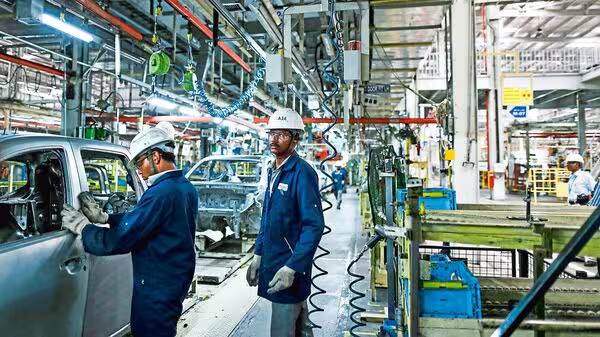

India’s manufacturing slowdown affects start ups in smaller towns because these regions depend heavily on factory orders, supplier networks and contract labour cycles. The main keyword India’s manufacturing slowdown sets the context for understanding why weaker industrial activity disrupts local business creation and how founders can pivot strategically.
The intent of this topic is informational with current economic relevance, so the tone remains analytical rather than opinion driven.
How the manufacturing slowdown filters into smaller town economies
Manufacturing drives a large share of economic activity in smaller towns through component units, machining workshops, logistics yards, fabrication shops and assembly lines. When national manufacturing growth softens, factories cut overtime, scale back orders and delay vendor payments. This impacts local start ups more quickly than metros because they operate closer to the industrial chain.
Start ups selling to factories or relying on industrial customers feel demand contraction immediately. For example workflow automation tools, maintenance services, safety equipment providers or small logistics operators see fewer inquiries. This drop affects revenue and makes it harder for early stage companies to maintain cash flow.
Additionally, smaller towns lack the diversified customer bases of metros. A slowdown in industrial activity affects everything from consumption to financing. For founders this means tightening of budgets, slower adoption of new products and prolonged customer sales cycles.
Why early stage start ups face heightened vulnerability
Early stage start ups depend on predictable customer behaviour to validate their business model. In a slowdown, factories prioritise essential expenses and delay discretionary spending. Start ups offering optimisation tools, digital platforms or non critical services find it harder to convert leads.
Payment delays also become common. Tier 2 and Tier 3 industrial belts operate with long credit cycles. When manufacturing customers face their own slowdown, they push payment timelines further. This disrupts early stage companies that rely on continuous receivables to fund operations.
Another challenge is talent. Many skilled workers choose metros when manufacturing clusters slow down. Start ups then struggle to hire competitively at a time when product adjustments or pivots require stronger teams.
Identifying early warning signals within local industrial clusters
Founders must build the habit of monitoring local industrial indicators that reveal slowdown pressure. These signals include production shift reductions, fewer trucks entering or leaving industrial zones, cutbacks in labour contractors and slowdown in orders at tool shops.
A decline in demand for basic raw materials in local markets, such as metals or packaging materials, also hints at lower output.
Start ups should track customer communication patterns as well. When repeated meetings get postponed, budgets remain unapproved or customers request shorter trial cycles, these are signs that the broader environment is tightening.
Pivot strategies that align with changing economic conditions
Even though demand weakens, slowdowns create opportunities for start ups to reposition themselves. The first way is cost efficiency. When factories try to reduce waste, they become more open to automation or optimisation tools that offer measurable savings. Start ups should position their solutions as cost reducers rather than add ons.
Second, diversify customer segments. Instead of selling only to manufacturing plants, founders can target logistics companies, construction contractors, equipment rental firms or mid sized distributors. These sectors may experience slower impact and provide steady revenue.
Third, start ups can redesign pricing models. Introducing outcome based billing, shared savings models or smaller entry level packages helps customers adopt solutions even in tight market cycles.
Leveraging digital adoption and AI driven optimisation
Manufacturing customers may slow expansion, but they still need efficiency improvements. Start ups can use this period to build lightweight digital tools, AI based forecasting systems, simple inspection automation or predictive maintenance features.
These tools appeal to factories because they save money without requiring major capital investment. Cloud based deployments reduce implementation friction.
Start ups in smaller towns often have closer access to operations data from local plants. They can use this advantage to design narrow AI tools that solve very specific problems like machine downtime prediction or energy waste reduction.
Building resilience through partnerships and ecosystem support
Founders should increase collaboration with industry associations, technical institutes and local business chambers. These organisations can provide access to new customer groups, procurement opportunities and shared training programs.
Working with banks or NBFCs to create tailored financing options for customers can also help close deals when client budgets are uncertain.
Internally, start ups must strengthen financial discipline by shortening receivable cycles, improving inventory management and building reserves to survive prolonged demand softness.
Preparing for the recovery phase ahead
Manufacturing cycles do recover. Start ups that use slowdown periods to refine their product, stabilise operations and strengthen customer trust will scale faster when industrial demand picks up.
Recovery phases bring new investments, fresh hiring and upgraded machinery. These moments create perfect openings for automation, analytics and digital adoption. Tier 2 founders well positioned at this stage can expand beyond their immediate geography and enter larger markets.
Takeaways
Manufacturing slowdown directly weakens demand for start ups in smaller towns
Early stage founders must track local industrial indicators to anticipate risk
Pivots should focus on cost efficiency, diversification and flexible pricing models
Digital and AI driven tools offer strong adoption potential even during weak cycles
FAQs
Why are start ups in smaller towns more affected than metro based ones?
Because they rely heavily on manufacturing customers and local supply chains, which feel contraction earlier and have limited diversification.
What type of start up products still sell during slowdowns?
Tools that reduce costs, improve efficiency or automate repetitive tasks remain in demand because they help factories manage tighter budgets.
Should start ups postpone scaling plans?
Scaling into new regions may be slower, but strengthening product value and building deeper customer relationships remains useful.
How long do manufacturing slowdowns typically last?
Duration varies, but preparing for six to twelve months of softer demand helps founders plan finances and operations responsibly.