
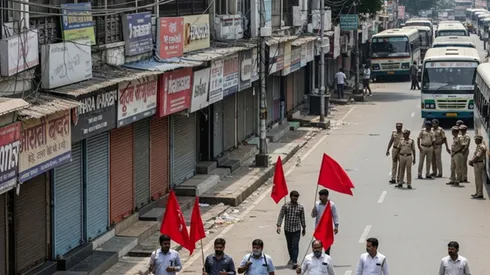

The Bharat Bandh on Feb 12 is affecting daily life across several non metro regions including Odisha and Assam, with visible disruption in schools, transport services, and routine work. While essential services remain functional in most areas, public movement and business activity have slowed significantly.
The Bharat Bandh Feb 12 impact is more pronounced in Tier 2 and Tier 3 cities where public transport, local markets, and government offices form the backbone of daily functioning. Unlike metro cities with multiple private alternatives, smaller urban centers depend heavily on state transport and public institutions, making them more sensitive to strike calls.
Schools and Colleges See Mixed Response
In Odisha and Assam, several schools remained closed as a precautionary measure following the Bharat Bandh call. District administrations in some areas issued advisories allowing institutions to suspend physical classes to ensure student safety. Private schools in urban pockets reported lower attendance where transport was disrupted.
Government colleges and universities largely operated based on local assessment. In towns where protests were reported near highways or market areas, institutions opted for partial shutdowns. Online classes were used in some cases, particularly by private institutions that already have digital infrastructure in place.
Parents in non metro districts expressed concern over transportation rather than academic schedules. School buses avoided certain routes due to road blockades and protest gatherings. In rural belts, where students rely on public buses, attendance dropped more sharply.
Public Transport and Highway Movement Slowed
Public transport disruption has been one of the most visible effects of the Bharat Bandh Feb 12 in Odisha, Assam, and adjoining regions. State run buses operated on limited routes in some districts. In areas where transport unions supported the strike, services were reduced or temporarily suspended.
Auto rickshaw and shared taxi operations varied by locality. In district headquarters, limited movement continued. In smaller towns, many drivers chose to stay off the roads due to safety concerns or solidarity with protest calls.
Rail services generally continued as per schedule, though minor delays were reported in certain routes due to precautionary checks. Long distance trains were not widely canceled, but passengers were advised to arrive early at stations in view of potential road slowdowns.
Highway blockades were reported in some pockets, particularly in semi urban areas. Freight movement experienced brief interruptions, impacting supply chains for local markets.
Impact on Workplaces and Small Businesses
In non metro regions, daily wage earners and small business owners felt the economic impact more directly. Many retail shops in market areas remained shut either voluntarily or due to low customer footfall. Wholesale mandis in certain towns reported reduced activity.
Government offices operated with reduced staff in some districts where employee unions supported the strike. However, essential services such as hospitals, water supply, and electricity distribution remained operational.
Private offices adopted flexible attendance policies. In smaller IT parks and service centers located in state capitals like Bhubaneswar and Guwahati, work from home options were offered where feasible.
For small entrepreneurs in Tier 3 towns, the disruption translated into a day of reduced revenue. Street vendors and transport dependent businesses reported slower movement compared to regular working days.
Banking and Essential Services Continue Cautiously
Bank branches in several districts opened with standard hours, though customer footfall was lower than usual. Digital banking services and UPI transactions continued without widespread technical issues.
ATMs remained functional in most surveyed areas, though some experienced temporary cash replenishment delays where transport was affected.
Healthcare services were largely insulated from disruption. Government hospitals and primary health centers operated normally, with security measures in place to avoid disturbances.
Utility services such as electricity and water supply were maintained. Local administrations prioritized continuity of essential infrastructure to prevent panic.
Public Sentiment and Law Enforcement Measures
Local administrations in Odisha and Assam deployed additional police personnel in sensitive areas to prevent untoward incidents. Preventive measures included traffic diversions and monitoring of major intersections.
Public sentiment appeared divided. While some residents supported the strike call, others expressed frustration over daily inconvenience, particularly those dependent on public transport.
In non metro regions, the immediate concern was safety rather than ideology. Families avoided unnecessary travel. Markets closed early in some towns to minimize risk.
Overall, the Bharat Bandh Feb 12 impact in these states reflected controlled disruption rather than complete shutdown. Essential systems remained intact, but economic and mobility slowdown was evident across multiple districts.
Takeaways
• Schools and colleges in non metro regions saw partial closures and low attendance
• Public transport disruptions were more visible in Tier 2 and Tier 3 towns
• Essential services such as healthcare and utilities largely remained operational
• Small businesses and daily wage earners faced short term economic impact
FAQs
Q1: Were schools completely shut in Odisha and Assam during Bharat Bandh Feb 12?
Not completely. Several institutions closed as a precaution, while others operated with reduced attendance depending on local conditions.
Q2: Did trains and long distance transport stop running?
Rail services largely continued, though road based transport saw localized disruption.
Q3: Were banks closed during the bandh?
Most banks opened as usual, but customer turnout was lower and some branches operated with limited staff.
Q4: Did essential services like hospitals and electricity shut down?
No. Essential services remained functional with additional monitoring to ensure continuity.