
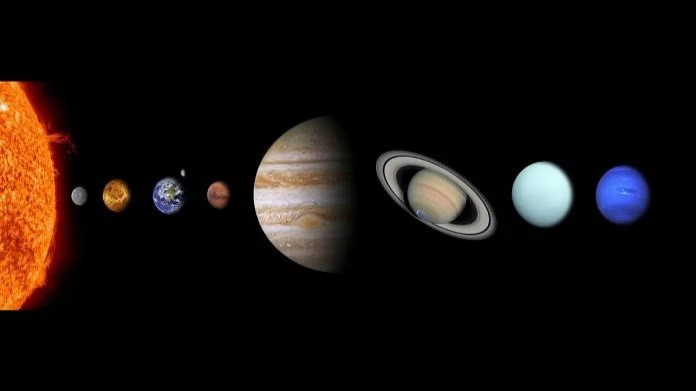

The six planet parade visible in India this weekend has generated strong interest among skywatchers and students. This rare planetary alignment offers a chance to observe multiple planets in a single stretch of sky with the right timing, location, and safety precautions.
The six planet parade is a time sensitive astronomical event because planetary alignments occur on specific dates and are visible only during certain hours. Such alignments are not perfectly straight lines in space, but from Earth they appear grouped closely along the ecliptic. For beginners in India, understanding when and where to look is critical to avoid missing the opportunity.
What Is a Six Planet Parade and Why It Matters
A six planet parade refers to an apparent alignment where six planets are visible in the night or early morning sky within a relatively small arc. These planets typically lie along the ecliptic, the same path the Sun and Moon follow. The effect happens because all planets orbit the Sun roughly in the same plane.
Depending on visibility conditions, the planets involved may include Mercury, Venus, Mars, Jupiter, Saturn, and sometimes Uranus. The brighter planets such as Venus and Jupiter are often visible to the naked eye, while Uranus usually requires binoculars or a small telescope.
Such alignments are uncommon but not once in a lifetime. They occur every few years in different combinations. However, seeing six planets in a short span of sky at convenient hours is rare enough to attract attention from astronomy clubs and observatories across India.
Best Timings to Watch the Planetary Alignment in India
The most important factor in viewing a six planet parade in India is timing. These events are usually best observed either shortly after sunset or before sunrise, depending on the positions of the planets relative to the Sun.
For this weekend, early morning hours before sunrise are expected to provide clearer views in many parts of India. Observers should step outside at least 45 to 60 minutes before sunrise. The sky should still be dark enough to see planets, but the horizon will begin to brighten gradually.
Urban observers must account for light pollution. In cities like Delhi, Mumbai, Bengaluru, or Hyderabad, the lower horizon may be hazy. Tier 2 and Tier 3 cities with lower light pollution offer better visibility. Clear skies without cloud cover are essential.
How to Identify Each Planet in the Night Sky
Beginners often confuse bright stars with planets. A simple rule is that planets usually shine steadily without twinkling, unlike stars that flicker due to atmospheric turbulence.
Venus is typically the brightest object after the Moon and appears as a bright white light. Jupiter also shines brightly and may show a slightly yellow tint. Mars appears reddish. Saturn looks pale yellow and is dimmer than Jupiter but still visible in dark skies.
Using a reliable sky mapping mobile app can help identify exact positions. These apps use your location and time to display a real time sky map. Hold your phone toward the sky and match the bright objects.
Binoculars enhance the experience, especially for spotting Saturn or Uranus. However, avoid looking through binoculars in the direction of the rising Sun as it can cause serious eye damage.
Safety Tips for Viewing the Six Planet Parade
Unlike a solar eclipse, a planetary alignment does not require special protective glasses. Observing planets at night or before sunrise is safe with the naked eye.
The only caution is to stop using binoculars or telescopes once the Sun rises above the horizon. Direct sunlight through optical devices can permanently damage eyesight.
Dress according to local weather conditions, especially in northern India where early mornings may still be cool. Choose an open area with an unobstructed view of the eastern or western horizon depending on the viewing window.
Avoid rooftops without proper safety barriers. Open grounds, terraces with railings, or designated astronomy club meetups are safer options.
Best Locations in India for Clear Sky Observation
Hill stations and rural areas offer the best experience due to minimal light pollution. Locations in Rajasthan, Ladakh, parts of Madhya Pradesh, and interior Karnataka often provide clearer skies.
Even within cities, parks away from streetlights can improve visibility. Coastal cities may face humidity that slightly reduces clarity, but bright planets like Venus and Jupiter remain visible.
If weather conditions are unfavorable in your region, follow updates from local astronomy groups. Some observatories may organize guided viewing sessions with telescopes.
Why This Alignment Is a Learning Opportunity
Events like the six planet parade are ideal for introducing children and students to basic astronomy. Seeing multiple planets together reinforces textbook concepts about the solar system and planetary orbits.
Schools and science clubs often use such opportunities for practical demonstrations. Observing the alignment and identifying each planet helps build spatial understanding of how celestial bodies move.
Even casual observers gain perspective on the scale of the solar system. While the planets appear close in the sky, they are separated by millions of kilometers in space.
Takeaways
The six planet parade is best viewed in India before sunrise with clear skies
Bright planets like Venus and Jupiter are visible to the naked eye
Binoculars improve clarity but should not be used after sunrise
Low light pollution areas provide the best viewing experience
FAQs
Q1. Do I need special glasses to watch the six planet parade?
No, planetary alignments are safe to observe with the naked eye. Special glasses are only required for direct solar viewing.
Q2. Can I see all six planets without a telescope?
Most bright planets such as Venus, Jupiter, and Mars are visible to the naked eye. Uranus may require binoculars or a small telescope.
Q3. What time should I step outside to watch the alignment?
Generally, 45 to 60 minutes before sunrise offers the best viewing window for morning alignments.
Q4. Will this alignment happen again soon?
Planetary groupings occur periodically, but the exact combination and visibility conditions vary. Similar events may occur in future years.