
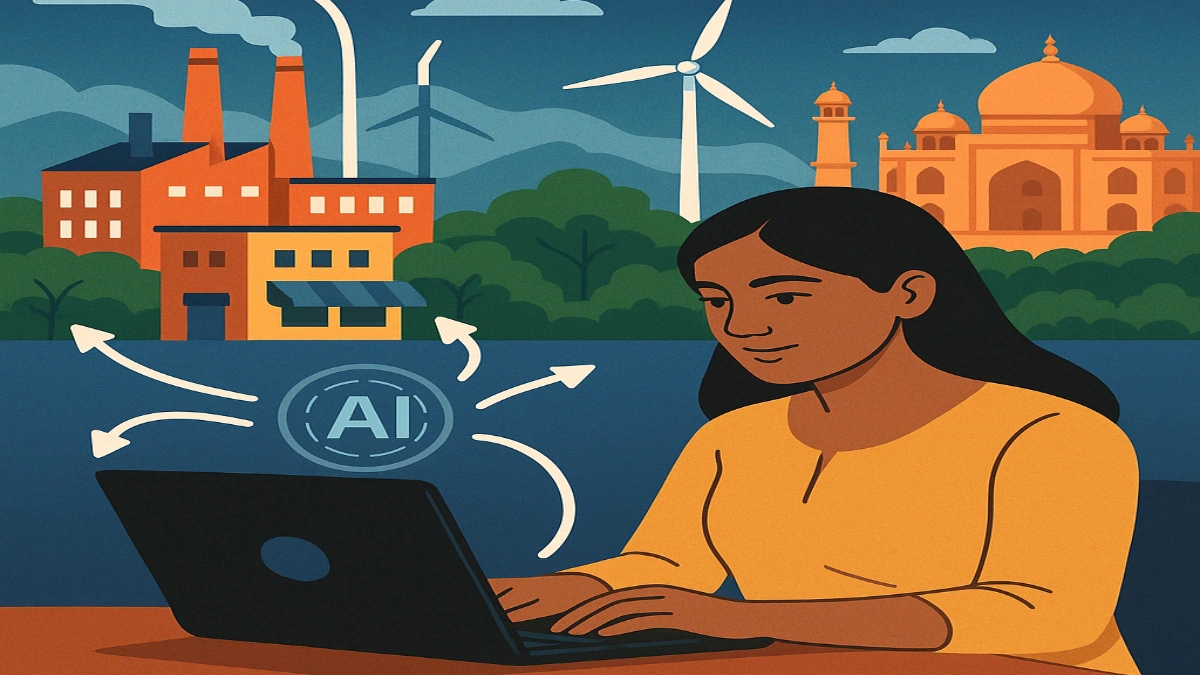

Artificial intelligence is no longer limited to large technology companies or metropolitan cities. AI tools for students, job seekers, and small business owners are becoming increasingly accessible across India’s Tier-2 cities, helping people learn new skills, improve productivity, find opportunities, and grow businesses with minimal investment.
AI Adoption Is Expanding Beyond Major Cities
AI tools for students, job seekers, and entrepreneurs have become more widely available thanks to affordable smartphones, better internet connectivity, and the rise of user-friendly applications. Cities such as Nagpur, Indore, Jaipur, Surat, Coimbatore, Lucknow, and Bhopal are witnessing growing interest in artificial intelligence-powered platforms.
Unlike earlier generations of software that required technical expertise, modern AI applications are designed for everyday users. Many platforms offer free versions that can assist with writing, research, language translation, design creation, customer communication, and data analysis.
For people living outside major technology hubs, AI is helping reduce barriers to information, education, and business growth. This shift is creating new opportunities for individuals who may not have access to expensive training programs or specialized resources.
How Students Can Use AI for Learning and Skill Development
AI-powered educational tools are transforming how students study and prepare for examinations. These applications can explain difficult concepts, summarize lengthy chapters, generate practice questions, and assist with language learning.
Students preparing for competitive examinations often use AI tools to organize study schedules, create revision notes, and simplify complex topics. Language translation features are particularly useful for learners who study in regional languages but need access to English-language resources.
AI can also support project work, coding practice, presentation preparation, and academic research. However, students should use these tools as learning assistants rather than substitutes for independent thinking.
Educational experts generally recommend verifying information from textbooks, official sources, and teachers because AI-generated content may occasionally contain inaccuracies. Used responsibly, AI can help improve efficiency and understanding.
AI Tools for Job Seekers and Career Growth
For job seekers in Tier-2 cities, AI is creating new ways to prepare for employment opportunities. Many candidates use AI-powered platforms to build professional resumes, draft cover letters, improve communication skills, and prepare for interviews.
Mock interview tools can simulate common interview questions and provide feedback on responses. Some platforms analyze resumes and suggest improvements based on industry requirements.
AI can also help users identify skill gaps by comparing their qualifications with job descriptions. This allows candidates to focus on learning relevant skills before applying for positions.
In addition, AI-powered language and communication tools can assist individuals who are transitioning from regional-language education to professional environments where English communication is often required.
The ability to access career guidance digitally is especially valuable in cities where professional career counseling services may be limited.
Small Businesses Are Using AI to Improve Operations
Small business owners are among the fastest-growing users of AI technology. Many entrepreneurs use AI-powered tools to create marketing content, manage customer communication, analyze sales trends, and automate routine tasks.
A local retailer can use AI to generate product descriptions and social media posts. Restaurant owners can create promotional campaigns more quickly. Service providers can automate responses to frequently asked customer questions.
AI-based design tools also help businesses create logos, advertisements, posters, and digital content without hiring professional designers for every task.
These capabilities allow smaller enterprises to compete more effectively with larger businesses while controlling operational costs. For many businesses in Tier-2 cities, AI functions as a low-cost productivity assistant rather than a replacement for employees.
Popular AI Applications for Everyday Users
Several categories of AI tools are gaining popularity across India. Conversational AI assistants help users generate content, answer questions, and solve problems. Design platforms assist with visual content creation for marketing and education.
Language tools help translate text, improve grammar, and simplify communication. Productivity applications support note-taking, scheduling, and document organization.
Students often use AI for learning support, while entrepreneurs focus on marketing and customer engagement. Job seekers typically benefit from resume optimization and interview preparation tools.
The increasing availability of mobile-friendly AI applications means users can access advanced capabilities directly from smartphones without requiring expensive hardware.
Challenges and Responsible Use of Artificial Intelligence
While AI offers many benefits, responsible usage remains important. Users should avoid sharing sensitive personal information, financial details, passwords, or confidential business data with public AI platforms.
AI-generated content should always be reviewed before publication or submission. Since AI systems generate responses based on patterns rather than human judgment, occasional errors can occur.
Businesses should also maintain transparency when using automated communication systems with customers. Human oversight remains important for decision-making, especially in areas involving finance, legal matters, healthcare, and education.
Understanding both the strengths and limitations of AI helps users maximize benefits while minimizing risks.
The Future of AI in Tier-2 India
Artificial intelligence is becoming a practical tool for everyday life rather than a technology reserved for specialists. As internet access improves and digital literacy increases, more students, professionals, and entrepreneurs in Tier-2 cities are expected to adopt AI-powered solutions.
The technology is helping bridge knowledge gaps, improve productivity, and create new economic opportunities. For many users, AI represents an affordable way to access capabilities that were previously available only to large organizations or urban professionals.
Its growing adoption suggests that artificial intelligence will play a significant role in shaping education, employment, and business development across India’s emerging cities in the years ahead.
Key Takeaways
• AI tools help students learn faster through summaries, explanations, and study assistance.
• Job seekers can use AI for resume building, interview preparation, and skill development.
• Small businesses can improve marketing, customer service, and productivity using AI applications.
• Responsible use and human verification remain essential when relying on AI-generated content.
FAQ
Q1. Can students rely entirely on AI for exam preparation?
No. AI should be used as a study aid alongside textbooks, teachers, and verified educational resources.
Q2. How can AI help job seekers in smaller cities?
AI can assist with resume creation, interview practice, career guidance, and identifying in-demand skills.
Q3. Is AI expensive for small business owners?
Many AI tools offer free or affordable plans, making them accessible to small businesses with limited budgets.
Q4. What is the biggest risk when using AI tools?
The main risk is relying on inaccurate information without verification. Users should always review important outputs before acting on them.
(AI tools for students, AI for job seekers, artificial intelligence India, AI for small business owners, Tier-2 city technology, AI learning tools, AI productivity tools, digital skills India, AI career development, AI business growth)