
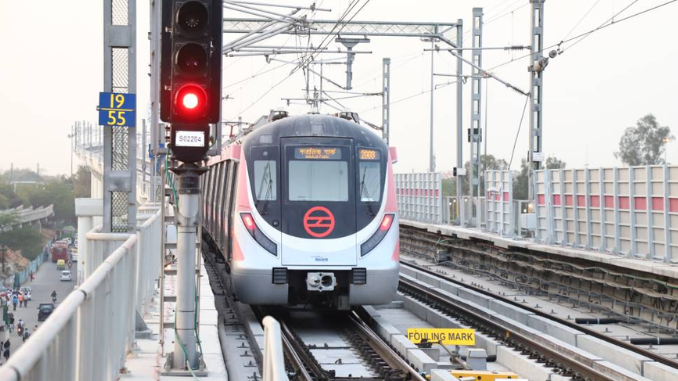

The proposed Ballabgarh-Palwal Metro extension has moved a step closer to implementation after the Haryana government approved its final feasibility report. The detailed project report has been sent to the Union Ministry of Housing and Urban Affairs for further consideration. The proposed corridor could improve public transport connectivity between Faridabad and Palwal, although central approval, funding arrangements, construction timelines and an opening date remain to be confirmed.
Haryana Approves Ballabgarh-Palwal Metro Feasibility Report
Haryana has taken another step towards extending Delhi Metro connectivity beyond Ballabgarh, with Chief Minister Nayab Singh Saini approving the final feasibility report for the proposed extension to Palwal.
According to reports published on October 8 and 9, 2026, the detailed project report (DPR) has been forwarded to the Union Ministry of Housing and Urban Affairs. The development was reviewed during the 66th board meeting of the Haryana Mass Rapid Transport Corporation (HMRTC), chaired by Chief Secretary Anurag Rastogi.
The latest decision advances the project through the planning process, but it should not be confused with final approval for construction. The proposal still requires further consideration at the central level, and the implementation schedule has not been announced.
For commuters travelling between Faridabad and Palwal, the project is important because it could eventually provide another public transport option along a busy stretch of southern Haryana.
Ballabgarh-Palwal Metro Route and Proposed Stations
The proposed extension is expected to continue the existing Delhi Metro Violet Line from Raja Nahar Singh station in Ballabgarh towards Palwal.
Earlier project reports described a roughly 28-kilometre elevated corridor with 10 proposed stations, ending near the Palwal Mini Secretariat. These details reflect the earlier planning proposal and may be revised as the project progresses through subsequent approvals.
An elevated alignment could help provide Metro connectivity while limiting the need for an entirely underground system. However, the final station locations, construction design and other technical details should be confirmed through the approved project documents.
The extension is intended to bridge the gap between the existing Metro network in Faridabad and the Palwal area. If implemented, it could offer commuters an alternative to relying entirely on road transport for local and regional journeys.
For residents living near the proposed alignment, the location of stations will be particularly important. Walking access, feeder buses, auto-rickshaw connectivity and parking facilities will influence how convenient the service becomes once operational.
How the Metro Extension Could Benefit Daily Commuters
Palwal and Faridabad have residential areas, industrial activity, educational institutions and commercial establishments that generate regular travel demand. Many residents commute for work, education, healthcare and other essential services.
A Metro extension could give passengers another option for reaching destinations connected to the wider Delhi Metro network. It may be particularly useful for people who currently depend on private vehicles, buses or shared transport.
The benefits, however, will depend on the final route, service frequency, fares and interchange arrangements. A station located far from residential neighbourhoods may offer limited convenience unless suitable last-mile transport is available.
For office workers, students and daily wage earners, reliable connections can matter as much as the journey itself. Convenient station access and predictable travel times would be important factors in determining whether the new corridor attracts regular passengers.
The proposed project could also improve access to employment and education opportunities across the wider National Capital Region. These are potential benefits rather than guaranteed outcomes, and their scale will depend on how the project is designed and operated.
What the Extension Could Mean for Palwal’s Development
Improved public transport can influence how residential and commercial areas develop. If the Ballabgarh-Palwal corridor becomes operational, locations near its stations could become more accessible to people travelling to Faridabad and other connected parts of the NCR.
Better connectivity may support demand for housing, retail establishments, offices and other services around station areas. Businesses could also benefit if employees and customers gain more convenient travel options.
However, Metro connectivity does not automatically guarantee higher property prices or rapid commercial growth. Local infrastructure, road access, employment opportunities, land-use rules and the availability of public services also influence development.
For Palwal, the long-term value of the project would depend on how effectively Metro services connect with existing transport networks and the city’s growing residential and commercial areas.
Authorities would also need to consider pedestrian access, road safety, drainage, traffic management and public facilities around proposed stations. These elements can determine whether the benefits of a major transport project reach surrounding neighbourhoods.
What Approvals Are Still Required?
The Haryana government’s approval of the feasibility report is an important milestone, but the project must progress through further stages before passengers can use the proposed line.
The Union Ministry of Housing and Urban Affairs will need to consider the detailed project report and the applicable approval requirements. The project will also need clarity on financing, the division of responsibilities between the relevant authorities, land requirements and implementation arrangements.
Once the necessary approvals and funding decisions are secured, the authorities can establish a construction plan and a realistic completion schedule.
The detailed project report is important because it sets out the technical and financial basis for the proposed corridor. Its examination can address matters such as alignment, station planning, estimated costs, passenger demand and implementation feasibility.
As of October 9, 2026, a confirmed construction start date, completion deadline, fare structure and operational launch date have not been announced in the reports reviewed.
Commuters should therefore treat the latest development as progress towards a proposed Metro connection rather than an indication that services will begin immediately.
Other Metro and Regional Transit Projects Under Consideration
The Ballabgarh-Palwal proposal was discussed alongside other transport infrastructure plans during the HMRTC board meeting.
These included a proposed 35.25-kilometre Metro corridor between Gurugram Sector 56 and Panchgaon, which is awaiting final state approval. The planned corridor is expected to have 28 stations and connect with the Namo Bharat Regional Rapid Transit System network.
Officials also reviewed proposed Namo Bharat corridors linking Delhi with Panipat and Karnal, as well as a possible connection between Gurugram, Faridabad, Noida and Greater Noida.
These projects remain at different stages of planning and approval. Their consideration reflects a broader effort to strengthen regional connectivity, but each proposal must be assessed according to its own approvals, financing and implementation schedule.
For commuters, the key issue is not simply the number of projects announced. It is whether the proposals move forward into funded construction, coordinated transport planning and reliable passenger services.
Key Takeaways
- Haryana has approved the final feasibility report for the proposed Ballabgarh-Palwal Metro extension.
- The detailed project report has been sent to the Union Ministry of Housing and Urban Affairs for further consideration.
- Earlier planning reports described a roughly 28-kilometre corridor with 10 proposed stations, extending from Ballabgarh towards Palwal.
- A confirmed construction start date, completion timeline, fares and opening date have not yet been announced.
Frequently Asked Questions
1. Has the Ballabgarh-Palwal Metro extension received approval?
The Haryana government has approved the final feasibility report, and the detailed project report has been forwarded to the Union Ministry of Housing and Urban Affairs. This is a planning milestone, not confirmation that all approvals for construction have been completed.
2. How long will the proposed Ballabgarh-Palwal Metro route be?
Earlier project reports described a corridor of approximately 28 kilometres. The final alignment and technical details should be confirmed through the project documents as the proposal progresses.
3. Where will the proposed Metro line start and end?
The planned extension is expected to continue from Raja Nahar Singh Metro station in Ballabgarh towards Palwal, with earlier reports identifying the Palwal Mini Secretariat area as the proposed endpoint.
4. When will the Ballabgarh-Palwal Metro line open?
No confirmed opening date or construction completion deadline has been announced in the reports reviewed as of October 9, 2026. The timeline will depend on the remaining approvals, financing and implementation process.