
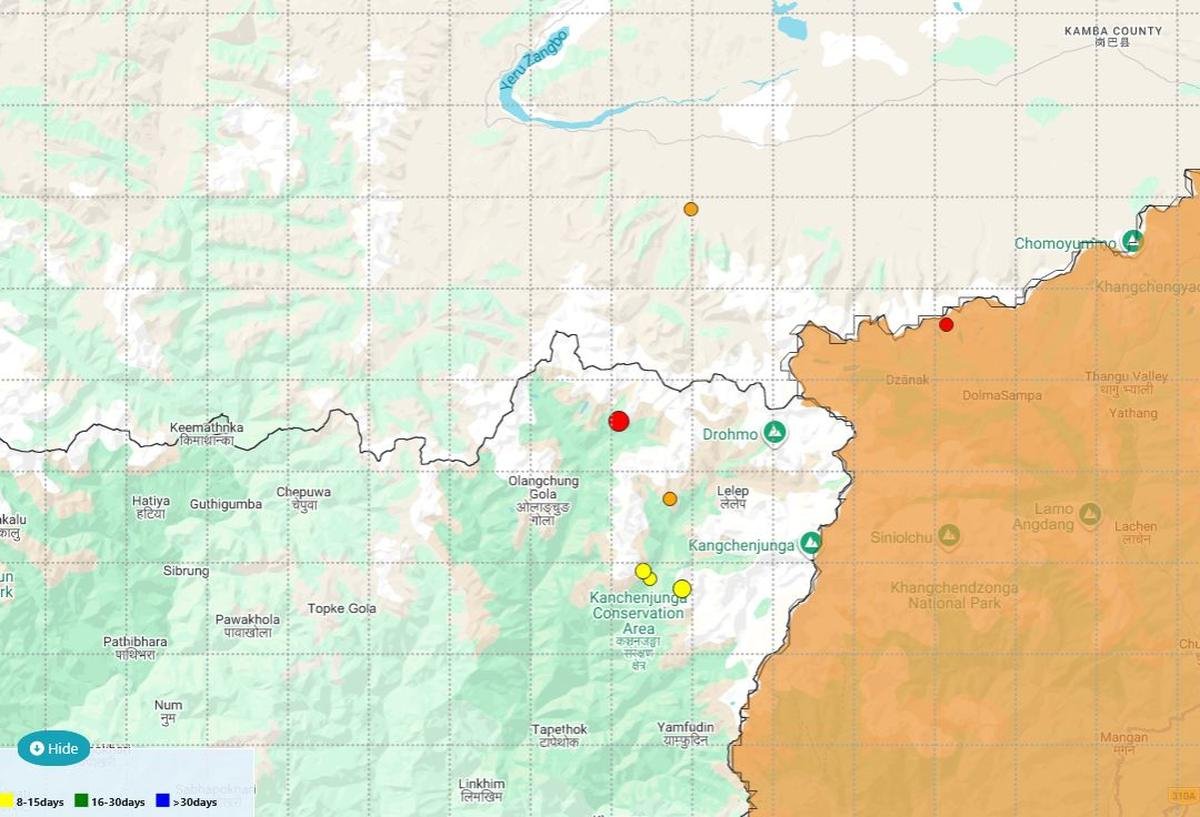

A magnitude 5.3 earthquake struck eastern Nepal on November 24, 2026, sending tremors across parts of North Bengal and Sikkim. Residents reported feeling the ground shake early in the morning, with several people stepping outside as a precaution. Authorities initially reported no casualties or major damage.
Magnitude 5.3 Earthquake Strikes Nepal Near Sikkim Border
An earthquake measuring 5.3 on the Richter scale struck Nepal’s Koshi Province at approximately 7:02 AM IST on Tuesday, November 24, according to India’s National Centre for Seismology.
The NCS recorded the earthquake at latitude 27.855° N and longitude 87.909° E, at a depth of 20 kilometres. Its monitoring data placed the epicentre approximately 61 kilometres north-northwest of Yuksom in Sikkim.
The earthquake occurred in eastern Nepal, close to the Indian border, which explains why tremors were experienced in neighbouring regions.
According to reports, the shaking was felt in several parts of Nepal and across neighbouring areas of India. Reports also indicated that the seismic activity was detected across parts of Bhutan, Bangladesh and China. seismo.gov.in+2
Tremors Reported Across North Bengal and Sikkim
Residents in North Bengal and Sikkim experienced noticeable shaking during the early morning hours.
In West Bengal, tremors were reported in districts including Darjeeling, Jalpaiguri and Cooch Behar. Some residents reportedly rushed out of their homes after feeling the movement.
In Sikkim, people in different areas also reported experiencing the earthquake. The proximity of the epicentre to the Himalayan region meant that the tremors were felt across neighbouring locations.
Reports also indicated that people in parts of Bihar experienced the shaking, including areas such as Purnea, Katihar, Araria and Kishanganj.
The early morning timing caught some residents by surprise, particularly those who were sleeping or preparing for their daily activities. PTIFeed+2
No Immediate Reports of Casualties or Property Damage
Following the earthquake, initial reports from North Bengal and Sikkim indicated no immediate casualties or major property damage.
According to a Press Trust of India report, officials said there were no immediate reports of injuries or damage in Darjeeling, Jalpaiguri and Cooch Behar districts or in Sikkim.
Residents in some locations reportedly moved outside their homes as a precaution after experiencing the tremors.
However, the absence of immediate damage reports does not necessarily mean that every affected location has been assessed. Local authorities may need additional time to inspect buildings, roads and other infrastructure.
The situation should be followed through official updates from the National Centre for Seismology and local disaster management authorities. PTIFeed+1
Why Do Earthquakes Occur in Nepal and the Himalayan Region?
Nepal and the surrounding Himalayan region are located in one of the world’s seismically active areas.
The Himalayan mountain range was formed through the ongoing collision of the Indian tectonic plate with the Eurasian plate. The movement and interaction of these plates create pressure within the Earth’s crust.
When accumulated stress is released along geological faults, it can generate earthquakes.
Because Nepal shares its geographical region with the Himalayan belt, earthquakes occurring there can sometimes be felt across neighbouring Indian states, including Sikkim and parts of West Bengal.
The impact of an earthquake depends on several factors, including its magnitude, depth, distance from populated areas, local ground conditions and the strength of buildings.
This is why a moderate earthquake in Nepal can be felt in nearby Indian regions even when the epicentre is outside India’s international boundary.
What Should Residents Do After Feeling Earthquake Tremors?
Residents of earthquake-prone regions should understand basic safety precautions, even when an earthquake causes no immediate damage.
The National Centre for Seismology and disaster management authorities provide safety guidance for people living in vulnerable areas.
Some important precautions include:
- Check walls, ceilings and other structural elements for visible cracks or damage.
- Stay away from buildings that appear structurally unsafe.
- Avoid touching damaged electrical wires or exposed equipment.
- Check gas connections if there is a possibility of leakage.
- Keep emergency contact numbers accessible.
- Follow official announcements rather than relying on unverified social media messages.
Residents should also avoid entering damaged buildings until they have been checked by appropriate authorities.
Earthquake Safety Tips: What to Do During Tremors
Knowing how to respond during an earthquake can reduce the risk of injuries.
The recommended safety method is Drop, Cover and Hold.
If You Are Inside a Building
- Drop to your hands and knees to prevent being knocked down.
- Take cover under a sturdy table or desk.
- Hold on to the furniture until the shaking stops.
- Protect your head and neck.
- Stay away from glass windows, mirrors and heavy objects.
- Do not use lifts during an earthquake.
People should generally remain indoors until the shaking stops rather than rushing towards exits while the building is moving.
If You Are Outdoors
Move towards an open area away from buildings, trees, streetlights and electrical wires.
Avoid standing near boundary walls, balconies or structures that could collapse.
If you are travelling in a vehicle, stop in a safe location away from buildings, bridges and overhead power lines. Remain inside until the shaking stops.
These precautions are consistent with the earthquake safety guidance issued by India’s National Centre for Seismology and disaster management authorities. seismo.gov.in+1
Could More Earthquake Tremors Occur After This Event?
Following an earthquake, people often worry about the possibility of additional tremors.
Smaller earthquakes sometimes occur in the same general area after a larger earthquake. These events are known as aftershocks and can continue for days or longer, depending on the seismic sequence.
However, it is not possible to determine from the magnitude of this earthquake alone whether another significant earthquake will occur.
Scientists cannot reliably predict the exact date, time, location and magnitude of a future earthquake.
Residents should therefore avoid believing social media messages that claim a major earthquake will strike a particular city or region at a specific time.
Instead, they should follow updates from recognised monitoring agencies and remain familiar with basic earthquake safety procedures. U.S. Geological Survey+1
Where Can Residents Check Official Earthquake Updates?
People in Sikkim, North Bengal and neighbouring regions can monitor earthquake information through official government platforms.
The National Centre for Seismology provides information about earthquake magnitude, location, depth and recorded activity.
Residents can use the following websites:
- National Centre for Seismology: seismo.gov.in for official earthquake monitoring information from India’s Ministry of Earth Sciences.
- National Disaster Management Authority: ndma.gov.in for disaster preparedness and safety information.
- Sikkim State Disaster Management Authority: ssdma.nic.in for state-level disaster safety guidance.
- West Bengal Government: wb.gov.in for state government information and official announcements.
Residents should rely on these sources for verified updates instead of forwarding unconfirmed earthquake warnings through WhatsApp or other social media platforms.
Key Takeaways
- A magnitude 5.3 earthquake struck Nepal’s Koshi Province at approximately 7:02 AM IST on November 24, 2026.
- Tremors were reported in Sikkim and North Bengal, including Darjeeling, Jalpaiguri and Cooch Behar.
- Initial reports indicated no immediate casualties or major property damage in the affected Indian regions.
- Residents should follow official earthquake updates and practise basic safety measures such as Drop, Cover and Hold.
Frequently Asked Questions (FAQs)
1. What was the magnitude of the Nepal earthquake on November 24, 2026?
The earthquake measured 5.3 in magnitude, according to India’s National Centre for Seismology. It occurred at approximately 7:02 AM IST at a depth of 20 kilometres.
2. Which Indian states felt the Nepal earthquake tremors?
Tremors were reported in Sikkim and parts of West Bengal, particularly North Bengal districts such as Darjeeling, Jalpaiguri and Cooch Behar. Reports also indicated shaking in parts of Bihar.
3. Were there any casualties or damage reported after the earthquake?
Initial reports from officials indicated no immediate casualties or major property damage in North Bengal and Sikkim. Further local assessments may provide additional information.
4. Where can people check live earthquake updates in India?
People can visit the official National Centre for Seismology website at seismo.gov.in to check recorded earthquake activity, magnitude, location and depth.