
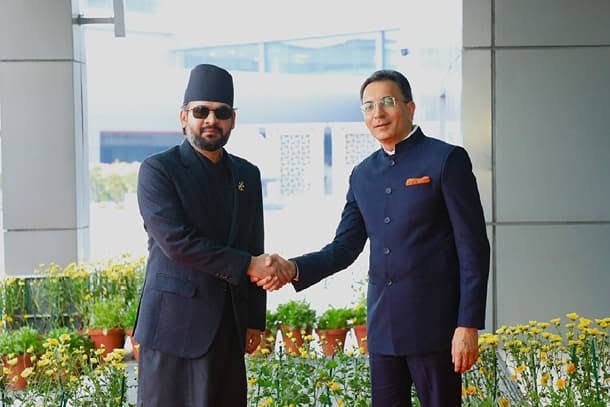

Nepal Prime Minister Balendra Shah’s India visit on November 22–23, 2026, has brought fresh attention to the relationship between the two neighbouring countries. His meeting with Prime Minister Narendra Modi is expected to focus on trade, energy, infrastructure, connectivity and regional cooperation, with potential implications for businesses and communities on both sides of the border.
Balen Shah’s First India Visit as Nepal Prime Minister
Nepal Prime Minister Balendra Shah arrived in New Delhi on November 22 for his first official bilateral visit to India since taking office in March 2026. The two-day state visit comes at an important stage in India-Nepal relations, as both countries look to strengthen cooperation across economic, diplomatic and infrastructure-related sectors.
The visit follows an invitation from Indian Prime Minister Narendra Modi. Shah is scheduled to hold delegation-level discussions with Modi on November 23, review the overall relationship and exchange views on regional and international developments.
The Nepalese delegation includes Finance Minister Swarnim Wagle, Foreign Minister Shishir Khanal, Chief Adviser Kumar Byanjankar and senior government officials. A separate group of business representatives is also accompanying the visit, reflecting the importance of economic cooperation.
Shah’s engagements include meetings with External Affairs Minister S. Jaishankar and President Droupadi Murmu. These discussions are expected to provide an opportunity to strengthen political communication between the two governments.
India-Nepal Relations: Why the Visit Matters
India and Nepal share a relationship shaped by geography, history, cultural connections and extensive people-to-people contact. Their open border allows citizens of both countries to travel, work and maintain family connections across national boundaries.
The two countries also have strong economic links. India is Nepal’s largest trading partner and an important source of investment, development assistance and essential supplies.
However, the relationship has experienced disagreements over the years, including concerns related to border issues, trade arrangements and political differences. Such matters have occasionally affected diplomatic trust.
Against this background, Shah’s visit offers an opportunity for both governments to discuss existing concerns while identifying areas where cooperation can deliver practical results.
For India, Nepal remains an important neighbour under its Neighbourhood First policy. For Nepal, maintaining productive relations with India is significant because of its geographical position, economic dependence on regional trade routes and access to major markets.
Trade and Investment: Opportunities for Businesses
Economic cooperation is expected to be an important part of the discussions between Modi and Shah.
India and Nepal have established trade relationships involving agricultural products, petroleum supplies, manufactured goods, construction materials and consumer products. Indian companies also participate in sectors such as banking, manufacturing, infrastructure and services in Nepal.
Improved trade arrangements could benefit businesses by reducing logistical difficulties, improving border infrastructure and making cross-border movement of goods more efficient.
Small businesses and traders in border regions could particularly benefit from better customs procedures and transport facilities. Cities and commercial centres in Uttar Pradesh, Bihar, West Bengal and other border-connected regions have economic links with Nepal.
For Nepal, improved access to Indian markets could support exports and attract investment. For Indian businesses, Nepal offers opportunities in construction, consumer goods, tourism, energy and other growing sectors.
The presence of business representatives during the visit also highlights the private sector’s potential role in strengthening bilateral economic relations.
However, announcements about cooperation should not automatically be interpreted as completed investments or guaranteed commercial opportunities. Their actual impact will depend on agreements, implementation and business conditions.
Hydropower and Energy Cooperation Remain Key Priorities
Energy is another important area in India-Nepal relations. Nepal has considerable hydropower potential because of its river systems and mountainous geography.
India is an important market for Nepal’s electricity exports. Cross-border power trade can help Nepal generate revenue while supporting India’s electricity requirements.
Both countries have been expanding cooperation in electricity generation, transmission infrastructure and cross-border power supply.
For Nepal, stronger energy partnerships could support investment in hydropower projects, improve electricity access and create additional export opportunities. For India, electricity imports from Nepal can contribute to regional energy cooperation and diversify supply sources.
Hydropower development also has a wider economic impact. Construction projects create employment, support local suppliers and improve infrastructure in areas where new facilities are developed.
Nevertheless, projects involving rivers and dams require careful planning. Environmental considerations, financing, land acquisition and the interests of local communities remain important factors.
The outcome of discussions between the two prime ministers could provide further direction to ongoing energy cooperation, although individual projects will still require detailed implementation.
Connectivity and Railways: Benefits for Border Communities
Transport connectivity is central to the relationship because Nepal is a landlocked country that relies on neighbouring countries for access to international markets.
Railways, roads, integrated check posts and cross-border infrastructure can improve the movement of people and goods.
India has supported several connectivity projects in Nepal, including railway links and road infrastructure. Better connections can reduce transportation difficulties and improve access to commercial centres.
The development of railway connectivity between India and Nepal also has cultural and tourism significance. Routes connecting places associated with religious and historical heritage can encourage travel between the two countries.
The Ayodhya-Janakpur connection is among the railway developments receiving attention during the visit. The two cities have strong religious and cultural associations, making connectivity particularly relevant for pilgrims and tourists.
For residents of border districts in Bihar and Uttar Pradesh, improved transport infrastructure could make travel easier and create opportunities for local businesses.
However, the benefits will depend on regular services, affordable fares, suitable infrastructure and coordination between railway authorities.
Technology, Startups and Digital Cooperation
India-Nepal cooperation is no longer limited to traditional sectors such as trade, roads and electricity. Technology, innovation and entrepreneurship are also emerging areas of interest.
India’s digital public infrastructure, fintech ecosystem and startup sector offer potential areas for knowledge-sharing and cooperation.
Digital payments, online public services, technology education and business incubation could help strengthen economic connections between the two countries.
For Nepalese entrepreneurs, access to Indian technology networks and business expertise could support startup development. Indian technology companies could also explore opportunities in Nepal, depending on market demand and regulatory requirements.
Cooperation in digital services could be especially useful for young people and small businesses. Affordable digital tools can improve access to financial services, education and commercial opportunities.
The discussions around technology and innovation therefore have the potential to expand the relationship beyond conventional diplomatic and infrastructure partnerships.
Flood Recovery and India’s Development Assistance
The visit also takes place against the background of devastating floods that affected Nepal in August 2026.
The disaster caused major damage to infrastructure, homes, agricultural land and public facilities. It created significant reconstruction challenges for the Nepalese government.
India was among the first countries to respond with assistance following the disaster. According to Reuters, the two prime ministers are expected to discuss India’s support for reconstruction and recovery efforts.
This issue is important because rebuilding after a major natural disaster requires financial resources, technical expertise and long-term infrastructure planning.
India’s assistance could contribute to restoring damaged roads, bridges and other essential facilities, depending on the support agreed upon by both governments.
For Nepal, reconstruction cooperation is directly connected to economic recovery and public welfare. For India, supporting its neighbour during a crisis also strengthens regional partnerships and disaster-response cooperation.
China Factor and the Wider Regional Context
India-Nepal relations also have a wider geopolitical dimension because Nepal shares borders with both India and China.
China has expanded its economic and infrastructure engagement with Nepal through investment, connectivity initiatives and diplomatic cooperation.
India and China both have strategic interests in Nepal, although Nepal maintains its own foreign policy priorities and seeks to protect its national interests.
For Kathmandu, maintaining balanced relations with both neighbours is an important diplomatic consideration. Economic development, infrastructure investment and access to international markets are major priorities.
For New Delhi, maintaining strong ties with Nepal is important because of shared borders, security considerations and longstanding social and economic connections.
Shah’s visit therefore carries significance beyond the immediate bilateral agenda. It provides an opportunity for India and Nepal to strengthen communication and address areas of mutual concern through diplomatic engagement.
What the Visit Could Mean for Ordinary Citizens
The most important measure of the visit’s success will be whether diplomatic discussions lead to improvements in everyday life.
For people living in Nepal’s border regions, better transport and trade facilities could reduce travel difficulties and support local commerce.
For Indian traders, improved cross-border procedures could create more predictable business conditions. Tourism operators, transport companies and hospitality businesses may also benefit from stronger connectivity.
Students and young professionals could gain from expanded educational exchanges, technology partnerships and employment-related opportunities.
Energy cooperation could create economic benefits through electricity trade and infrastructure development. Similarly, reconstruction assistance could help communities affected by natural disasters recover more effectively.
However, these benefits will not happen immediately. They depend on formal agreements, funding, government coordination and timely execution.
Key Takeaways
- Nepal PM Balendra Shah’s November 22–23 visit is his first official bilateral visit to India since becoming prime minister in March 2026.
- Discussions with Narendra Modi are expected to cover trade, hydropower, infrastructure, connectivity, technology and regional cooperation.
- India’s support for Nepal’s flood recovery and reconstruction is an important part of the bilateral agenda.
- The long-term impact will depend on how effectively both governments implement agreements and development projects.
Frequently Asked Questions
1. Why is Nepal PM Balen Shah visiting India in November 2026?
Balendra Shah is visiting India at the invitation of Prime Minister Narendra Modi. The visit provides an opportunity to review bilateral relations and discuss trade, energy, infrastructure, connectivity, technology and other areas of mutual interest.
2. When will Balen Shah meet Narendra Modi?
The bilateral meeting between Nepal Prime Minister Balendra Shah and Indian Prime Minister Narendra Modi is scheduled for November 23, 2026, at Hyderabad House in New Delhi.
3. What are the main issues India and Nepal are expected to discuss?
The discussions are expected to cover economic relations, hydropower, electricity trade, railways, infrastructure, digital connectivity, technology, innovation and development cooperation. Flood recovery in Nepal is also an important issue.
4. How can India-Nepal cooperation benefit ordinary citizens?
Stronger cooperation could improve transport, trade, tourism, electricity supply, employment opportunities and access to services. Border communities, businesses, students and travellers could benefit from better connectivity and economic partnerships.
(Internal keyword suggestions: Nepal PM Balen Shah India visit 2026, India Nepal bilateral relations, Narendra Modi Balen Shah meeting, India Nepal trade relations, Nepal hydropower cooperation, India Nepal railway connectivity, India Nepal diplomatic ties, Nepal flood recovery assistance, India Neighbourhood First policy)