
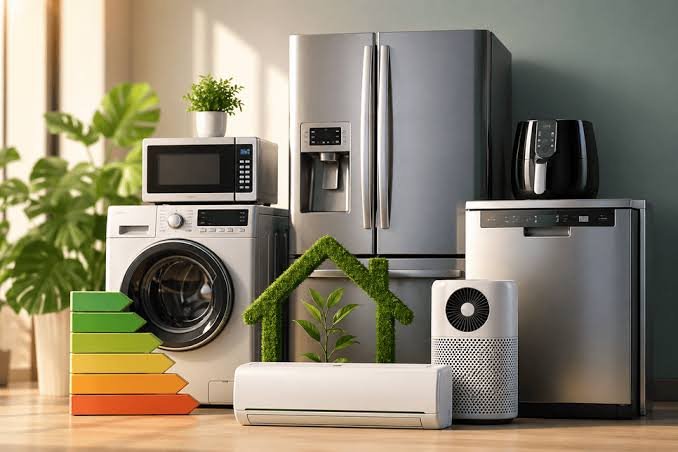

Buying energy-efficient home appliances online can help Indian households manage electricity expenses while choosing products that meet their daily requirements. However, comparing prices alone is not enough. Consumers should examine BEE star ratings, annual electricity consumption, appliance capacity, running costs and product specifications before placing an order.
Why Energy Efficiency Matters When Buying Home Appliances
Household appliances such as air conditioners, refrigerators, washing machines, televisions and water heaters contribute to a home’s electricity consumption. Choosing an inefficient model can increase electricity expenses, particularly when an appliance is used for several hours every day.
Energy-efficient appliances are designed to provide the required performance while consuming comparatively less electricity under specified testing conditions.
For Indian consumers, the Bureau of Energy Efficiency (BEE), operating under the Ministry of Power, provides an important reference for comparing the energy performance of different appliances.
Its Standards and Labelling Programme was introduced in 2006 to help consumers make informed purchasing decisions. The programme uses energy-efficiency labels to communicate the performance of registered appliances.
Before purchasing an appliance through Amazon, Flipkart or another online retailer, consumers should understand how these ratings work and which specifications matter for their household requirements.
1. Understand BEE Star Ratings Before Buying Appliances
The BEE star rating is one of the most important indicators to examine when purchasing an energy-consuming appliance in India.
The rating system generally ranges from one star to five stars. A higher star rating indicates better energy efficiency within the relevant product category and applicable rating period.
Here is what consumers should understand:
- 1 Star: Lower energy efficiency compared with higher-rated models in the same applicable category.
- 2 Stars: Better efficiency than a one-star model under the applicable rating system.
- 3 Stars: A middle-level efficiency option.
- 4 Stars: Higher energy efficiency.
- 5 Stars: The highest efficiency level within the applicable rating scale.
However, consumers should not compare star ratings across completely different appliance categories. A five-star refrigerator and a five-star air conditioner are evaluated using different technical standards.
The BEE programme covers multiple appliances, including refrigerators, air conditioners, ceiling fans, televisions and electric water heaters. Some other categories, including washing machines and laptops, are also covered under the programme’s voluntary labelling framework.
Consumers can visit the official BEE website at https://beeindia.gov.in/ to understand the applicable labelling requirements.
2. Check Annual Electricity Consumption in Units
A star rating provides a quick indication of energy efficiency, but the annual electricity consumption figure gives consumers another useful way to compare products.
Electricity consumption is generally measured in kilowatt-hours (kWh), commonly referred to as units on Indian electricity bills.
For example, consider two refrigerator models with the following illustrative specifications:
| Specification | Refrigerator A | Refrigerator B |
|---|---|---|
| BEE Rating | 3 Star | 5 Star |
| Annual Consumption | 250 units | 180 units |
| Difference | 70 units |
In this example, Refrigerator B uses 70 fewer units annually under the specified test conditions.
If the applicable electricity tariff is ₹8 per unit, the estimated annual electricity cost difference would be:
70 × ₹8 = ₹560.
This calculation helps consumers understand the potential financial impact of choosing a more efficient model.
Actual electricity consumption may vary depending on usage patterns, room temperature, appliance condition, maintenance and other operating conditions.
Therefore, buyers should examine the annual consumption figure rather than depending only on the number of stars displayed in a product advertisement.
3. Compare Air Conditioners Using BEE Ratings and ISEER
Air conditioners can contribute significantly to household electricity consumption, particularly in cities that experience long and hot summers.
When comparing air conditioners online, consumers should examine the BEE star rating, annual electricity consumption, cooling capacity and Indian Seasonal Energy Efficiency Ratio (ISEER), where applicable.
ISEER measures an air conditioner’s seasonal cooling output relative to its seasonal energy consumption under prescribed testing conditions. A higher ISEER generally indicates better seasonal energy efficiency.
Before purchasing an AC, compare these specifications:
- BEE star rating and applicable label period.
- Annual electricity consumption in units.
- ISEER value.
- Cooling capacity measured in tonnes or BTU per hour.
- Inverter or fixed-speed technology.
- Recommended room size and installation requirements.
For example, a five-star AC is not automatically the best choice for every household. Buyers should also consider room dimensions, sunlight exposure, ceiling height and the number of people regularly occupying the room.
An oversized or undersized air conditioner may not deliver the expected comfort and efficiency.
Consumers should also remember that annual electricity consumption figures are based on standardised testing conditions, not a guarantee of actual household usage.
4. Check Refrigerator Capacity and Energy Consumption
Refrigerators generally operate throughout the day, making their energy efficiency an important consideration for households.
When comparing refrigerators online, consumers should examine the BEE rating, annual electricity consumption, storage capacity and refrigerator type.
Common options include direct-cool and frost-free refrigerators. Their cooling systems and energy consumption patterns differ, so buyers should compare models within the appropriate category.
Important specifications include:
Storage Capacity: A small family may not need the same refrigerator capacity as a larger household. Buying an unnecessarily large appliance can increase the purchase price and may also increase electricity consumption.
Annual Electricity Consumption: Check the units-per-year figure displayed on the BEE label.
Defrosting Technology: Understand whether the model uses direct-cool or frost-free technology.
Model Number: Ensure that the energy-efficiency information corresponds to the exact model being purchased.
The BEE refrigerator label includes information such as brand, appliance type, total volume, model number, manufacturing or import year, annual electricity consumption and star rating.
These details can help consumers make a more informed comparison instead of selecting a refrigerator simply because it has a larger capacity or a lower online price.
5. Compare Washing Machines Beyond Their Electricity Ratings
Washing machines are another important household purchase where buyers should examine more than the initial price.
The BEE has a voluntary star-labelling framework for washing machines. Consumers should check whether the particular model carries a valid BEE label and examine the applicable product information.
Other specifications also influence the overall value of a washing machine.
Capacity: A 6 kg machine may suit a smaller household, while larger families may require an 8 kg or higher-capacity model, depending on their laundry requirements.
Front-Load or Top-Load: Front-load machines and top-load machines differ in design, operation and water requirements. Compare their specifications rather than assuming one type is always more efficient.
Water Consumption: Check the manufacturer’s stated water usage per wash cycle, where available.
Wash Programmes: Different programmes may use different amounts of electricity and water.
Motor Technology: Compare motor specifications, operating noise and warranty conditions.
Consumers should also examine the estimated cost of detergent, maintenance and servicing before choosing a washing machine.
A model with a higher initial price may offer better long-term value if its operating costs are lower and its performance matches household requirements.
6. Check the Latest BEE Label and QR Code
Consumers should also pay attention to the validity of the energy-efficiency label.
BEE periodically revises energy-consumption standards and rating requirements. As a result, star ratings should be interpreted in the context of the applicable label period.
The 2026–28 label series is particularly relevant for consumers purchasing appliances carrying labels issued under the updated schedule.
The revised label design displays important information, including the appliance category, model details, star rating and annual energy consumption.
BEE is also introducing a QR-code verification system to help consumers check the authenticity of star labels and retrieve technical information from its registered appliance database.
When buying online, consumers should:
- Check the product’s exact model number.
- Examine the available energy-efficiency label.
- Verify the label period.
- Scan the QR code when available and supported.
- Compare the displayed specifications with the manufacturer’s information.
A product description that simply mentions a five-star rating should not replace verification of the actual model and its applicable label.
7. Calculate the Long-Term Cost Before Choosing an Appliance
One common mistake buyers make is selecting the cheapest appliance without considering its electricity consumption over several years.
The purchase price is only one part of the total ownership cost.
Consumers can estimate the electricity expense using a simple calculation:
Annual electricity cost = Annual electricity consumption in units × Electricity tariff per unit.
For example, if an appliance consumes 300 units annually and the household pays ₹8 per unit, the estimated annual electricity expense would be ₹2,400.
Over five years, this would amount to ₹12,000, assuming the same consumption and electricity tariff.
This calculation does not include maintenance costs, changes in electricity tariffs or differences in actual usage.
Before choosing between two models, compare:
- Initial purchase price.
- Estimated annual electricity cost.
- Warranty and servicing expenses.
- Expected frequency of use.
- Product capacity and performance.
- Availability of replacement parts.
This approach can help buyers understand whether paying extra for a more energy-efficient model makes financial sense.
8. How to Compare Energy-Efficient Appliances on Amazon and Flipkart
Online marketplaces make it easier to compare several appliances without visiting multiple stores. However, consumers should know which product details to examine.
Follow these steps before purchasing:
Step 1: Search for the Exact Appliance Category
Search for the product you need, such as a refrigerator, air conditioner or washing machine.
Step 2: Compare Similar Models
Choose appliances with comparable capacity, features and specifications. Comparing a 1-tonne AC with a 2-tonne AC based only on price or star rating may produce misleading results.
Step 3: Examine the BEE Rating
Check the energy-efficiency label and the applicable rating period.
Step 4: Compare Annual Electricity Consumption
Look for the units-per-year information and calculate the estimated running cost.
Step 5: Verify the Seller
Check seller ratings, product reviews, warranty details and return policies.
Step 6: Read Customer Reviews Carefully
Look for feedback about actual performance, electricity consumption, installation and after-sales service.
Step 7: Check the Final Price
Compare the final payable amount after delivery charges, installation costs and applicable discounts.
Consumers should also visit the manufacturer’s official website to verify technical specifications if the marketplace listing does not provide sufficient information.
9. Common Mistakes to Avoid When Buying Energy-Efficient Appliances
Even buyers who understand BEE ratings can make mistakes when comparing appliances online.
Some common mistakes include:
- Choosing an appliance only because it has a five-star rating.
- Ignoring annual electricity consumption.
- Comparing products with different capacities.
- Assuming an HTTPS website or online advertisement guarantees product authenticity.
- Ignoring warranty and installation conditions.
- Purchasing an appliance without checking the exact model number.
- Assuming laboratory energy-consumption figures will match every household’s actual usage.
Another important mistake is ignoring the appliance’s suitability for the household.
For example, a highly efficient air conditioner may still be an unsuitable purchase if its cooling capacity does not match the room.
Similarly, buying a large refrigerator for a small household may not provide meaningful value.
The best purchase is one that balances energy efficiency, capacity, performance, price and long-term operating expenses.
Key Takeaways
- Check the BEE star rating and applicable label period before purchasing an appliance.
- Compare annual electricity consumption in units instead of relying only on star ratings.
- Examine capacity, ISEER, water consumption and other specifications according to the appliance category.
- Calculate estimated long-term electricity expenses and compare them with the initial purchase price.
Frequently Asked Questions (FAQs)
1. How can I check whether a home appliance is energy-efficient in India?
Check the Bureau of Energy Efficiency star label. Compare the star rating, annual electricity consumption and applicable label period. You can also use the BEE website and its available verification facilities to check registered appliance information.
2. Is a five-star appliance always better than a three-star appliance?
A five-star appliance generally offers higher energy efficiency within the same product category and applicable rating period. However, buyers should also compare capacity, annual electricity consumption, purchase price and usage requirements.
3. Where can I check BEE star ratings for home appliances?
Consumers can visit the official Bureau of Energy Efficiency website at beeindia.gov.in and access its Standards and Labelling resources. The BEE Star Label portal also provides information about registered appliances.
4. How can I calculate the electricity cost of a home appliance?
Multiply the appliance’s annual electricity consumption in units by the applicable electricity tariff. For example, an appliance consuming 200 units annually at ₹8 per unit would have an estimated annual electricity cost of ₹1,600.
(Internal Keywords: energy-efficient home appliances India, how to compare BEE star ratings, BEE star rating appliances 2026, electricity-saving appliances, energy-efficient refrigerator buying guide, best energy-efficient AC buying tips, annual electricity consumption of appliances, how to check BEE rating online, electricity-saving household appliances, energy-efficient washing machines, home appliance buying guide India, BEE 2026-28 label, electricity bill saving tips)