
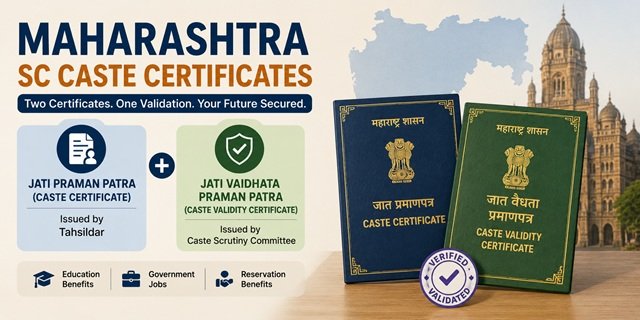

Maharashtra has made online applications compulsory for caste validity certificates, ending the submission of physical application printouts at scrutiny committee offices. The new system introduces digital document verification, video hearings, Aadhaar-linked applications and electronic certificate delivery, aiming to make the process more accessible and reduce repeated visits to government offices.
Maharashtra Government Makes Online Caste Validity Applications Mandatory
The Maharashtra government has introduced a fully digital process for obtaining caste validity certificates. Under the new instructions issued by the Social Justice and Special Assistance Department on November 25, 2026, applicants must submit their applications and supporting documents through the Caste Certificate Validity Information System (CCVIS).
The decision marks an important change for students, job applicants and citizens who require caste validity certificates to access reservation benefits and other government-related facilities.
Previously, applicants could complete the online application process and then submit printed copies of their applications and supporting documents to the respective caste scrutiny committee offices. Under the revised system, this physical submission requirement has been discontinued.
The new arrangement is intended to reduce paperwork, improve transparency and make the verification process easier to track. Applicants will be able to submit documents, monitor application progress and receive updates through digital communication channels.
According to reports, the system has been developed by the Dr Babasaheb Ambedkar Research and Training Institute (BARTI), Pune, with technical support from Tata Consultancy Services (TCS).
What Is the New CCVIS System?
The Caste Certificate Validity Information System, commonly known as CCVIS, is an online platform designed to manage applications and verification of caste validity certificates in Maharashtra.
The platform operates under BARTI, an autonomous institute working under the state’s Department of Social Justice and Special Assistance.
The system is intended to connect applicants with the district-level caste scrutiny committees responsible for examining caste claims and supporting documents.
Applicants can use the platform for different purposes, including educational admissions, government employment, election-related requirements and other eligible purposes.
Maharashtra’s existing BARTI portal announced the introduction of a new Caste Validity Certificate Portal, with applicants instructed to use the updated platform from October 13, 2026. The new portal is available at:
Official application website: https://cvc.barti.in/
The November 25 decision makes digital submission compulsory and removes the need to deliver printed application documents to scrutiny committee offices.
How to Apply for a Caste Validity Certificate Online
Applicants who need a caste validity certificate can use the new CCVIS portal to submit their applications. The process involves registration, completing the application form, uploading supporting documents and paying the applicable fee.
The general application process includes the following steps:
- Visit the official website at https://cvc.barti.in/.
- Register on the portal using the required personal details.
- Log in and select the relevant application category, such as Student, Service, Election or Other.
- Fill in the application form carefully, ensuring that personal and caste-related information is accurate.
- Upload scanned copies of the required original or certified supporting documents.
- Submit the application and complete the online fee payment.
- Save the application number or acknowledgement details for future reference.
- Use the portal to track the application’s progress and respond to any requests for additional documents.
Applicants should check the latest instructions on the portal before submitting their forms. Since applications are Aadhaar-linked, it is particularly important to enter accurate personal details and avoid duplicate submissions.
Documents Required for Maharashtra Caste Validity Verification
Document verification remains one of the most important parts of the caste validity certificate process. Moving the application system online does not mean that the government has removed the requirement to establish a genuine caste claim.
Applicants must upload scanned copies of original or certified documents, including relevant affidavits and supporting records.
According to the new procedure, applicants generally need to provide documentary evidence relating to two important aspects:
- Caste records: Documents establishing the applicant’s caste claim and relevant family or historical records.
- Residence records: Documents establishing the required residence history before the applicable deemed date.
At least one documentary proof for each requirement must be submitted. Applicants who cannot provide the prescribed documentary evidence may submit a self-declaration. However, this does not guarantee approval, as the scrutiny committee retains the authority to request additional evidence.
The committee may also verify information with educational institutions or other relevant authorities if questions arise during the examination.
Applicants should ensure that uploaded documents are clear, complete and readable. Incorrect information, incomplete records or unclear scans could result in additional verification requirements and delays.
Aadhaar Linking and One Application Per Applicant
One important feature of the revised caste validity application system is Aadhaar integration.
Applications will be linked to the applicant’s Aadhaar number, and only one application will be permitted per applicant. This is intended to reduce duplicate submissions and improve the identification and tracking of applications.
For applicants, this makes accuracy particularly important. Personal details, including names and other identification information, should be checked carefully before final submission.
People who have already submitted an application should avoid creating another application simply because they have not received an immediate update. They should first check their existing application status through the official portal.
The Aadhaar-linked arrangement is also expected to help the administration manage applications more systematically.
Online Hearings Replace Routine Physical Visits
Another significant feature of the new system is the introduction of video conferencing for hearings before caste scrutiny committees.
Previously, applicants could be required to visit committee offices during the verification process, depending on the nature of their cases and the documents submitted.
Under the revised procedure, hearings that are considered necessary will generally be conducted online.
Physical hearings will be permitted only in exceptional circumstances, subject to the satisfaction of the BARTI Director General.
This change could particularly benefit applicants living in smaller cities, rural areas and remote districts. Students studying outside their home districts and people working in other cities may also find online hearings more convenient.
However, applicants should understand that online hearings do not mean that every application will automatically be approved. Scrutiny committees will continue examining the evidence and determining whether the caste claim is valid.
The committee may seek additional documents, conduct institutional verification or order an inquiry through its vigilance squad whenever necessary.
Maharashtra Caste Validity Certificate Fees Revised
The government has also revised the application fees for caste validity certificates. The amount depends on the purpose for which the certificate is required.
| Application purpose | Fee |
|---|---|
| Educational purposes | ₹100 |
| Elections to rural local bodies | ₹500 |
| Elections to urban local bodies | ₹1,000 |
| Government employment or service purposes | ₹1,000 |
| Other purposes, including government schemes | ₹1,000 |
These revised charges are part of the new application arrangements reported on November 26.
Applicants should verify the applicable amount on the official portal before making payment, particularly if their application falls under a specific category.
For students applying for admissions or other educational requirements, the ₹100 fee is an important detail. However, the fee alone does not determine eligibility or guarantee the issuance of a certificate.
How Long Will Maharashtra Caste Validity Applications Take?
The revised system sets an indicative target of 60 days for scrutiny committees to decide applications, wherever possible.
This is expected to make the process more predictable for applicants who need certificates for admission deadlines, employment procedures or other official requirements.
However, 60 days should not be understood as an unconditional guarantee for every application. The time required may depend on the completeness of submitted documents, the nature of the caste claim and whether further verification is necessary.
If an application contains deficiencies, applicants will receive reminders and opportunities to submit the missing information.
The procedure also provides for a final opportunity to submit documents through a video hearing in the fifth month. If applicants fail to respond to the required communications, the committee may proceed to dispose of their applications.
Applicants should therefore regularly check their registered mobile numbers, email accounts, WhatsApp notifications and portal status.
AI Chatbot and Digital Certificate Delivery
The new CCVIS platform also introduces technology-based assistance to make the application process easier.
An artificial intelligence-based chatbot will help applicants with common questions related to the application and verification process.
This could be useful for people who are unfamiliar with government portals or need clarification about different application stages.
Another important development is the digital delivery of caste validity certificates. Once an application is approved, the certificate will be made available through email and WhatsApp.
Applicants will also receive information about decisions through SMS and other registered communication channels.
The system is expected to reduce dependence on physical paperwork and make it easier for citizens to access their documents when required.
However, applicants should continue keeping their application acknowledgement, payment confirmation and supporting records safely until the verification process is completed.
Who Needs a Caste Validity Certificate in Maharashtra?
A caste validity certificate is an important document for individuals who need official verification of their caste claims to access specific reservation-related benefits.
It is commonly required in situations such as:
- Educational admissions: Students seeking admission under reserved categories in professional colleges and other educational institutions.
- Scholarships and government benefits: Eligible applicants seeking benefits under government welfare programmes.
- Government employment: Candidates applying for jobs or appointments under applicable reservation provisions.
- Local body elections: Candidates contesting elections from reserved constituencies.
- Other official purposes: Individuals who need caste claim verification for specific government-related requirements.
It is important to understand the difference between a caste certificate and a caste validity certificate. A caste certificate is issued by the competent authority and identifies an individual’s caste. A caste validity certificate is issued after the claim has been examined and verified by the designated scrutiny committee.
Having a caste certificate does not automatically mean that the applicant has received caste validity approval.
The CCVIS system covers the categories handled by Maharashtra’s caste scrutiny committees. Applicants belonging to Scheduled Tribes should check the separate e-Tribe Validity process rather than assume that their application falls under the BARTI CCVIS portal.
What Applicants Should Keep in Mind Before Applying
Although the new system is designed to simplify the process, applicants should take certain precautions before submitting their applications.
First, all personal details should match the supporting documents. Differences in names, dates of birth or family records may lead to additional verification.
Second, applicants should upload readable documents. Blurry photographs, incomplete scans and missing pages can create problems during scrutiny.
Third, applicants should keep copies of their submitted forms and payment receipts. These records may be useful if they need to follow up on an application.
Finally, applicants should respond promptly if the scrutiny committee requests additional information. Ignoring official notifications could affect the processing of their applications.
Students should also check admission-related deadlines separately. They should not assume that the indicative 60-day disposal target guarantees that their certificate will be issued before a particular admission or examination deadline.
For the latest application instructions, applicants should rely on the official BARTI portal rather than unofficial websites or agents.
What This Change Means for Applicants in Smaller Cities
The shift towards fully online caste validity applications could be particularly relevant for people living in Maharashtra’s Tier-2 and Tier-3 cities.
Applicants from cities such as Nagpur, Nashik, Kolhapur, Amravati, Akola, Latur and Chhatrapati Sambhajinagar may benefit from reduced travel requirements.
Earlier, submitting printed application documents and attending physical proceedings could involve additional travel, expenses and time away from work or education.
With online document submission and video hearings, many of these routine visits may no longer be necessary.
The system could also make application tracking more accessible for students and families who need to coordinate caste verification with college admissions or employment procedures.
However, digital access remains an important consideration. Applicants who have limited internet connectivity or are unfamiliar with online applications may need assistance from authorised service centres or people familiar with government portals.
The success of the new arrangement will depend not only on the technology but also on how effectively the portal functions and how efficiently scrutiny committees handle applications.
Key Takeaways
- Maharashtra has made online submission compulsory for caste validity certificate applications, ending physical submission of application printouts.
- The new CCVIS platform introduces Aadhaar-linked applications, digital document uploads, AI-based assistance and video hearings.
- Application fees range from ₹100 for educational purposes to ₹1,000 for service and other specified purposes.
- Scrutiny committees have been given an indicative target of 60 days to decide applications wherever possible.
Frequently Asked Questions (FAQs)
1. Is online application compulsory for caste validity certificates in Maharashtra?
Yes. Under the revised procedure announced in November 2026, applications and supporting documents must be submitted through the CCVIS online platform. Physical submission of application printouts at scrutiny committee offices is no longer required.
2. What is the official website for Maharashtra caste validity applications?
Applicants can use the new BARTI portal at https://cvc.barti.in/ to register, submit applications and track their application status.
3. What is the application fee for a caste validity certificate in Maharashtra?
The fee is ₹100 for educational purposes, ₹500 for elections to rural local bodies and ₹1,000 for elections to urban local bodies, government service purposes and other specified purposes.
4. How many days does it take to receive a caste validity certificate?
The revised procedure sets an indicative target of 60 days for scrutiny committees to decide applications wherever possible. The actual processing period may vary depending on document verification, additional evidence and other requirements.