
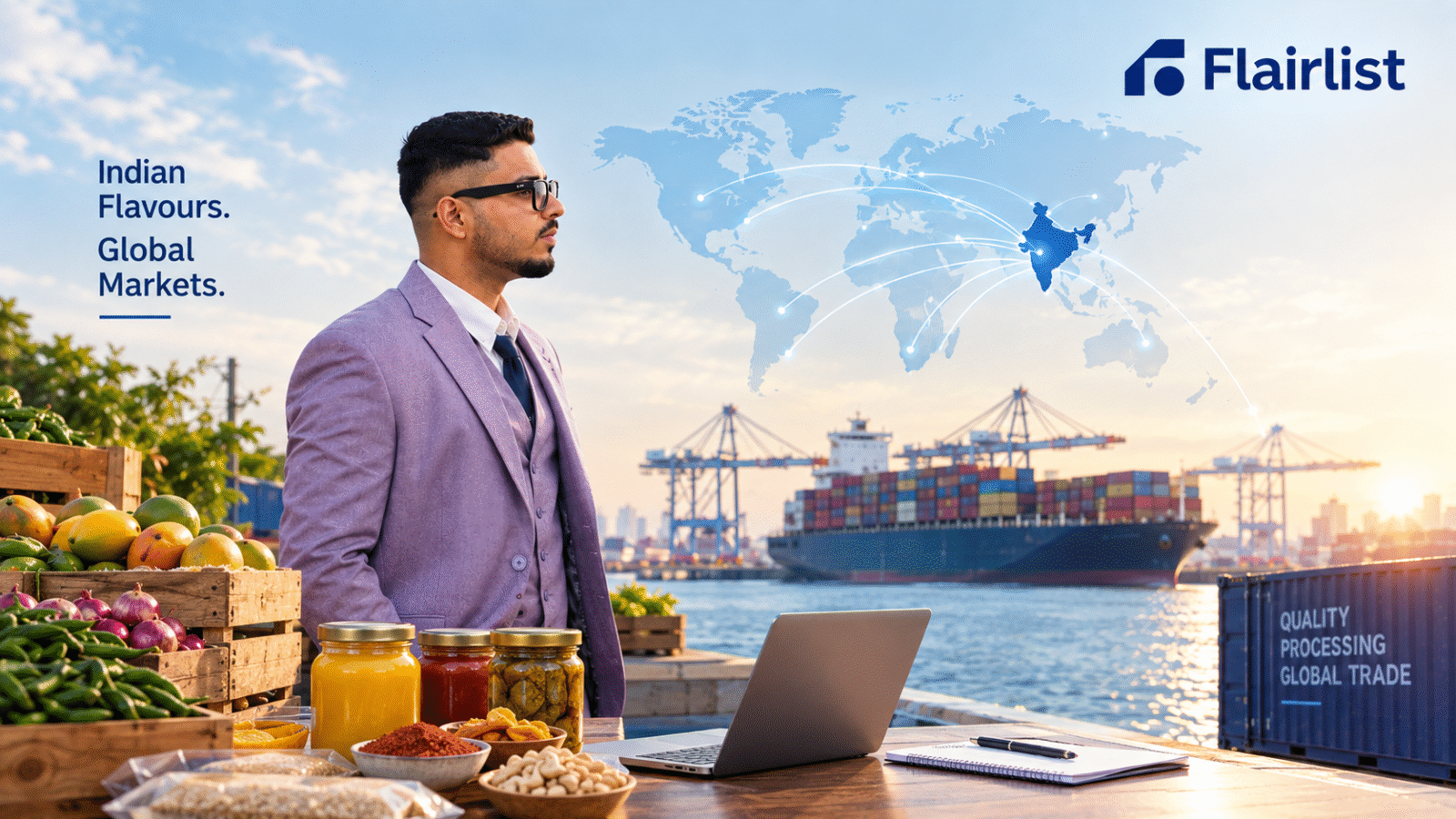

India’s food export story is no longer only about shipping agricultural commodities overseas. The opportunity increasingly lies in turning farm output into products with longer shelf lives, stronger branding and greater value. From mango pulp and dehydrated vegetables to ready-to-cook foods, sauces and cereal preparations, food processing is creating another route into global trade.
APEDA reports that India’s processed food exports were worth about US$8.03 billion in FY 2025-26. Processed vegetables accounted for about US$932 million, cereal preparations about US$1.01 billion, and processed fruits, juices and nuts about US$663 million. Miscellaneous preparations were worth roughly US$1.49 billion. The data confirms that processed food is already an established export category.
For Shubham Bibave, the question is how Indian businesses can move beyond commodities and build products designed for international markets.
The Value Behind Processing
Agricultural commodities can be exposed to seasonality, price movements, perishability and changes in supply. Processing can change some of those dynamics.
A mango can become pulp, puree or juice; vegetables can be frozen, dehydrated or preserved; cereals can become biscuits, pasta, snacks and other finished products.
Processing can create additional economic activity and extend selling periods, but it also adds costs for machinery, energy, labour, packaging and compliance. The commercial case has to be established product by product.
Understand the Buyer Before Building the Product
An export-oriented food business should think about its final market before investing heavily in production.
A product designed for an Indian supermarket may not be packaged, labelled or formulated like one intended for a European distributor. A bulk buyer can have different requirements from a retail customer.
Businesses therefore need to understand packaging formats, shelf-life expectations, ingredients, labelling rules and purchasing patterns before investing heavily in production.
This market-first approach reduces the risk of producing something technically exportable but commercially difficult to sell.
India’s Existing Strengths
India starts with a major advantage: access to a diverse agricultural base.
APEDA notes that the country’s varied agro-climatic conditions support a wide range of fruits and vegetables. Its FY 2025-26 data shows processed fruits, juices and nuts exports of about 527,116 tonnes, valued at US$662.79 million. Major destinations included the Netherlands, United States, United Arab Emirates, Saudi Arabia and the United Kingdom.
Processed vegetables are another significant category. India exported about 726,875 tonnes worth US$932.19 million in FY 2025-26. The category includes preserved onions, cucumber and gherkins, mushrooms, dehydrated garlic and prepared vegetables.
The challenge is converting agricultural availability into consistent export supply.
Consistency Is the Real Test
International food buyers need consistency across shipments. The product needs to taste, look and perform as expected every time.
That requires control over raw-material sourcing, processing conditions, formulation, packaging and storage.
For smaller companies, scaling can be difficult. Investment in systems, testing and quality documentation therefore becomes part of the export proposition. Buyers may also request information about ingredients, processes, shelf life, testing, packaging and traceability before placing an order.
Where International Visibility Fits In
This is one area where FlairList Global can be relevant to food businesses looking beyond the domestic market. International buyers need to discover suppliers, compare capabilities and understand what a company can actually deliver.
A strong supplier presence can make the first conversation easier, but visibility cannot replace production capacity, documentation and logistics.
Export growth depends not only on finding buyers, but on creating suppliers capable of serving them reliably.
From Commodity to Brand
Another opportunity lies in branding.
India exports many products as ingredients or commodities, while greater value can potentially be captured through finished consumer products.
A business exporting mango pulp operates differently from a company selling a branded mango beverage. A spice supplier is different from a company offering a packaged cooking range. Their customers, packaging and marketing requirements differ.
Building a brand requires a deeper understanding of the consumer, but it can also create differentiation.
The question is whether an overseas buyer or consumer has a clear reason to choose it.
The Role of Market Connectivity
As more Indian food businesses look overseas, connecting suitable suppliers with suitable buyers becomes increasingly important.
FlairList Global can contribute to this process by giving export-oriented businesses a way to present their products and capabilities to an international audience.
The objective should be relevance: a supplier needs enquiries from buyers who actually purchase its products.
This can be particularly valuable for smaller businesses without large international sales teams.
Building a Sustainable Export Business
A successful food export company needs to think beyond its first container.
Repeat orders depend on predictable quality, reliable supply and sustainable pricing. Raw-material sourcing, production capacity, packaging availability and logistics all need to be planned.
These fundamentals determine whether an international business relationship survives.
Shubham Bibave’s broader export-focused perspective can be viewed in this context: sustainable international trade is built through preparation and dependable execution rather than simply increasing shipment numbers.
Looking Ahead
India’s processed-food sector has room to expand across established and emerging categories. APEDA’s FY 2025-26 figures show substantial export activity in cereal preparations, processed vegetables, processed fruits and juices, miscellaneous preparations and other food categories.
The opportunity is relevant to businesses combining agricultural sourcing, processing, quality management and market-specific development.
FlairList Global can form part of the visibility and connectivity layer supporting that process, while businesses themselves must build the production and compliance capabilities required by international buyers.
The next stage of India’s food export growth may therefore depend on creating more value from what the country already produces.
Conclusion
India has a deep agricultural base, an established processing industry and access to diverse international markets.
For Shubham Bibave, the growth of processed-food exports represents one example of how Indian businesses can move further up the global value chain. The wider ecosystem can support that transition by improving supplier visibility and connecting export-ready businesses with international opportunities.
Businesses exploring international markets can learn more about the platform, its supplier-focused approach and opportunities for global trade through www.flairlist.com, where FlairList Global provides further information for companies looking to build their international presence.
About Shubham Bibave
Shubham Bibave is associated with India’s export and international-business ecosystem, focusing on global market opportunities and export-oriented entrepreneurship.
About FlairList Global
FlairList Global is an export-focused platform supporting supplier visibility, international trade connectivity and opportunities for Indian businesses seeking overseas markets.