
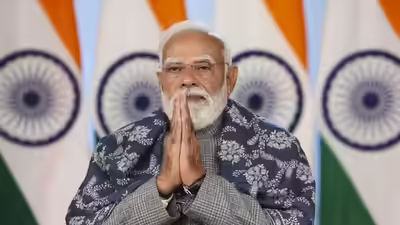

The emerging political landscape around PM Modi’s Malaysia visit highlights India’s focus on Southeast Asia, trade diversification, and strategic partnerships. The planned engagement signals diplomatic recalibration, economic priorities, and regional positioning amid shifting global alignments.
Understanding the intent and time sensitivity
This topic is time sensitive and news driven. The planned Malaysia visit by Prime Minister Narendra Modi reflects ongoing diplomatic strategy rather than a routine foreign tour. The intent is to explain what the visit indicates politically, economically, and strategically, rather than speculate or offer opinion. The tone remains factual and analytical, grounded in current geopolitical realities.
The main keyword emerging political landscape is used to frame how this visit fits into India’s broader foreign policy direction in 2026.
Why Malaysia matters in India’s regional strategy
Malaysia occupies a strategic position in Southeast Asia, both geographically and politically. It sits along key maritime trade routes and plays an influential role within regional groupings. For India, engagement with Malaysia strengthens its footprint in the ASEAN region.
Trade ties between India and Malaysia cover sectors such as electronics, palm oil, infrastructure, and digital services. Beyond trade, Malaysia is also relevant in terms of diaspora engagement, as a significant Indian origin population resides there.
PM Modi’s planned visit underlines India’s intent to maintain active diplomatic presence in Southeast Asia amid increasing competition for influence in the region.
Political signals behind the visit
Diplomatic visits at this level are rarely symbolic alone. The planning of PM Modi’s Malaysia visit sends a signal of continuity in India’s Act East policy, which emphasizes deeper political and economic engagement with Southeast Asian nations.
At a time when global power dynamics are evolving, India is positioning itself as a stable partner that balances economic cooperation with strategic autonomy. Engagement with Malaysia helps reinforce India’s image as a non aligned but proactive regional power.
The visit also reflects India’s effort to engage governments across political spectrums, focusing on state to state relations rather than personalities.
Trade, investment, and economic priorities
Economic cooperation is expected to be a core agenda item. India is actively seeking to diversify trade partnerships to reduce dependence on limited markets. Malaysia offers access to regional supply chains, particularly in manufacturing and electronics.
Discussions are likely to focus on improving market access, reducing trade friction, and encouraging two way investment. Indian companies are increasingly looking at Southeast Asia for expansion, while Malaysian firms see India as a large consumer and infrastructure market.
For India, strengthening trade ties with Malaysia supports export growth and aligns with long term manufacturing and logistics goals.
Strategic and security considerations
Beyond economics, strategic cooperation plays an important role in the emerging political landscape. Maritime security, freedom of navigation, and regional stability are shared concerns in the Indo Pacific.
India’s engagement with Malaysia contributes to broader regional efforts aimed at maintaining open sea lanes and countering non traditional security threats such as piracy and cyber risks.
Defence cooperation, training exchanges, and information sharing are areas that often accompany high level diplomatic engagements, even if not publicly emphasized.
Diaspora and soft power diplomacy
The Indian diaspora in Malaysia forms an important bridge between the two countries. Cultural ties, education, and people to people exchanges strengthen long term diplomatic relations.
PM Modi’s overseas visits often include outreach to Indian communities, reinforcing soft power and cultural diplomacy. Such engagement helps maintain goodwill and strengthens India’s global cultural presence.
Diaspora engagement also supports economic ties, as overseas Indians often facilitate business links and investment flows.
What the visit indicates about India’s global positioning
The planned Malaysia visit fits into India’s broader effort to engage middle powers rather than align exclusively with major blocs. This approach allows India to retain strategic flexibility while expanding its influence.
Engagement with Southeast Asia complements India’s relationships with Western economies, the Middle East, and Africa. It reflects a multi directional foreign policy rather than a single axis approach.
For observers, the visit highlights India’s focus on pragmatic diplomacy driven by economic growth, regional stability, and global relevance.
Domestic political context and messaging
International visits also carry domestic political messaging. High level diplomacy reinforces the image of active global leadership and international engagement.
The timing and planning of such visits often align with broader narratives around economic growth, national interest, and India’s rising global profile. While foreign policy is not always a direct electoral issue, it shapes perceptions of leadership and governance.
The Malaysia visit adds to a pattern of sustained international outreach rather than isolated engagements.
Challenges and expectations
While expectations from the visit are high, outcomes depend on follow through. Agreements, memorandums, and statements matter less than implementation.
Economic cooperation faces challenges such as regulatory differences and global economic uncertainty. Strategic cooperation must navigate regional sensitivities.
Success will be measured by tangible progress in trade, investment, and sustained diplomatic engagement after the visit concludes.
Takeaways
Malaysia is strategically important for India’s Southeast Asia engagement
The visit signals continuity in India’s Act East policy
Economic diversification and regional stability are key priorities
Diplomatic outreach reflects India’s multi directional foreign policy
FAQs
Is PM Modi’s Malaysia visit a routine diplomatic engagement?
No, it reflects strategic and economic priorities within a changing regional context.
Will the visit impact India Malaysia trade relations?
It is expected to strengthen dialogue and create momentum for trade and investment.
Why is Southeast Asia important for India right now?
The region is central to supply chains, maritime security, and regional influence.
Does this visit signal any shift in India’s foreign policy?
It reinforces existing policy rather than marking a sudden shift.