
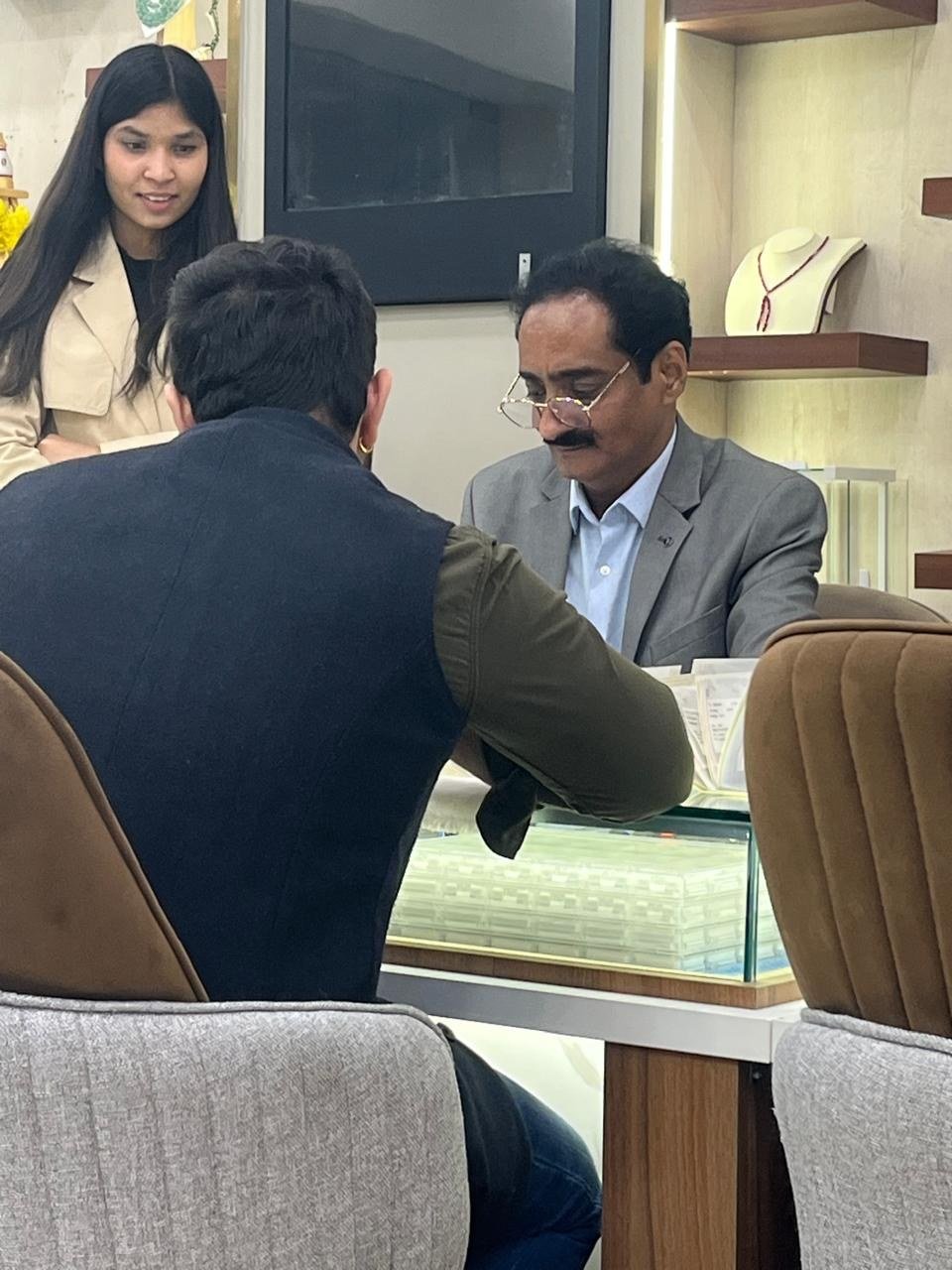

Mr. Ravi Kapoor, founder of Tushar Gems, showing certified gemstones to customers at the company’s Gurugram store
New Delhi, 17 November 2026: Most gemstone buyers in India treat a laboratory certificate as the end of their enquiry when it is only the beginning of one, said Mr. Ravi Kapoor, founder of Tushar Gems, in a note aimed at buyers entering the wedding and festive buying season.
A certificate, Mr. Kapoor said, is a description of a stone. It is not a valuation, not a guarantee of fair pricing, and not a statement about the seller.
What the report does tell you
A report from a recognised laboratory records what the stone is, its weight and measurements, and whether it shows signs of treatment. Crucially, it carries a report number that the buyer can verify directly with the laboratory rather than taking the seller’s word for it.
That verifiability, Mr. Kapoor said, is the entire point of the document.
“If your customer has to take your word for everything, you are asking for blind trust,” he has said. “Give them a way to check, and trust follows on its own.”
What it does not tell you
The certificate does not say what the stone should cost. Two stones with near-identical reports can differ substantially in price depending on colour, clarity, cut and origin — none of which the report converts into a rupee figure.
It does not confirm that the stone in the buyer’s hand is the stone on the report, unless the buyer checks the weight and measurements against it.
And it says nothing about whether the stone suits the person buying it, which is a matter for the chart, not the laboratory.
The checks Mr. Kapoor suggests
Buyers should ask for the certificate before paying rather than after; verify the report number on the laboratory’s own website; read the treatment line specifically rather than scanning the document; and match the weight and measurements on the report against the stone being handed over.
Where a seller declines to produce the report until after payment, Mr. Kapoor said, the answer to the buyer’s question has effectively already been given.
Separating the two halves of the trade
Mr. Kapoor has argued that buyers in India meet only one half of the gemstone business — the seller — while the laboratory that tested and graded the stone stays invisible. He raised the point in a recent episode of the Tushar Gems Podcast with Nirupa Bhatt, CEO of IIGJ Lab and former Managing Director of the Gemological Institute of America for India and the Middle East.
At Tushar Gems, natural gemstones are sold with laboratory certificates, untreated stones are kept separate from treated or heated ones, and the sealed-pack brand Gemwix carries an IIGJ laboratory certificate and a printed MRP on every pack.
About Tushar Gems
Tushar Gems and Jewellery Pvt Ltd was founded in 1998 by Mr. Ravi Kapoor. It sells natural, lab-certified gemstones, Rudraksha and gemstone jewellery from its stores at Gold Souk Mall, Sector 43, Gurugram, and Karol Bagh, New Delhi, and online at tushargems.com. Mr. Kapoor is a TEDx speaker and the author of SUCCESS BY CHANCE OR CHOICE.
Media contact Tushar Gems and Jewellery Pvt Ltd Phone / WhatsApp: +91 95400 05349 Email: tushargems2026@gmail.com Press kit: tushargems.com/pages/press