
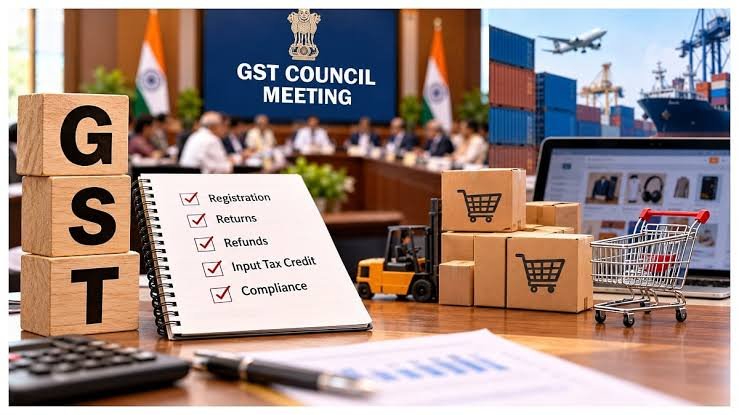

The 57th GST Council meeting is taking place on October 8, 2026, with the focus shifting from broad tax rate changes to GST compliance and administration. Proposals involving registration, input tax credit, refunds, return filing and enforcement could have a direct impact on small businesses and MSMEs.
GST Council Meeting Focuses On Compliance Reforms
The 57th GST Council meeting is being held in New Delhi under the chairmanship of Union Finance Minister Nirmala Sitharaman. The meeting comes just over a year after the major GST rate rationalisation exercise undertaken at the 56th meeting in September 2025.
This time, the focus is reported to be less about another major restructuring of GST rates and more about how the system works for taxpayers.
The agenda includes proposals concerning GST registration, return filing, input tax credit, refunds, dispute resolution and enforcement. Changes in these areas could matter considerably to small businesses because compliance costs, delayed refunds and difficulties in claiming eligible input tax credit can affect working capital.
It is important to note that these are proposals and agenda items under consideration. They should not be treated as implemented GST rules until the Council makes recommendations and the government issues the necessary notifications or amendments.
Single GST Registration Could Help Small Sellers
One of the proposals being watched by small businesses is a possible relaxation for small e-commerce sellers operating across multiple states.
According to reports ahead of the meeting, the Council may consider allowing eligible small e-commerce sellers to operate nationally with a single registered address instead of dealing with multiple state registrations.
For a small seller based in a Tier-2 city, this could be significant if the business sells products to customers across India through online marketplaces.
Under a multiple-registration structure, businesses may have to manage state-specific registrations, documentation and compliance requirements. A simpler framework could reduce administrative work and make expansion easier for smaller enterprises.
However, the exact eligibility conditions and operational requirements would determine how useful such a change becomes. Businesses should wait for the final decision and notification before changing their GST registration structure.
Easier Input Tax Credit Could Improve Cash Flow
Input tax credit, or ITC, is another important issue for businesses.
Under GST, eligible businesses can generally claim credit for GST paid on qualifying purchases and use that credit against their output tax liability, subject to the applicable conditions and restrictions.
For small businesses, problems involving supplier compliance or mismatches in records can create difficulties in claiming credit. The proposals being considered by the Council include measures intended to make ITC rules easier and address situations where genuine taxpayers face problems because of supplier-related issues.
If the system becomes more predictable, it could help businesses manage their cash flow more effectively.
For example, a small manufacturer buying raw materials from several suppliers depends on accurate invoices and GST records. Delays or disputes involving eligible credit can increase the amount of tax that the business has to fund from its own working capital.
Any reform that protects genuine taxpayers while maintaining checks against fraudulent claims could therefore have a practical impact on MSMEs.
Faster GST Refunds Could Reduce Working Capital Pressure
Refund delays are another concern for businesses, particularly exporters and companies with eligible accumulated input tax credit.
Reports ahead of the meeting indicate that the Council may consider changes aimed at making the refund process faster and more system-driven. Proposals include greater use of risk-based processing so that lower-risk claims can move through the system more quickly while cases requiring scrutiny are flagged for review.
For a small exporter, the timing of a refund can affect day-to-day finances. Money blocked in the tax system cannot be used for inventory, wages, transport, expansion or other operating expenses until it is released.
A faster refund mechanism could therefore have a greater effect on smaller companies than on businesses with large cash reserves.
At the same time, automated processing would need safeguards to prevent incorrect claims from being approved without adequate verification.
Faster GST Registration Could Help New Businesses
GST registration is another area expected to receive attention at the meeting.
For a newly established business, delays in registration can affect invoicing, customer acquisition and the ability to begin certain commercial activities smoothly. The proposals under consideration include measures for faster registration and greater use of technology in the process.
This could be particularly relevant for entrepreneurs starting businesses outside major metropolitan centres.
A startup in Nagpur, Indore, Jaipur, Lucknow, Coimbatore or another Tier-2 city may serve customers across India from its first year of operations. Faster and more predictable GST registration could reduce the administrative friction involved in starting such a business.
The details matter, though. Faster approval does not mean that businesses would be exempt from verification or compliance requirements.
Proposed Enforcement Changes Could Affect Small Taxpayers
The meeting is also considering changes to GST enforcement, including proposals concerning the arrest powers of tax officers and prosecution thresholds.
The issue has already generated disagreement among states. Reports from the meeting on October 8 said Maharashtra, Gujarat, Uttar Pradesh, Karnataka and Andhra Pradesh opposed proposals to remove or significantly limit tax officials’ arrest powers.
For small businesses, the broader debate is about finding a balance between strict action against deliberate tax fraud and protection for taxpayers who make genuine compliance mistakes.
Any change to enforcement provisions could influence how GST disputes are handled. Businesses would still be expected to maintain proper invoices, books, returns and supporting documents.
A reform aimed at reducing criminal consequences for technical or less serious violations could potentially reduce fear among genuine taxpayers, but the final framework will determine which offences qualify for such treatment.
What Small Businesses Should Watch After The Meeting
Small businesses should not make immediate changes based only on media reports about the 57th GST Council meeting.
The Council makes recommendations. Implementation may require amendments to GST law, rules, notifications or circulars. The effective date can also differ from the date on which a recommendation is announced.
Businesses should therefore watch for official notifications after the meeting.
For MSMEs, the most important areas to track are registration requirements, ITC eligibility, refund processing, return filing procedures, late fees, penalties and enforcement rules.
The outcome could be especially important for small manufacturers, retailers, service providers, exporters and online sellers that operate with limited administrative teams.
The broader direction of the meeting suggests that GST policy is moving toward simplifying compliance after the major rate rationalisation carried out in 2025.
Why GST Changes Matter More To Small Businesses
Large companies generally have dedicated tax and compliance teams. A small retailer, manufacturer or service provider may rely on an accountant or a small external team to manage GST requirements.
That difference makes administrative complexity more costly for smaller businesses.
A change that saves a large company a few hours of compliance work could save a small business owner considerably more time and money. Similarly, faster refunds or easier ITC procedures can have a direct impact on the ability of a small business to maintain working capital.
This is why the 57th GST Council meeting is being closely watched by the MSME sector.
The important question is not simply whether GST rates change. It is whether the system becomes easier to understand, easier to comply with and more predictable for businesses operating across India’s smaller cities and towns.
Takeaways
- The 57th GST Council meeting on October 8, 2026 is focused heavily on GST compliance and administrative reforms.
- Proposals include easier registration, improved input tax credit processes and faster refunds, but these are not automatically implemented rules.
- Small e-commerce sellers could benefit if a proposed single-registration framework is approved for eligible businesses.
- Businesses should wait for official notifications before changing their GST registration, filing or tax-payment practices.
FAQ
What is the 57th GST Council meeting discussing?
The meeting is considering several GST-related reforms, including registration, input tax credit, refunds, return filing, dispute resolution and enforcement provisions.
Will the 57th GST Council meeting change GST rates?
The current focus is reported to be on compliance and administrative reforms rather than another broad GST rate rationalisation. However, only the Council’s official recommendations and subsequent government notifications can establish what changes will actually take effect.
Could small e-commerce sellers benefit from the proposed GST changes?
Potentially. One reported proposal would allow eligible small e-commerce sellers to operate nationally with a single registered address, which could reduce the burden associated with multiple state registrations. The proposal still depends on the Council’s decision and final rules.
When will new GST changes become effective?
A Council recommendation does not necessarily become effective immediately. Depending on the proposal, implementation may require notifications, rule changes or amendments to GST law. Businesses should follow official government notifications for the effective date.