
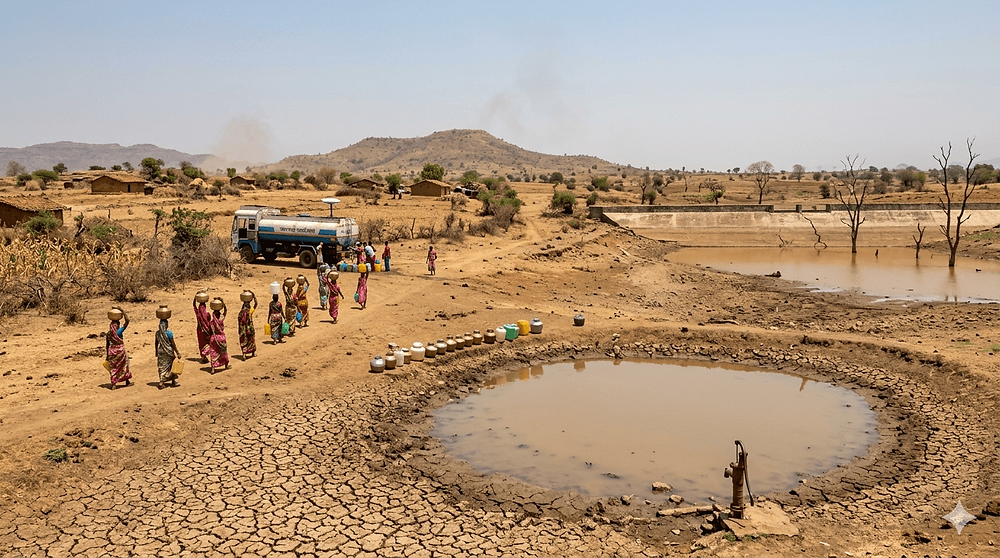

Groundwater levels are coming under fresh pressure across Vidarbha as prolonged dry spells and uneven rainfall affect Maharashtra. The decline is creating concerns for farmers, drinking-water supplies and urban areas, with Chandrapur and parts of Amravati among the locations facing particularly serious pressure.
Vidarbha Groundwater Levels Show a Sharp Decline
The groundwater situation in Vidarbha has become a major concern as Maharashtra enters the post-monsoon period with several districts facing drought conditions. A report published on October 7 said groundwater levels in Nagpur division had recorded an overall 42% decline, with Chandrapur reporting the sharpest fall at 73%. The report linked the situation to erratic rainfall, groundwater extraction and inadequate water conservation.
The development comes at a difficult time for the region. Maharashtra’s southwest monsoon withdrew early in 2026, while 21 districts recorded rainfall deficits. Nagpur and Chandrapur were among the districts reporting below-normal rainfall. The state received 804.4 mm of rainfall between June 1 and September 30, around 19% below its seasonal average of 994.5 mm.
For Vidarbha, the issue is not simply about how much rain fell during the monsoon. The timing of rainfall, long dry spells and the ability of soil and local water bodies to recharge groundwater also matter.
Why Farmers Are Feeling the Groundwater Pressure
Agriculture is one of the sectors most directly exposed to falling groundwater levels. Farmers depend on wells and borewells when rainfall is insufficient, particularly during dry periods between major rain events.
In Yavatmal, one of Vidarbha’s major agricultural districts, all 16 talukas have been placed under the Trigger-1 drought category. Farmers are reporting severe losses in cotton and other crops after prolonged dry spells. In some affected farms, expected cotton production has fallen dramatically compared with normal seasons.
The groundwater problem can make that situation worse. When surface water is inadequate, farmers increase dependence on borewells and wells for irrigation. If groundwater recharge remains weak, repeated pumping can push the water table deeper.
This creates a difficult cycle. Less rainfall reduces natural recharge. Farmers pump more groundwater to protect crops. Lower groundwater then makes the next irrigation cycle more expensive and uncertain.
The pressure is particularly important for small and marginal farmers because they may have limited financial capacity to deepen wells, install new pumps or shift to alternative irrigation systems.
Amravati Shows How Water Stress Can Build
Amravati district provides another example of the pressure building in parts of Western Vidarbha.
Recent groundwater assessments reported that Warud, Daryapur and Chandur Bazaar have been classified as over-exploited, while Morshi and Achalpur have been placed in the critical category. The assessment attributed the situation to prolonged dry spells, uneven rainfall and increasing temperatures.
Warud is particularly important because of its orange-growing economy. Reports said extensive pumping to protect orange orchards has pushed groundwater depths beyond 15 to 20 metres in some locations. A rainless period lasting more than 40 days during August and September further limited natural groundwater recharge.
Daryapur also faces concerns about groundwater quality, with high total dissolved solids reported in groundwater in the area. This means groundwater availability is not the only concern. Its quality can also determine whether water is suitable for drinking or irrigation.
Falling Groundwater Could Affect Rabi Crops
The timing of the groundwater decline is especially important for farmers because the Kharif season is followed by Rabi cultivation.
Lower groundwater availability can restrict irrigation for crops such as wheat, chickpea and other Rabi crops. In Yavatmal, water levels in several reservoirs were reported to be below their five-year average at the end of September, raising concerns about irrigation during the coming Rabi season.
This does not mean every farm in Vidarbha will face the same level of water shortage. Groundwater conditions vary significantly according to geology, rainfall, local recharge and extraction.
Maharashtra’s Groundwater Surveys and Development Agency maintains observation wells and digital water-level monitoring systems across the state. Its official dashboard lists 3,698 observation wells and more than 1,400 digital water-level recorders across its monitoring network.
That monitoring is important because groundwater conditions can differ sharply even between nearby locations.
What Falling Groundwater Means for Cities
The impact is not restricted to villages and agricultural fields. Cities and growing towns across Vidarbha also depend on groundwater for different purposes.
Groundwater can support households, institutions, industries and smaller settlements, particularly where piped surface-water supplies are limited. When groundwater levels fall, borewells may have to be drilled deeper or existing sources may become less reliable.
This can increase the cost of accessing water for households and businesses. In areas where groundwater quality is already a concern, falling availability can also make dependence on alternative sources more important.
The wider Maharashtra water situation shows why this matters. The state government has been considering restrictions on urban water use amid the drought, including a possible 10% reduction in urban water supply.
The pressure is therefore not simply an agricultural issue. It can affect municipal planning, household water security and the cost of maintaining reliable supplies.
Why Rainfall Alone Cannot Solve the Problem
A common assumption is that groundwater will automatically recover after the next spell of rain. In reality, groundwater recharge depends on several factors.
Rainfall must reach the ground and infiltrate into the soil and underlying geological formations. Heavy rainfall that quickly runs off into drains, rivers or reservoirs does not necessarily provide the same groundwater benefit as sustained rainfall that can infiltrate the ground.
Land use also matters. Concrete surfaces in expanding towns can reduce the area available for natural recharge. In rural areas, soil conditions, vegetation and water conservation structures influence how much rainwater enters the groundwater system.
Maharashtra has therefore continued to emphasise measures such as watershed development, stream deepening, percolation tanks and cement nala bunds. The state allocated ₹550 crore to the Jalyukta Shivar Abhiyan for 2026-27, with water conservation identified as an important part of drought preparedness.
What Can Help Recharge Groundwater in Vidarbha
Groundwater recovery requires measures at both village and city levels.
Farmers can benefit from micro-irrigation systems that reduce water use, while crop planning can take local water availability into account. Water harvesting structures can help slow runoff and improve infiltration where local conditions are suitable.
Villages can also maintain farm ponds, percolation tanks and recharge structures instead of allowing rainwater to leave the area quickly.
Cities have a different but equally important role. Rainwater harvesting, protection of natural drainage channels and preventing unnecessary groundwater extraction can help preserve local water reserves.
The objective should not simply be to pump more water from deeper levels. It should be to maintain a balance between groundwater extraction and recharge.
The Bigger Challenge for Vidarbha
The current groundwater situation comes against a wider agricultural crisis in the region. Maharashtra has declared drought in 265 of its 358 talukas, covering almost three-fourths of the state’s administrative blocks. Yavatmal is among the worst-affected districts, with all 16 talukas placed under Trigger-1 drought conditions.
For Vidarbha, this makes groundwater management increasingly important. Farmers need reliable water not only to protect current crops but also to make decisions about the next sowing season.
Cities, meanwhile, need to prepare for the possibility that groundwater cannot continue to serve as an unlimited backup source.
The immediate priority is therefore to monitor water levels closely, control excessive extraction where necessary and strengthen recharge before the next dry season intensifies.
Key Takeaways
- Groundwater levels in Nagpur division have reportedly fallen by 42%, while Chandrapur has recorded a 73% decline.
- Yavatmal and parts of Amravati are facing serious drought and groundwater pressure, affecting agriculture and irrigation.
- Falling groundwater can affect both farmers and urban residents by increasing dependence on deeper borewells and alternative water sources.
- Rainwater harvesting, watershed development, efficient irrigation and responsible groundwater extraction will be important for long-term water security.
FAQs
Why are groundwater levels falling in Vidarbha?
The current decline is linked to prolonged dry spells, uneven rainfall, rising water demand and groundwater extraction. Weak natural recharge during extended rainless periods can further reduce groundwater availability.
Which areas of Vidarbha are facing serious groundwater pressure?
Recent reports have highlighted Chandrapur in Nagpur division and several talukas in Amravati district. Warud, Daryapur and Chandur Bazaar in Amravati have been classified as over-exploited, while Morshi and Achalpur have been classified as critical.
How does falling groundwater affect farmers?
Farmers may face difficulty accessing enough water for irrigation, particularly during dry periods and the Rabi season. Greater dependence on deeper borewells can also increase pumping and infrastructure costs.
Can rainwater harvesting increase groundwater levels?
Rainwater harvesting and recharge structures can help improve groundwater recharge when they are properly designed for local soil, geology and rainfall conditions. They work best as part of a wider watershed and water-management strategy rather than as a standalone solution.