
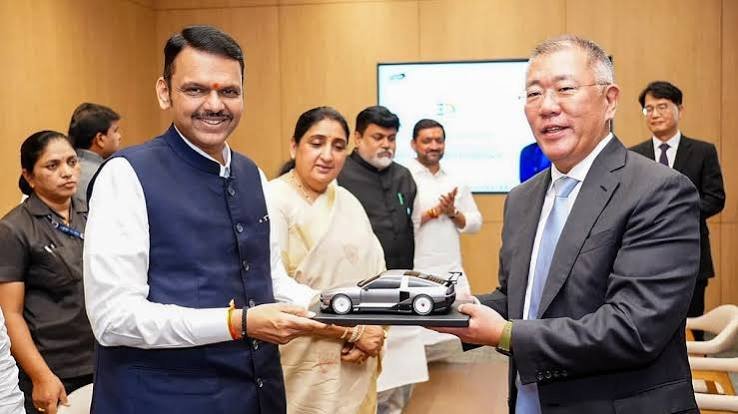

Hyundai Motor India’s new manufacturing plant in Talegaon, Pune, marks a major development for Maharashtra’s automobile industry. With an additional investment of ₹11,000 crore planned in phases, the company aims to increase production capacity, strengthen local manufacturing and create potential opportunities across the automotive supply chain.
Hyundai Pune Plant: Investment and Production Plans
Hyundai Motor India inaugurated its Talegaon manufacturing facility in Pune district on October 14, 2026, expanding its manufacturing presence beyond its established operations in Tamil Nadu.
The company has announced plans to invest an additional ₹11,000 crore at the facility in phases. Its installed annual vehicle production capacity currently stands at 1.7 lakh units, with plans to increase it to 3.2 lakh units by 2030.
The expansion comes as automakers compete to strengthen their manufacturing capabilities, introduce new vehicles and respond to changing consumer demand. For Hyundai, increasing production capacity could provide greater flexibility to serve the Indian market and support exports.
The Pune facility has already begun manufacturing the Hyundai Venue, including vehicles intended for export markets. According to the company’s announcement, the model produced at the plant is being exported to more than 35 markets.
The planned expansion is therefore relevant not only to vehicle manufacturing but also to the wider network of component suppliers, engineering firms, logistics operators and industrial service providers operating in Maharashtra.
How Hyundai’s Investment Could Strengthen Maharashtra’s Automobile Industry
Pune has an established industrial base, with automotive manufacturers, engineering companies, component suppliers and technical institutions operating across the region. Hyundai’s expansion could add to this manufacturing ecosystem.
A large automobile plant requires more than assembly lines. Vehicle production depends on a coordinated network of suppliers that provide components, raw materials, specialised equipment and technical services.
As production capacity increases, suppliers may need to expand their own operations to meet demand, depending on the company’s procurement plans. This could create opportunities for businesses involved in precision engineering, metal fabrication, electrical components, plastics, rubber products and industrial tooling.
The potential benefits may also extend to warehousing, transportation, packaging and equipment maintenance. Companies that support manufacturing operations could explore contracts with Hyundai or other businesses within its supplier network.
However, the investment announcement does not guarantee that every local company will receive orders. Suppliers must meet specific quality standards, production requirements, pricing expectations and delivery schedules.
For Maharashtra, the longer-term impact will depend on how much of the additional manufacturing activity translates into local procurement, business expansion and sustained industrial demand.
Hyundai Plant and Employment: What Job Seekers Can Expect
The Pune expansion has raised expectations about employment opportunities in manufacturing and related industries. Higher production capacity can increase demand for workers across several functions, although the actual number of new jobs will depend on operational requirements.
Potential areas of employment include production operations, mechanical and electrical engineering, quality inspection, machine maintenance, logistics, inventory management and manufacturing supervision.
The wider supply chain may also require workers with skills in welding, machining, industrial automation, equipment servicing and component testing. If local suppliers expand to serve additional orders, some may need to recruit employees or provide further training to their existing workforce.
For job seekers in Pune and nearby districts, technical education and vocational training could improve access to relevant opportunities. Candidates should monitor official company recruitment channels and verified vacancies rather than rely on unconfirmed claims about large-scale hiring.
It is also important to distinguish between direct employment at the plant and indirect employment among suppliers and service providers. These are separate categories, and their growth depends on different business decisions.
Hyundai’s investment announcement establishes a direction for manufacturing expansion, but it should not be interpreted as confirmation of a specific number of new jobs unless the company publishes verified employment targets.
Opportunities for Small Businesses and Local Suppliers
Small and medium-sized enterprises could play a role in supporting the manufacturing ecosystem around Talegaon. However, businesses will need to identify where their products or services fit into the supply chain.
Component manufacturers may explore opportunities in fasteners, metal parts, moulded plastic products, electrical assemblies and other automotive components. Industrial service providers could focus on machine maintenance, calibration, equipment installation and technical support.
Businesses in transportation, warehousing and industrial packaging may also investigate demand from manufacturers and their approved vendors. These opportunities could emerge directly through the plant or indirectly through existing suppliers.
Smaller firms should begin by preparing a profile of their capabilities, production capacity, quality systems and relevant experience. They can then investigate official procurement channels and approach established automotive suppliers that may need additional vendors.
Entering an automotive supply chain often requires investment in equipment, trained staff and quality-control processes. Companies should also review payment terms and working-capital requirements before accepting contracts.
The most sustainable opportunity will be for businesses that can meet customer requirements consistently. Being located near an industrial facility may offer logistical advantages, but it does not replace the need for competitive pricing, reliable delivery and quality compliance.
Smart Manufacturing and Technology at the Pune Facility
Hyundai has described the Talegaon facility as a smart manufacturing plant incorporating digital technologies and advanced production systems.
The facility uses Hyundai’s E-FOREST manufacturing platform, which supports digitalisation across factory operations. The company has highlighted features such as AI-assisted quality inspection, predictive maintenance, digital simulation and augmented reality-based worker training.
These technologies are intended to improve manufacturing processes, support quality management and help identify operational issues. Predictive maintenance, for example, can help manufacturers identify signs of equipment problems before they lead to major disruptions.
For suppliers, the shift towards more technology-intensive manufacturing may increase the importance of consistent product quality, traceability and digital coordination. Smaller companies may need to strengthen their own inspection procedures and production records to meet customer requirements.
Technology can also change the types of skills needed on factory floors. Workers may increasingly need to understand automated equipment, digital monitoring systems and data-based quality processes alongside traditional mechanical skills.
The precise employment effect of these technologies will depend on how production expands and how tasks are organised. Smart manufacturing does not automatically mean either fewer jobs or a particular level of job creation.
Hyundai’s Expansion and India’s Automotive Growth Strategy
The Talegaon investment is part of a wider effort by Hyundai Motor Group to strengthen its presence in India. On October 13, 2026, the group announced a commitment to invest $15.5 billion in India between 2026 and 2032.
The broader investment plan covers manufacturing expansion, research and development, supplier development and future automotive technologies. It is separate from Hyundai Motor India’s additional ₹11,000 crore investment planned for the Pune facility.
India is an important market for global automakers because of its passenger vehicle demand, manufacturing capabilities and potential as an export base. Expanding local production can help companies improve capacity and strengthen their position in a competitive market.
For Maharashtra, the development provides an opportunity to build stronger links between large manufacturers, local component makers and technical institutions. The extent of the benefit will depend on actual investment, supplier participation, workforce development and the performance of the automotive market.
The expansion also comes with challenges, including competition, changing vehicle technologies, cost pressures and the need for continuous quality improvement. Businesses will need to adapt rather than assume that additional production capacity will automatically translate into profitable contracts.
What the Hyundai Pune Expansion Means Going Forward
Hyundai’s Talegaon plant gives the company additional manufacturing capacity and creates scope for further industrial activity in Maharashtra. The planned increase from 1.7 lakh to 3.2 lakh vehicles annually by 2030 provides a clear measure of the expansion’s intended scale.
For job seekers, the development highlights the value of technical skills and verified recruitment information. For small businesses, it offers a reason to assess whether their products and services could serve automotive manufacturers and their suppliers.
The immediate announcement is a significant manufacturing milestone, but the long-term economic impact will become clearer as the investment progresses. Actual job creation, supplier contracts and business growth will depend on implementation, demand and procurement decisions.
Maharashtra’s ability to convert this expansion into broader industrial benefits will depend on how effectively local businesses prepare to participate in the automotive supply chain.
Key Takeaways
- Hyundai Motor India plans to invest an additional ₹11,000 crore in phases at its Talegaon plant, targeting annual capacity of 3.2 lakh vehicles by 2030.
- The expansion could create opportunities for automotive suppliers, engineering firms, logistics operators and other industrial service providers.
- Manufacturing, engineering and technical skills may be relevant to future employment opportunities, but no specific new job total should be assumed without an official announcement.
- Local businesses will need to meet quality, cost, delivery and financial requirements to compete for contracts linked to the expanded facility.
Frequently Asked Questions
1. How much is Hyundai investing in its Pune plant?
Hyundai Motor India has announced plans for an additional investment of ₹11,000 crore at its Talegaon facility in phases. The expansion aims to increase annual vehicle production capacity from 1.7 lakh units to 3.2 lakh units by 2030.
2. Will Hyundai’s new Pune plant create jobs?
The expansion could support employment in manufacturing, engineering, quality control, maintenance and supply-chain operations. However, the number of additional jobs will depend on the company’s operational plans and the growth of its supplier network.
3. Can small businesses in Maharashtra benefit from Hyundai’s expansion?
Potentially. Component manufacturers, logistics firms, packaging businesses and industrial service providers can investigate opportunities within the automotive supply chain. Contracts are not guaranteed and will depend on procurement requirements and business capabilities.
4. What vehicles are being manufactured at Hyundai’s Talegaon plant?
Hyundai has announced that the all-new Hyundai Venue is being manufactured at the Talegaon facility for domestic and export markets. Future production plans will depend on the company’s manufacturing strategy and subsequent announcements.