
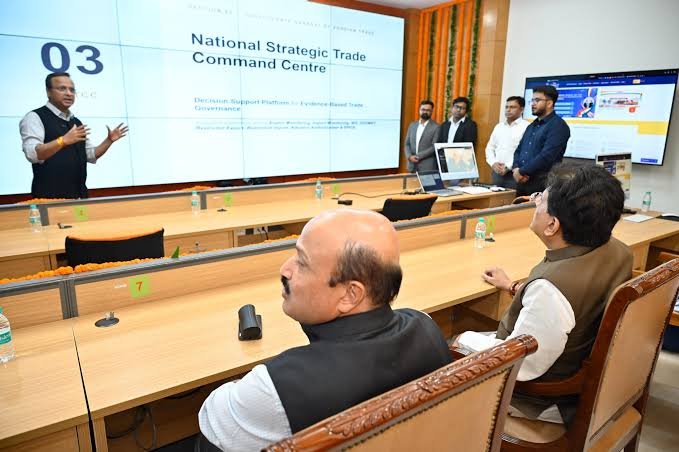

India has launched the National Strategic Trade Command Centre (NSTCC) to strengthen trade intelligence, monitor export-related processes and improve evidence-based decision-making. The initiative could help Indian exporters identify market opportunities and administrative bottlenecks, while improving coordination between trade authorities.
What Is the National Strategic Trade Command Centre?
The National Strategic Trade Command Centre was launched by Union Commerce and Industry Minister Piyush Goyal on 15 October 2026 at Vanijya Bhawan in New Delhi. Developed by the Department of Commerce under the Ministry of Commerce and Industry, the platform aims to improve how India monitors and analyses its international trade ecosystem.
The centre brings together trade-related information through an integrated analytics and visualisation platform. Its dashboards cover trade performance, export promotion schemes, regulatory approvals, application processing and other operational indicators.
The initiative is designed to give policymakers a consolidated view of developments across India’s export and import activities. Instead of relying only on periodic reports, authorised officials will be able to monitor selected indicators, identify emerging patterns and examine areas where administrative intervention may be necessary.
For exporters, the significance lies in the government’s effort to use trade data more systematically. However, the centre’s launch should not be interpreted as an immediate change to existing export procedures or a guarantee of faster approvals in every case.
How the Trade Command Centre Could Help Indian Exporters
One of the NSTCC’s main objectives is to improve product-wise and market-wise trade analysis. This can help authorities examine which products are performing well, where export opportunities may exist and how India’s position is changing across international markets.
For example, an Indian manufacturer considering expansion into a new country needs to understand demand, competition, trade conditions and applicable regulations. Better access to consolidated trade intelligence can help government agencies identify relevant trends and develop more targeted policy responses.
The centre is also designed to monitor export promotion schemes, application pendency, processing timelines and regional performance. This information can help officials identify recurring administrative delays and assess whether particular processes require improvement.
Such monitoring could be relevant to small and medium-sized enterprises, which may have fewer resources for international market research than large corporations. More effective public-sector trade intelligence could support better-informed decisions about market development and export promotion.
The actual benefit to individual businesses will depend on how the platform develops, how effectively identified problems are addressed and what information becomes accessible to authorised stakeholders.
Export Promotion Schemes and Regulatory Processes Under Monitoring
The NSTCC’s initial phase covers several functions associated with the Directorate General of Foreign Trade (DGFT). These include the Importer Exporter Code (IEC), Advance Authorisation, Export Promotion Capital Goods (EPCG), Certificate of Origin (CoO), SCOMET and restricted imports and exports.
These areas are important because exporters often need to comply with different requirements depending on their products, destination markets and the nature of their transactions.
The Importer Exporter Code is a key identification requirement for many import and export activities, subject to applicable exemptions. Advance Authorisation and EPCG are linked to specific export-related policy benefits and obligations. Certificates of Origin establish the origin of goods for relevant trade purposes, including where preferential treatment under a trade agreement is claimed.
By monitoring these processes, the command centre is intended to help officials assess scheme utilisation, application backlogs, compliance indicators and operational performance across regional authorities.
This consolidated view could make it easier to identify where processes are working efficiently and where further administrative attention may be required.
SCOMET Applications and Export Control Compliance
A notable issue highlighted during the launch was the processing of pending applications related to SCOMET, which stands for Special Chemicals, Organisms, Materials, Equipment and Technologies.
SCOMET covers specified items that may be subject to strategic export controls, including certain dual-use goods and technologies. Such controls are important because some products have legitimate civilian applications but may also have sensitive military, security or proliferation-related uses.
During the launch, Piyush Goyal reviewed the SCOMET dashboard and called for regular meetings of the Inter-Ministerial Committee, including weekly meetings if required, to clear pending applications and expedite their disposal.
This direction indicates that application pendency is an area receiving attention. For businesses dealing in controlled goods or technologies, timely regulatory decisions can affect production schedules, contractual commitments and delivery planning.
However, exporters should not assume that the new command centre makes SCOMET approvals automatic. Classification requirements, licensing conditions and restrictions continue to depend on the applicable foreign trade policy, DGFT notifications and the circumstances of each transaction.
Businesses handling potentially controlled items should continue to verify their obligations before exporting.
Will the New Command Centre Reduce Export Delays?
Reducing administrative bottlenecks is one of the objectives of the NSTCC. Its dashboards are intended to show application pendency, processing timelines and operational performance, allowing officials to identify issues that may require intervention.
In practice, better monitoring can help authorities recognise repeated delays, compare performance across regional offices and determine where additional coordination may be needed.
For example, if a particular category of application repeatedly remains pending, the data may help officials investigate whether the problem involves documentation, interdepartmental coordination or another procedural issue.
However, monitoring a delay and resolving it are two different things. The command centre can provide information to support administrative action, but improvements will depend on how authorities respond to the findings.
Exporters should therefore continue to submit complete applications, monitor their status through official channels and respond promptly to requests for additional information. Businesses should not change contractual delivery commitments solely on the expectation that processing will automatically become faster following the launch.
What Small Businesses and MSME Exporters Should Know
Small businesses and micro, small and medium enterprises (MSMEs) often face challenges when entering overseas markets. These can include identifying suitable buyers, understanding destination-market requirements, managing documentation and navigating export promotion schemes.
The NSTCC could support the broader trade ecosystem by helping authorities identify opportunities and administrative problems affecting different products, markets and regions. Over time, better trade intelligence may contribute to more focused export promotion measures.
For an MSME exploring international sales, product-wise and market-wise analysis can be valuable when deciding which markets deserve further research. Understanding how a product performs in different destinations may help a business assess its expansion options.
Nevertheless, the command centre is primarily a government decision-support platform, not a direct guarantee of market access, export orders or financial assistance for individual businesses.
Exporters should continue using official DGFT services, the Trade Connect ePlatform, export promotion councils and other appropriate resources to understand market requirements and available support.
Businesses should also calculate shipping expenses, insurance, payment risks, product standards and working capital requirements before committing to overseas orders.
How the NSTCC Fits Into India’s Digital Trade Infrastructure
The command centre is designed to build on existing digital infrastructure, including DGFT systems and the Trade Connect ePlatform. Its purpose is to bring relevant information together for monitoring and policy analysis rather than operate as an isolated trade system.
The government has indicated that the platform could gradually integrate additional datasets from other departments and trade-related agencies. Its analytical capabilities may also be strengthened through automated alerts and advanced analytics.
The longer-term vision is to develop the NSTCC into a broader government decision-support mechanism. The proposed approach includes phased access for authorised stakeholders such as relevant ministries, state governments, export promotion councils and other institutions.
Greater coordination could help government agencies assess trade developments across different regions and sectors. It may also help identify common regulatory challenges that are difficult to recognise when information is examined separately by individual departments.
The effectiveness of this approach will depend on data quality, timely updates, coordination between agencies and the practical use of insights in policy decisions.
What Exporters Should Do After the Launch
For exporters, the immediate priority is to continue following existing rules while watching for official updates that affect their business activities.
Companies should keep their IEC details current where required, maintain accurate export documentation and check the conditions attached to any scheme they use. Businesses dealing in restricted goods or potentially controlled technologies should verify the applicable classification and authorisation requirements before shipment.
Exporters awaiting regulatory decisions should monitor their applications through official channels rather than assume that the launch has changed processing deadlines.
Businesses planning expansion should also continue conducting their own market research. Government trade intelligence can be useful, but commercial decisions still require assessment of demand, competition, logistics, pricing, payment terms and regulatory requirements in the destination country.
The NSTCC represents a move towards more integrated trade monitoring and evidence-based governance. Its value for exporters will become clearer as the platform develops and authorities translate the information it provides into practical improvements.
Key Takeaways
- The National Strategic Trade Command Centre was launched on 15 October 2026 to strengthen trade intelligence and evidence-based decision-making.
- Its initial dashboards cover IEC, Advance Authorisation, EPCG, Certificates of Origin, SCOMET and other trade-related processes.
- The centre could help authorities identify export opportunities, monitor application delays and improve coordination, but these outcomes depend on implementation.
- Exporters must continue following existing DGFT requirements, checking official notifications and complying with applicable export-control rules.
Frequently Asked Questions
1. What is the National Strategic Trade Command Centre?
The NSTCC is a platform developed by the Department of Commerce to consolidate trade-related information and support monitoring, analysis and evidence-based decisions about India’s international trade.
2. Who launched the NSTCC in India?
Union Commerce and Industry Minister Piyush Goyal launched the National Strategic Trade Command Centre at Vanijya Bhawan in New Delhi on 15 October 2026.
3. Will the NSTCC make export approvals faster?
The centre is designed to help officials monitor application pendency and processing timelines, identify bottlenecks and support timely intervention. Faster approvals may depend on the action taken by the relevant authorities. The launch does not guarantee faster clearance for every application.
4. Does the new command centre change SCOMET export rules?
The launch announcement does not itself change SCOMET classification or licensing requirements. Exporters must continue to follow the applicable DGFT rules, notifications and authorisation conditions for their goods and transactions.