
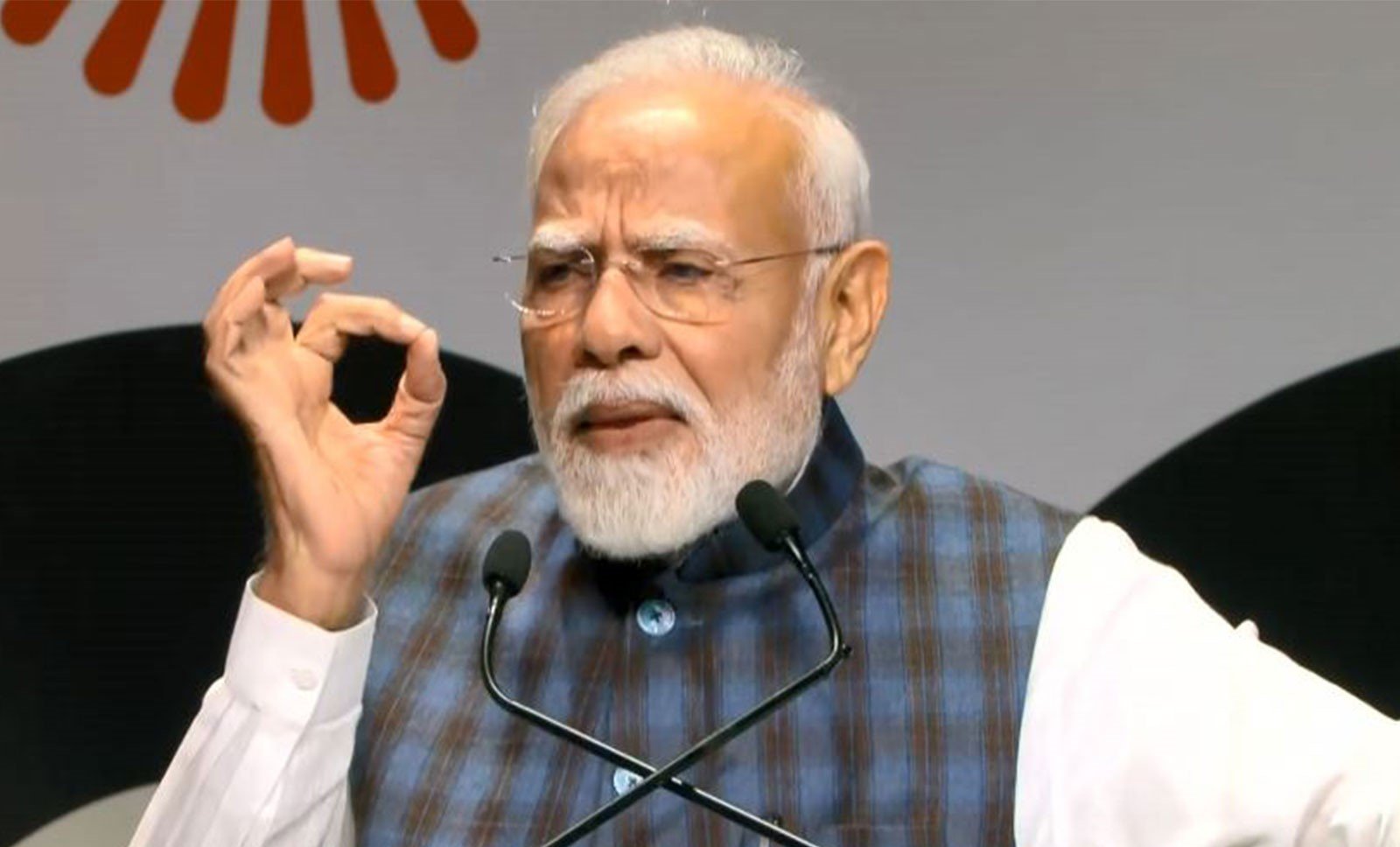

Prime Minister Narendra Modi has called on Indian businesses to look beyond domestic markets and make long-term investments that support India’s development goals. Addressing FICCI’s centenary convention in New Delhi, he emphasised self-reliance, global competitiveness, industrial innovation and the vision of a developed India by 2047.
PM Modi Addresses FICCI’s Centenary Convention in New Delhi
Prime Minister Narendra Modi inaugurated the Annual General Meeting and Annual Convention of the Federation of Indian Chambers of Commerce and Industry (FICCI) at Bharat Mandapam in New Delhi on November 19, 2026. The event marked an important milestone in the organisation’s journey as it entered its centenary year.
The convention was organised around the theme Bharat 2047, bringing together more than 2,500 delegates, including business leaders, company executives, ambassadors, diplomats and policymakers. The discussions focused on India’s economic development, industrial progress and the role of businesses in achieving the country’s long-term national objectives.
During his address, Modi described FICCI’s 100-year journey as a significant achievement and acknowledged its contribution to India’s economic transformation. He also urged the country’s business community to prepare for the opportunities and challenges that could emerge over the next two decades.
FICCI Completes 100 Years of Supporting Indian Industry
Established in 1927, FICCI was founded when Indian businesses had limited representation in economic policymaking. Over the decades, the organisation has developed into one of India’s major industry associations, representing businesses across different sectors.
According to the government, FICCI represents more than 2.5 lakh companies, directly and through over 300 affiliated regional and state-level industry associations. It also maintains partnership agreements with 250 national business associations across more than 100 countries.
The organisation’s centenary year falls in 2026-27, with 100 years of establishment being completed on April 7, 2027.
Referring to this milestone, Modi said that an institution’s ability to remain active, adapt to changing economic conditions and contribute to the country’s development for a century was a major achievement.
However, he also challenged the industry body to think beyond its past accomplishments and consider what Indian businesses could achieve in the next 20 years.
India First: PM’s Message on Long-Term Business Investments
One of the central messages of the Prime Minister’s address was the importance of making India First the foundation of long-term investment decisions.
Modi asked industry leaders to consider how their investment strategies could contribute to India’s journey towards becoming a developed and self-reliant economy. He pointed out that businesses should not focus only on established sectors or opportunities that offer immediate financial benefits.
Instead, companies need to prepare for future national and international requirements by developing new capabilities, strengthening industrial infrastructure and investing in emerging opportunities.
He also highlighted the importance of protecting India’s economic interests at a time when access to resources and supply chains has become increasingly important in global competition.
The message places greater responsibility on Indian businesses to balance commercial growth with long-term national economic priorities.
Domestic Market Should Help Indian Companies Compete Globally
Another important point in Modi’s speech was the need for Indian companies to expand their international ambitions.
He said India’s large domestic consumer market should not become a comfort zone for businesses. Instead, companies should use the confidence gained from serving Indian customers to compete more effectively in international markets.
The Prime Minister encouraged businesses to study consumer preferences across different countries and regions before expanding their products and services internationally.
He suggested that companies should invest in market research, send teams to understand local demand and develop products suited to the preferences of international customers.
This includes paying attention to product design, colours, usability and other consumer requirements that can influence purchasing decisions.
For Indian manufacturers and startups, this approach highlights the importance of developing products that can compete on quality, design, pricing and customer experience rather than depending primarily on domestic demand.
Global Standards and Distribution Networks Remain Important
Expanding into international markets requires more than producing goods at competitive prices. Businesses also need to meet global quality standards and establish reliable distribution networks.
During the convention, Modi emphasised that Indian products should earn the confidence of international customers and strengthen India’s presence in global markets.
For small and medium enterprises, this presents both an opportunity and a challenge. Businesses operating in smaller cities may have access to skilled workers, local resources and manufacturing opportunities, but international expansion can require additional investment in technology, quality control, certifications and logistics.
Developing dependable supply chains and understanding international regulations will also be important for companies looking to increase exports.
The Prime Minister’s message underlined that India’s industrial growth should be supported by a stronger export-oriented mindset and an improved understanding of global consumer markets.
PM Highlights India’s Economic Growth and Poverty Reduction
Modi also referred to India’s economic progress during his address. He highlighted the contribution of young people, farmers, workers and the industrial sector to the country’s development.
Citing a recent World Bank report, the Prime Minister said that around 50 crore Indians had moved out of poverty over a period of 12 to 13 years.
He used this figure to underline the importance of policy implementation and sustained economic development. The statement was presented as part of his broader argument that India’s development journey requires continued participation from both the government and the private sector.
The Prime Minister also described India as the fastest-growing major economy and referred to growth estimates of around 7 per cent.
He highlighted India’s goods exports in October 2026, stating that they had reached nearly $50 billion, which he described as the country’s highest-ever monthly goods export figure.
These observations formed part of his argument that Indian businesses have an opportunity to strengthen the country’s economic position through investment, innovation and international expansion.
What India’s 2047 Development Vision Means for Businesses
India’s vision of becoming a developed nation by 2047 requires progress across several economic areas, including manufacturing, infrastructure, technology, education, employment and exports.
The private sector is expected to play an important role in this process. Businesses can contribute through capital investment, research and development, job creation, skill development and the adoption of new technologies.
For startups, the focus on future capabilities could create opportunities in areas such as artificial intelligence, clean energy, advanced manufacturing, digital services and supply-chain technology.
For established companies, the challenge will be to improve productivity, adopt modern production methods and compete with international manufacturers.
Small businesses will also have an important role, particularly in Tier-2 and Tier-3 cities where local enterprises contribute to employment and regional economic activity.
However, achieving these objectives will depend on several factors, including access to finance, infrastructure quality, workforce skills, regulatory conditions and the ability of businesses to respond to changing market requirements.
PM Modi Calls for Greater Industry-Government Cooperation
Towards the end of his address, Modi encouraged industry leaders to openly communicate the reforms they believe are necessary for business growth.
He invited members of the business community to share their suggestions with the government, stating that such feedback could help identify areas where policy improvements are required.
He also referred to Mahatma Gandhi’s earlier emphasis on Swadeshi and connected it with the present focus on Atmanirbhar Bharat.
The Prime Minister urged businesses not to wait another century to make a meaningful contribution to the country’s development. Instead, he asked them to consider what they could deliver for India over the next decade.
Concluding his speech, he described the goal of a developed India as a commitment rather than merely a slogan, calling for collective participation from citizens and industry.
Key Takeaways
- Prime Minister Narendra Modi addressed FICCI’s centenary convention on November 19, 2026, under the theme Bharat 2047.
- He urged Indian businesses to make India First the foundation of their long-term investment decisions.
- The Prime Minister encouraged companies to use India’s domestic market as a starting point for competing globally.
- He called for stronger industry-government cooperation, investment in future capabilities and greater attention to international quality standards.
FAQs
1. When did PM Modi address FICCI’s centenary convention?
Prime Minister Narendra Modi addressed FICCI’s Annual General Meeting and Annual Convention on November 19, 2026, at Bharat Mandapam in New Delhi.
2. What was the theme of FICCI’s 2026 centenary convention?
The convention was organised around the theme Bharat 2047, focusing on India’s development ambitions and the role of industry in building a developed nation.
3. What did PM Modi say about India’s domestic market?
He said that India’s large domestic market should not become a comfort zone for businesses. Instead, companies should use their domestic experience and capabilities to compete in international markets.
4. What is FICCI and when was it established?
The Federation of Indian Chambers of Commerce and Industry is a major Indian industry association established in 1927. It represents businesses across different sectors and supports industry-government engagement and international business partnerships.
(Internal Keywords: PM Modi FICCI speech 2026, FICCI centenary convention, Bharat 2047 vision, India’s economic growth, Atmanirbhar Bharat, India First investment strategy, Indian manufacturing industry, India global exports, Indian business news, developed India 2047)