
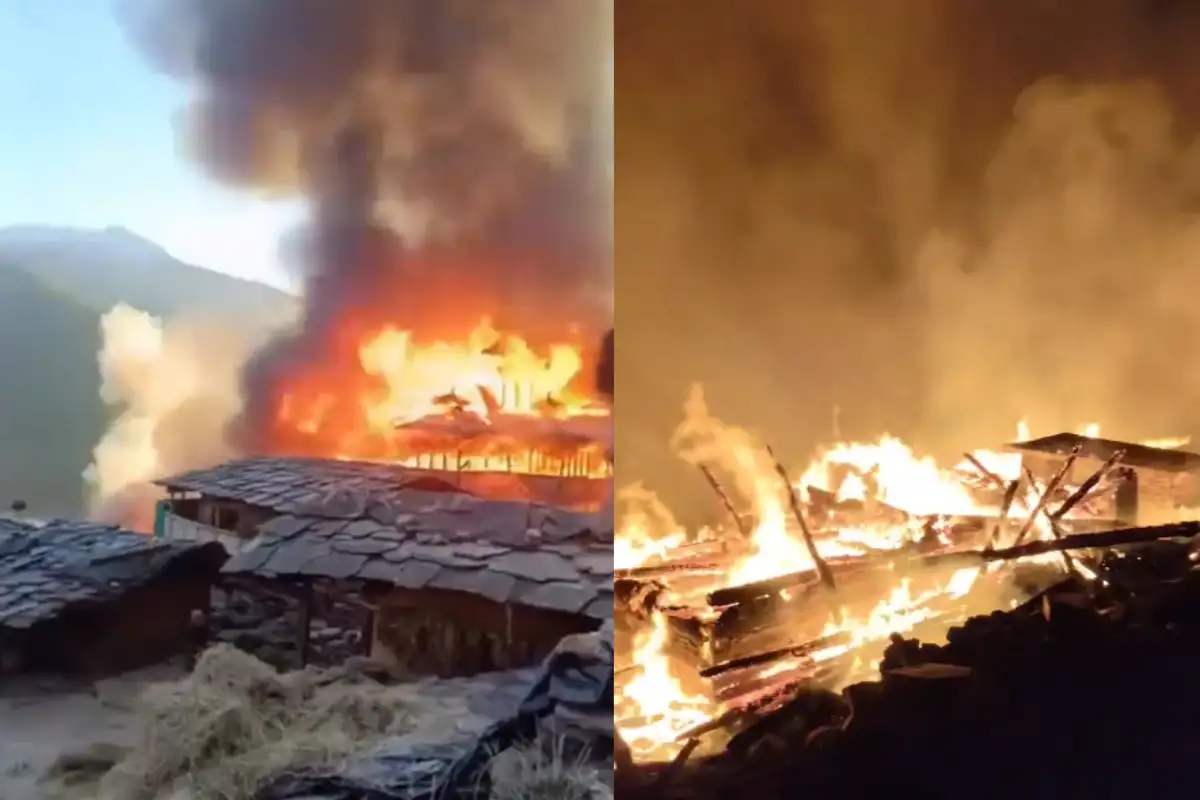

A massive fire in Pawani village of Uttarkashi district, Uttarakhand, has destroyed 33 residential buildings, a panchayat building and a primary school, affecting 58 families. The November 24 incident has highlighted the difficulties of emergency response, infrastructure access and rehabilitation in remote Himalayan settlements.
Uttarkashi Fire: 33 Houses Destroyed in Pawani Village
A major fire broke out in Pawani village under Mori tehsil of Uttarkashi district on Tuesday evening, November 24, 2026. The blaze spread through residential structures, leaving dozens of families without homes and destroying important community infrastructure.
According to the latest report received from the Sub-Divisional Magistrate (SDM), Purola, 33 residential buildings were completely destroyed. The village panchayat building and a primary school were also damaged.
A total of 58 families have been affected by the incident, while 13 houses reportedly remained safe.
The fire was reported at approximately 4:49 PM and was brought under control around 9:16 PM after more than four hours of firefighting and rescue efforts.
Local residents joined government teams in attempting to control the flames. Although no deaths of humans or livestock were reported, one person sustained injuries while helping with firefighting operations.
The incident has raised concerns about the vulnerability of remote Himalayan settlements, particularly where difficult terrain and limited infrastructure can complicate emergency response.
How Did the Fire Spread Across Pawani Village?
The fire reportedly originated at the residence of a villager identified as Budhi Singh. However, the exact cause of the incident had not been established in the reports available on November 25.
Reports also indicated that around five to seven cooking gas cylinders exploded during the incident, contributing to the intensity of the blaze. However, this detail has not been established as the confirmed cause of the fire.
The presence of closely situated residential buildings created additional challenges as flames spread through the village.
The incident also demonstrated how quickly a residential fire can become a larger community emergency when several households and public facilities are located within the affected area.
The destruction of 33 houses has left 58 families facing immediate accommodation and rehabilitation concerns. Beyond residential losses, damage to the panchayat building and primary school has affected facilities used by the wider village.
The administration will need to assess individual household losses, identify the immediate requirements of displaced residents and determine the assistance needed for rebuilding.
Remote Location Created Challenges for Firefighting Operations
One of the major difficulties during the Pawani fire was the village’s geographical location.
Situated in the mountainous Mori region of Uttarkashi, the village has limited road connectivity. Reports indicated that the approach road was under construction and that reaching the affected area required a trek from the nearest roadhead.
The difficult terrain affected the movement of emergency teams and firefighting equipment.
According to reports, fire tenders dispatched from Mori faced difficulties reaching the location. This highlights an important challenge for emergency services operating in remote Himalayan settlements.
Unlike urban areas, where fire stations and road networks may allow relatively quick access, villages in mountainous regions can require additional travel time and coordination.
The absence of reliable mobile network connectivity in Pawani also complicated communication with the affected location.
According to the district emergency report, authorities faced difficulties establishing contact with people at the site because mobile connectivity was unavailable.
Such communication gaps can make it harder to coordinate rescue operations, assess damage and share urgent information with district-level authorities.
SDRF, Police and Local Residents Joined Rescue Operations
Following the information about the fire, the Uttarkashi district administration dispatched teams from several departments.
The response involved personnel from the State Disaster Response Force (SDRF), National Disaster Response Force (NDRF), police, fire services, health services and revenue departments.
Local residents also participated in efforts to control the flames and support the emergency response.
The combined teams worked for more than four hours before bringing the fire under control at approximately 9:16 PM.
A medical team and a 108 ambulance were also sent to the location. Ganga Singh, a resident of Osla village, sustained injuries after falling while helping with firefighting operations.
The incident did not result in reported human or animal deaths, according to the district-level information available after the fire.
However, the scale of property destruction has created a significant relief and rehabilitation requirement for the affected households.
58 Families Face Housing and Livelihood Challenges
The destruction of 33 residential buildings has affected 58 families, creating immediate concerns about shelter, food, clothing and essential household supplies.
For families living in remote mountain villages, a house often contains more than basic furniture and appliances. It may also store agricultural equipment, food supplies, clothing, documents, savings and other belongings accumulated over several years.
The loss of these possessions can make recovery particularly difficult.
The IANS report on November 25 noted that several families had lost cash, gold, silver, household belongings and other property in the fire.
The affected residents will also need temporary accommodation while the administration evaluates the damage and prepares longer-term rehabilitation measures.
The district administration has started arranging food and essential supplies for the 58 affected families. Plans are also being made to provide safe accommodation through relief arrangements.
The local MLA, Durgeshwar Lal, met Chief Minister Pushkar Singh Dhami and sought immediate assistance, financial support and permanent rehabilitation for affected residents.
His requests included safe accommodation, drinking water, blankets, clothes, food and other essential materials.
The actual financial losses and compensation requirements will depend on the administration’s assessment.
Damage to School and Panchayat Building Adds to Village Concerns
The fire has affected more than individual households. The destruction of the primary school and panchayat building has created additional concerns for Pawani’s community.
A primary school provides an important educational facility for children living in remote settlements. When such a building becomes unusable, students may face disruption until alternative arrangements are made.
The availability of another accessible school, transportation facilities and temporary learning arrangements will influence how quickly education can resume.
Similarly, the panchayat building serves as an important local administrative facility.
It provides a space for community meetings, local coordination and access to village-level administrative activities.
Damage to this building could make it more difficult for residents to coordinate rehabilitation requirements and communicate with local authorities.
Restoring these public facilities will therefore be an important part of the village’s recovery process, alongside rebuilding residential structures.
Why Remote Himalayan Villages Face Greater Disaster Response Challenges
The Pawani incident highlights several difficulties that can affect emergency management in remote Himalayan villages.
1. Difficult Road Connectivity
Mountainous terrain, narrow roads and incomplete road construction can delay the movement of fire tenders, ambulances and heavy rescue equipment.
In some locations, emergency teams may have to continue on foot after reaching the nearest motorable road.
2. Limited Communication Networks
Mobile connectivity is essential during emergencies. It allows residents to report incidents, authorities to coordinate teams and relief agencies to communicate with affected households.
When networks are unavailable, even sharing basic information about casualties and damage can become difficult.
3. Closely Located Residential Structures
In villages where houses are located close together, a fire can spread from one building to another before emergency teams reach the location.
The materials used in construction, weather conditions and availability of firefighting water can also influence how quickly a blaze spreads.
4. Limited Access to Emergency Infrastructure
Remote settlements may not have fire stations, emergency water storage systems or specialised firefighting equipment nearby.
This increases dependence on district-level resources, local residents and coordinated response teams.
The Pawani fire demonstrates why emergency preparedness in mountain regions needs to consider geographical conditions rather than depend entirely on arrangements designed for accessible towns and cities.
Uttarakhand Government Orders Relief and Rehabilitation Measures
Chief Minister Pushkar Singh Dhami expressed grief over the incident and directed the district administration to accelerate relief and rescue operations.
He instructed officials from the SDRF, police, revenue, health and fire departments to coordinate their response.
The administration has also been directed to move affected families to safe locations and provide food, shelter, medical facilities and essential supplies.
The government has stated that the damage will be assessed and eligible assistance will be provided according to applicable rules.
Another proposal under consideration involves seeking support from SJVN Limited’s Nathpa Jhakri and other relevant corporate social responsibility resources for the construction of safe shelters for affected families.
Such support could help supplement immediate government relief, although the proposal should not be treated as a confirmed construction or rehabilitation commitment until formally approved.
The next stage will involve documenting household losses, identifying the requirements of individual families and determining the assistance needed for long-term recovery.
What the Pawani Fire Reveals About Disaster Preparedness in Uttarakhand
Uttarakhand’s mountain geography creates specific challenges for emergency services. Many villages are located away from major highways and district headquarters, with access depending on narrow roads and walking routes.
The Pawani fire has brought attention to the importance of local emergency preparedness.
Early warning arrangements, accessible firefighting equipment, reliable communication systems and community-level training can help residents respond during the initial stages of an emergency.
Village-level disaster management plans can also identify vulnerable buildings, evacuation routes, water sources and locations where residents can gather safely.
For remote settlements, the availability of basic firefighting equipment and trained local volunteers may be particularly useful when professional emergency teams require additional time to reach the location.
The incident also highlights the need to restore essential community infrastructure after a disaster. Housing rehabilitation alone may not be sufficient if schools, administrative facilities and other shared resources remain unavailable.
For Pawani, the immediate priority remains providing safe accommodation and essential supplies to affected families. A detailed damage assessment and rehabilitation plan will determine how quickly residents can begin rebuilding their lives.
Key Takeaways
- A major fire in Pawani village, Uttarkashi, destroyed 33 residential buildings, a panchayat building and a primary school, affecting 58 families.
- The fire broke out on November 24 and was brought under control around 9:16 PM after more than four hours of firefighting.
- Difficult road access and the absence of mobile network connectivity created additional challenges for emergency response.
- The Uttarakhand administration has initiated relief arrangements and is assessing assistance and rehabilitation requirements for affected families.
Frequently Asked Questions (FAQs)
1. Where did the Uttarkashi fire take place in November 2026?
The fire occurred in Pawani village under Mori tehsil of Uttarkashi district, Uttarakhand, on November 24, 2026.
2. How many houses were destroyed in the Uttarkashi fire?
According to the latest report from the Purola Sub-Divisional Magistrate, 33 residential buildings were completely destroyed. The incident also damaged the village panchayat building and a primary school.
3. How many families were affected by the Pawani village fire?
A total of 58 families were affected. The district administration has started arranging food, essential supplies and safe accommodation for them.
4. What caused the Uttarkashi village fire?
The fire reportedly originated at the residence of a villager identified as Budhi Singh. However, the exact cause had not been officially established in the reports available on November 25, 2026.
(Internal Keywords: Uttarkashi fire November 2026, Pawani village fire, 33 houses destroyed in Uttarkashi, Uttarakhand village fire news, 58 families affected Uttarkashi, Mori tehsil fire incident, Uttarkashi disaster management, Himalayan village emergency response, remote village infrastructure Uttarakhand, Uttarakhand fire rescue operation, SDRF Uttarkashi, Uttarakhand rehabilitation news, Himalayan disaster preparedness, Uttarakhand government relief measures)