
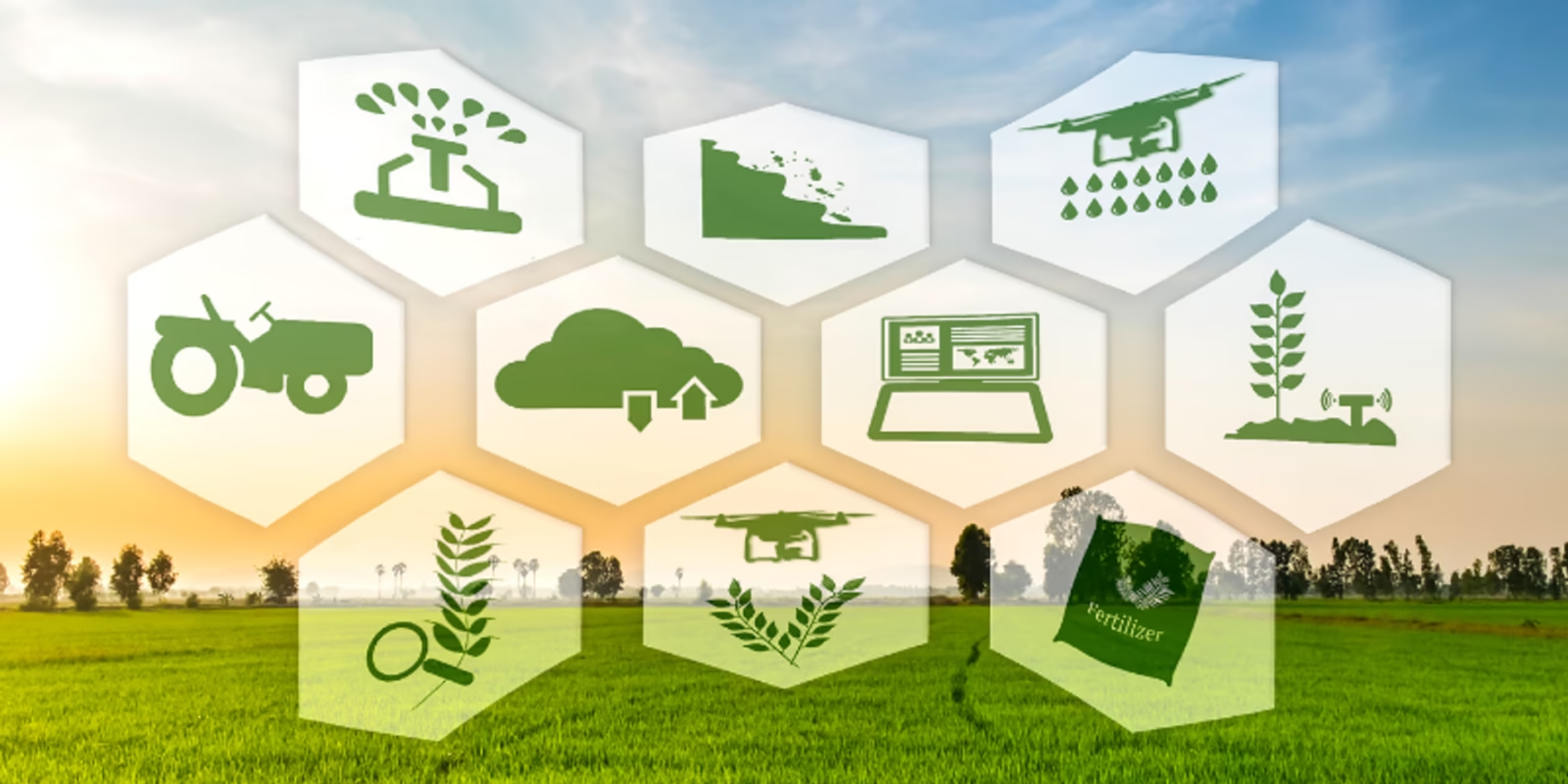

India’s agritech sector is attracting renewed investor attention, with the country accounting for nearly half of agtech investment tracked across 17 emerging markets since 2023. The funding is increasingly moving toward AI, supply chains, farm services and technologies that could reshape access to markets and farm support.
India Emerges as a Major Agritech Investment Market
The latest investment data puts India’s agritech sector firmly in focus. According to the AgTech Investment in Emerging Markets, 2025 report from AgBase, Briter and ISF Advisors, India attracted about $2.1 billion in agtech investment between 2023 and 2025, out of $4.39 billion tracked across 17 emerging markets. That is nearly half of the total investment covered by the report.
The report classifies India as a commercial front-runner because of its large agricultural market, digital infrastructure, domestic capital availability, entrepreneurial ecosystem and potential exit opportunities.
However, funding figures should not be interpreted as money going directly to farmers. Most investment is raised by companies developing products and services for the agricultural value chain. The important question for farmers is whether those businesses can translate investment into affordable and useful services at the local level.
That distinction matters particularly in Tier-2 and Tier-3 regions, where agriculture remains closely connected to local markets, mandis, transport networks and smaller farming operations.
Where Agritech Investment Is Going
Agritech covers much more than farming apps. Investors are backing businesses working across different parts of the agricultural value chain.
These include digital marketplaces, agricultural finance, supply-chain technology, cold storage, food processing, farm machinery, crop monitoring, irrigation and climate-related solutions.
Artificial intelligence is becoming another important area. Government programmes are also supporting the development and adoption of AI, precision farming, drones and climate-smart agriculture. The Agriculture Ministry has been running its Innovation and Agri-Entrepreneurship Development programme under RKVY to support agricultural startups and incubation.
The government has also identified artificial intelligence applications in agriculture and digital agriculture as priority areas under the Research Development and Innovation framework.
This combination of private investment and public support could increase the number of technologies being tested in Indian farming, although adoption will ultimately depend on cost, reliability and local usefulness.
What It Could Mean for Tier-2 Farmers
For farmers outside major metropolitan areas, the biggest potential benefit is better access to services that were previously difficult to reach.
A farmer in a Tier-2 or rural district may not have direct access to agricultural specialists, organised buyers, modern storage facilities or detailed market information. Technology can potentially connect some of these services through smartphones, local centres, farmer producer organisations and other intermediaries.
For example, digital platforms can provide information about crop prices, weather conditions and farm inputs. Supply-chain companies can help connect producers with buyers. Technology-enabled financial services can potentially improve access to credit and insurance.
The impact will vary considerably by crop, region and business model.
A technology that works well for horticulture in Maharashtra may not provide the same value to a paddy farmer in Odisha or a cotton farmer in Telangana. Local conditions remain critical.
AI and Digital Agriculture Are Expanding
India’s digital agriculture infrastructure has also expanded in recent years. According to the government, more than 7.63 crore Farmer IDs had been created and 23.5 crore crop plots surveyed under the Digital Agriculture Mission as of February 2026.
The National Pest Surveillance System covers 66 crops and more than 432 pest types, while the Kisan e-Mitra chatbot had answered more than 93 lakh queries by December 2025, according to the same government backgrounder.
AI-based tools are also being tested for weather and crop-related decisions. One pilot for local monsoon onset forecasting reached 3.88 crore farmers across 13 states through SMS during Kharif 2025, with the government reporting that a portion of surveyed farmers changed sowing or land-preparation decisions based on the forecasts.
These systems show how digital agriculture can move beyond simple information delivery toward more targeted farm advice.
Funding Does Not Automatically Mean Higher Farm Income
The rise in agritech investment should not be confused with an automatic increase in farmer earnings.
Agriculture businesses face long sales cycles, climate risks, commodity price fluctuations and infrastructure challenges. A January 2026 analysis by Inc42 reported that Indian agritech startups raised $202 million across 36 deals in 2025, down from $269 million across 2024 deals, highlighting how funding conditions can fluctuate sharply.
More recent sector data points to renewed investment activity. An AgInvest bulletin covering January to April 2026 reported $176.91 million across 18 agriculture and allied-sector deals, 27% higher in value than the $138.82 million recorded across 16 deals during September to December 2025.
The two figures measure different periods and datasets, so they should not be directly combined into a single annual funding estimate.
For farmers, the more meaningful measure is whether funded companies can build sustainable services that reduce costs, improve productivity, reduce wastage or improve price realisation.
Supply Chains Could Be a Major Opportunity
One area where agritech investment could have a direct effect on Tier-2 India is the agricultural supply chain.
Farmers can lose value between harvesting and final sale because of inadequate storage, transportation challenges, fragmented markets and post-harvest losses.
Technology companies are increasingly working on areas such as cold storage, logistics, digital marketplaces, food processing and supply-chain management.
The International Finance Corporation has highlighted investments in India involving digital dairy platforms, solar-powered irrigation and cold storage, waste-to-value businesses and agrifintech. Its work with agritech investors focuses on businesses intended to improve productivity, reduce post-harvest losses and strengthen market and financial access for smallholder farmers.
For Tier-2 agricultural regions, these services could be important because better farm output does not necessarily translate into better income if the supply chain remains inefficient.
Drones, Machinery and Shared Services
Agritech investment is also creating opportunities around farm equipment and mechanisation.
Not every farmer can afford to purchase expensive machinery or technology individually. Rental and shared-service models can potentially make equipment more accessible.
Government policy has recognised this challenge. Budget documents have included support for startups working on agricultural and rural enterprises, including machinery available to farmers on a rental basis and technology-based support for Farmer Producer Organisations.
Drone services are another example. Instead of every farmer owning a drone, service providers or organised groups can potentially offer spraying, monitoring or other services on a rental basis.
For smaller farmers, this model can be more practical than purchasing expensive equipment outright.
What Farmers Should Watch Before Adopting New Technology
Farmers should evaluate agritech products based on their actual usefulness rather than the technology label.
Before paying for a service, farmers can ask whether the company clearly explains its pricing, expected benefits, refund terms and data practices.
It is also useful to check whether the product has been tested in the local crop and climate conditions. Recommendations from agricultural universities, Krishi Vigyan Kendras, government extension officers, FPOs and trusted local agricultural organisations can provide additional context.
Farmers should also be cautious about companies promising guaranteed yields, guaranteed profits or instant solutions to complex agricultural problems.
Technology can support agricultural decisions, but it cannot eliminate weather, market or crop risks.
Why Tier-2 Cities Could Become Agritech Hubs
The next stage of India’s agritech growth may not be limited to Bengaluru, Mumbai, Delhi or other major startup centres.
Agricultural businesses often need to operate close to farms, mandis, warehouses, processors and local buyers. That creates opportunities for startups and service providers in cities such as Nagpur, Indore, Nashik, Coimbatore, Lucknow, Jaipur, Rajkot and other regional centres.
Tier-2 cities can function as operational hubs where technology companies recruit local teams, work with FPOs and agricultural institutions, and build relationships with farmers.
For the sector to scale sustainably, these local connections will be as important as the technology itself.
Key Takeaways
- India attracted about $2.1 billion in agtech investment across the 17 emerging markets tracked by the latest AgBase, Briter and ISF Advisors report since 2023.
- Funding is moving into areas including AI, supply chains, farm services, digital agriculture and agricultural finance.
- Tier-2 farmers could benefit from improved access to market information, machinery, storage, finance and advisory services, but adoption will depend on affordability and local relevance.
- Agritech investment does not automatically increase farmer income. The long-term impact depends on whether funded businesses deliver measurable improvements in productivity, costs, market access or post-harvest management.
Frequently Asked Questions
What is agritech funding?
Agritech funding is investment provided to companies developing technology and business solutions for agriculture. These businesses can work in areas such as farm management, supply chains, agricultural finance, irrigation, machinery, food processing, AI and digital marketplaces.
How can agritech benefit farmers in Tier-2 India?
Agritech can potentially improve access to crop information, weather data, buyers, financial services, machinery, storage and agricultural advisory services. The actual benefit depends on whether the technology is affordable, reliable and suited to local farming conditions.
Is India’s agritech funding increasing in 2026?
Investment activity has shown signs of recovery in parts of the sector. An AgInvest bulletin reported $176.91 million across 18 agriculture and allied-sector deals between January and April 2026, up 27% in value from the September to December 2025 period covered in the same dataset. However, agritech funding remains uneven across business models and stages.
Will AI replace traditional farming methods?
AI is more likely to be used as a decision-support tool than as a replacement for farmers. Current Indian applications include pest surveillance, weather forecasting, crop-related advisories and digital agricultural services. Farmers still need to combine technology-based information with local knowledge, field conditions and market realities.