
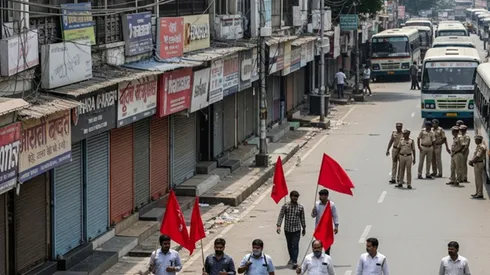

The Bharat Bandh region wise impact today has led to confusion among residents about whether banks and schools are open in their city. Across multiple states, the situation varies by district, local participation, and administrative advisories.
The Bharat Bandh has triggered different levels of disruption in Tier 1, Tier 2, and Tier 3 cities. While essential services are generally maintained, closures of schools and partial functioning of banks have been reported in select regions. This state snapshot explains what is open, what is affected, and what residents should check locally.
Banks During Bharat Bandh Region Wise Overview
In most states, bank branches are officially scheduled to remain open unless a separate banking union strike has been announced. However, on a Bharat Bandh day, actual functioning depends on staff attendance and local law and order conditions.
Public sector banks in some districts have operated with reduced footfall as customers avoid travel due to transport disruptions. In areas where employee unions support the bandh call, limited counters may function. Private sector banks have largely remained operational in major urban centers.
Digital banking services including UPI, mobile apps, internet banking, and ATM withdrawals continue to function in most regions. However, in smaller towns where cash replenishment depends on road transport, ATM cash availability may fluctuate later in the day.
Customers are advised to check official branch communication before visiting. If a transaction is urgent, completing it through digital channels is often the safest option.
School and College Status Across States
School closures during Bharat Bandh are typically precautionary rather than mandatory. State governments and district administrations assess local conditions before issuing advisories.
In several districts of eastern and northeastern states, schools have remained closed for the day to ensure student safety, particularly where protest marches or road blockades are anticipated. Private schools in some cities have shifted to online classes temporarily.
In northern and western states, many schools have opened as usual, especially in metro cities with strong police deployment. Attendance levels, however, may be lower if parents prefer to keep children at home.
Government colleges and universities often continue classes unless specific instructions are issued. In semi urban areas, institutions monitor real time conditions and may suspend afternoon sessions if disruptions escalate.
Public Transport and Its Impact on Attendance
One of the key factors influencing whether banks and schools function normally is public transport. In states where state transport corporations or bus unions participate in the Bharat Bandh, reduced services directly impact attendance.
Auto rickshaw and shared taxi services in smaller cities sometimes remain off the roads either in solidarity or due to safety concerns. This creates practical difficulty for students and bank employees who rely on daily commuting.
Rail services generally continue operations, but last mile connectivity from stations can be affected. In cities with metro rail systems, operations are usually maintained with security support.
When transport disruption is limited, institutions remain open but operate with fewer people physically present.
Government Offices and Essential Services
Most state governments classify essential services such as hospitals, electricity supply, water distribution, and emergency services as protected. These continue functioning during Bharat Bandh.
Government offices not directly linked to essential infrastructure may see lower staff turnout. However, administrative control rooms and law enforcement units are typically strengthened to maintain order.
In district headquarters and smaller towns, markets and local business establishments sometimes shut voluntarily. This indirectly affects daily routine, even if schools and banks are technically open.
Residents should rely on official district administration updates rather than social media rumors. Closure decisions are often city specific rather than state wide.
How to Check Your City’s Real Time Status
The most reliable way to confirm whether banks and schools are open in your city is through official communication. Bank websites and mobile apps often display branch level notifications. School managements usually send SMS or app alerts to parents.
Local police and district administration social media handles provide traffic and safety advisories. In Tier 2 and Tier 3 cities, community groups also share verified updates, but these should be cross checked.
If you have important work such as an exam, document submission, or high value bank transaction, call the institution directly before leaving home.
The Bharat Bandh region wise breakdown shows that while essential systems remain largely operational, mobility and attendance are influenced by local participation levels. The situation is fluid and may evolve during the day.
Takeaways
• Banks are generally open but may function with reduced staff in some districts
• Schools close in certain regions as a precaution based on local assessment
• Public transport disruption is the main factor affecting attendance
• Official district and institutional updates are the most reliable information sources
FAQs
Q1: Are all banks closed during Bharat Bandh?
No. Most banks remain officially open, but branch level functioning may vary depending on local conditions.
Q2: Do schools automatically shut during a Bharat Bandh?
Not automatically. Closure decisions are made by district administrations or school managements based on safety considerations.
Q3: Are online banking and UPI services affected?
Digital banking platforms usually continue functioning normally during a bandh.
Q4: How can I confirm if my local branch or school is open?
Check official websites, mobile apps, SMS alerts, or contact the institution directly for confirmation.