
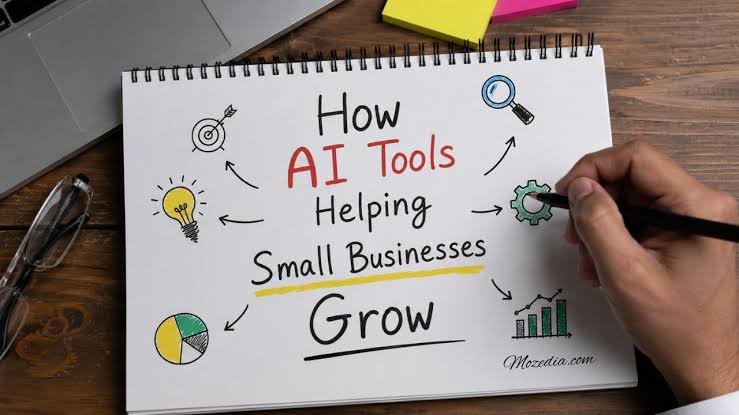

Artificial intelligence is no longer limited to large corporations. Today, AI tools for small businesses are becoming accessible, affordable, and practical for entrepreneurs and freelancers in Tier-2 cities across India. From content creation to customer support, AI is helping businesses save time, reduce costs, and compete in a digital-first economy.
AI tools for small businesses are increasingly being adopted by shop owners, consultants, agencies, freelancers, and local startups in cities such as Nagpur, Indore, Surat, Coimbatore, Jaipur, Ranchi, and Mysuru. Improved internet access, affordable software subscriptions, and growing digital awareness have made AI a useful business assistant rather than a complex technology reserved for experts.
Why AI Adoption Is Growing in Tier-2 Cities
The digital transformation of India’s smaller cities has accelerated in recent years. Businesses that once relied entirely on walk-in customers are now building websites, running social media campaigns, and selling products online. This shift has created a demand for tools that can improve productivity without requiring large teams.
AI-powered platforms can perform tasks that previously required dedicated employees or external agencies. Content writing, customer communication, scheduling, market research, and data analysis can now be handled more efficiently using AI-based solutions.
For freelancers, the benefits are equally significant. Graphic designers, writers, digital marketers, video editors, and consultants can complete projects faster while maintaining quality standards. This allows them to take on more clients and increase revenue without proportionally increasing workload.
Using AI for Content Creation and Digital Marketing
One of the most popular uses of AI is content creation. Small businesses often struggle to maintain a consistent online presence due to limited resources. AI writing assistants can help generate blog ideas, product descriptions, social media captions, email campaigns, and marketing copy.
Digital marketing automation is another growing application. AI tools can analyze audience behavior, suggest posting schedules, create advertising content, and identify trending topics relevant to local markets.
For example, a clothing store in Nagpur can use AI to generate social media content for festive seasons, while a freelance marketing consultant can use AI-powered analytics to optimize client campaigns.
The key advantage is speed. Tasks that previously took several hours can often be completed in minutes while still requiring human review and customization.
AI Tools for Customer Service and Business Operations
Customer support is another area where artificial intelligence is delivering value. AI chatbots can answer common customer questions, provide business information, and respond to inquiries outside working hours.
Small businesses often lose potential customers because they cannot respond immediately. Automated chat systems help bridge that gap and improve customer experience.
AI can also assist with operational tasks such as appointment scheduling, invoice generation, inventory management, and meeting summaries. Freelancers can use AI transcription tools to convert conversations into notes, while local service providers can automate routine administrative work.
These capabilities allow business owners to focus more on growth and customer relationships rather than repetitive tasks.
How Freelancers Can Increase Productivity with AI
Freelancers in Tier-2 cities are increasingly competing for clients across India and international markets. AI tools can help them improve efficiency and professionalism.
Writers can use AI for research assistance and content structuring. Designers can generate creative concepts more quickly. Video editors can automate subtitles and basic editing processes. Consultants can use AI to organize data and prepare presentations.
However, successful freelancers understand that AI works best as an assistant rather than a replacement. Human expertise, creativity, industry knowledge, and client communication remain essential.
The most effective approach is combining AI-generated support with professional judgment to deliver high-quality work.
Challenges and Responsible Use of AI
While AI offers significant advantages, businesses should use it responsibly. Information generated by AI should always be verified before publication or business use. Incorrect or outdated content can damage credibility and create operational issues.
Privacy and data security also deserve attention. Businesses should avoid uploading sensitive customer information to third-party platforms without understanding data handling policies.
Another common mistake is relying entirely on AI-generated content without editing. Customers still value authenticity, local understanding, and personal engagement.
AI should be viewed as a productivity tool that enhances human capabilities rather than replacing human decision-making.
The Future of AI for Local Entrepreneurs
As AI platforms become more affordable and user-friendly, adoption among small businesses and freelancers is expected to increase. Businesses that learn to integrate AI into daily operations can improve efficiency, reduce routine workload, and remain competitive in rapidly evolving markets.
For entrepreneurs in Tier-2 cities, AI presents an opportunity to access capabilities that were once available only to larger organizations. Whether used for marketing, customer service, research, or productivity, AI can help local businesses scale more effectively while maintaining operational flexibility.
The businesses that succeed will be those that combine technology with human expertise, customer understanding, and strong execution.
Key Takeaways
• AI tools help small businesses automate content creation, marketing, and customer support.
• Freelancers can improve productivity and handle more projects using AI-assisted workflows.
• Human review remains essential for accuracy, creativity, and professional quality.
• Responsible AI use includes fact-checking information and protecting customer data.
FAQ
Q1. Do small businesses need technical expertise to use AI tools?
No. Most modern AI platforms are designed for non-technical users and require minimal training.
Q2. Can AI replace employees in small businesses?
AI can automate repetitive tasks, but human skills such as decision-making, creativity, and customer relationships remain important.
Q3. Are AI tools expensive for freelancers?
Many AI platforms offer free plans or affordable subscriptions, making them accessible to independent professionals and small businesses.
Q4. What is the best use of AI for local businesses?
Common uses include content creation, customer support, digital marketing, appointment scheduling, and administrative automation.
(AI tools for small businesses, AI for freelancers, artificial intelligence in Tier-2 cities, digital marketing AI, business automation tools, AI productivity tools, AI for entrepreneurs, local business technology, freelancer productivity, AI business solutions)