
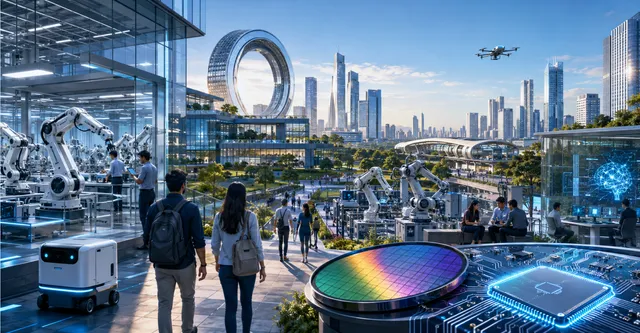

Summary: India’s AI and deeptech ecosystem is gradually expanding beyond Bengaluru, Hyderabad and Delhi-NCR. With government-backed funding programmes, regional incubators and growing technical talent, Tier-2 cities have an opportunity to become important innovation centres, although infrastructure and investment gaps remain.
India’s AI and Deeptech Startup Ecosystem Is Expanding Beyond Metros
India’s AI and deeptech startups have traditionally been associated with major technology centres such as Bengaluru, Hyderabad, Mumbai and Delhi-NCR. These cities offer access to investors, experienced professionals, research institutions and established technology companies. However, the country’s startup ecosystem is gradually becoming more geographically diverse.
According to government data released in November 2026, India has more than 2.40 lakh DPIIT-recognised startups, with over half emerging from Tier-2 and Tier-3 cities. This indicates that entrepreneurship is no longer concentrated exclusively in major metropolitan markets. However, the figure covers startups across industries and should not be interpreted as the share of AI or deeptech companies located in smaller cities.
The expansion raises an important question: can cities such as Jaipur, Coimbatore, Indore, Lucknow, Bhubaneswar and Gandhinagar develop the infrastructure needed to support advanced technology businesses?
Their potential depends on more than the number of startups being registered. Deeptech companies need research facilities, specialised talent, patient capital and access to customers who can test and adopt their products.
Why Tier-2 Cities Are Attracting More Startup Founders
The growing interest in smaller cities is connected to changing business conditions. Founders can increasingly access digital infrastructure, cloud computing, online professional networks and technology services without being physically located in a major metropolitan centre.
Operating costs can also be lower in some Tier-2 cities. Office rentals, employee accommodation and certain operational expenses may be more affordable than in Bengaluru or Mumbai. This can help early-stage companies manage their budgets while developing products.
Another advantage is access to local problems that require technology-based solutions. Agricultural regions may offer opportunities for AI-powered crop monitoring, supply-chain management and precision farming. Industrial cities can support innovation in manufacturing automation, predictive maintenance and robotics.
For example, a startup developing AI-based agricultural advisory tools may benefit from working closely with farmers, agricultural universities and local cooperatives. A company building industrial automation software may find opportunities through manufacturing clusters and small industrial units.
These advantages do not automatically make a city an innovation hub. Founders still need access to experienced mentors, research partnerships, skilled employees and customers willing to invest in new technology.
Which Tier-2 Cities Could Become AI and Deeptech Centres?
Different cities have different strengths. Their opportunities are likely to emerge from existing educational institutions, industrial activity, research capabilities and regional demand rather than from competing directly with Bengaluru across every technology category.
1. Coimbatore: Industrial technology and manufacturing AI
Coimbatore has a strong engineering and manufacturing base, particularly in textiles, pumps, machinery and industrial equipment. This creates opportunities for startups working on industrial automation, robotics, predictive maintenance and AI-based quality control.
Companies developing software for factories can test products in real manufacturing environments. The presence of engineering colleges and technical institutions can also support research and talent development.
2. Jaipur: AI applications and technology entrepreneurship
Jaipur has an expanding technology and startup ecosystem supported by educational institutions, incubators and entrepreneurship programmes.
The city can explore opportunities in enterprise software, AI applications, education technology and digital services. Its participation in the MeitY Startup Hub’s GENESIS NextGen Startup Summit in October 2026 also reflects efforts to strengthen regional deeptech entrepreneurship.
3. Indore: Enterprise technology and applied AI
Indore’s educational institutions, commercial activity and growing startup environment provide a foundation for technology-led businesses.
Potential areas include AI-powered business applications, logistics technology, financial software and automation tools for small and medium enterprises. Its industrial connections could also support startups developing solutions for manufacturing and supply-chain operations.
4. Bhubaneswar: Research-led technology development
Bhubaneswar has an established educational and research environment, with institutions such as IIT Bhubaneswar and other technical universities.
This creates opportunities for research-based startups in electronics, AI, materials science and engineering. Stronger links between research institutions, incubators and private companies could help convert academic work into commercial products.
5. Lucknow: AI applications and emerging technology services
Lucknow’s growing technology ecosystem and access to educational institutions provide opportunities for software and AI businesses.
Startups could work on applications in healthcare, public services, education, agriculture and enterprise automation. The challenge will be developing specialised research and engineering capabilities that go beyond conventional IT services.
These cities represent possible areas of specialisation, not established rankings of India’s leading deeptech hubs. Their long-term performance will depend on investment, research output and the ability to build sustainable businesses.
Government Schemes Supporting Tier-2 and Tier-3 Deeptech Startups
Government programmes are playing an important role in expanding startup support beyond metropolitan centres. Several initiatives are designed to improve access to incubation, funding, research infrastructure and mentorship.
GENESIS: Support for startups in smaller cities
The Ministry of Electronics and Information Technology launched GENESIS, or Gen-Next Support for Innovative Startups, in July 2022.
The programme has a budgetary outlay of ₹490 crore over five years and aims to support approximately 1,600 technology startups, particularly in Tier-2 and Tier-3 cities.
Its approach involves collaboration between startups, government institutions, academic organisations and industry partners. The programme is relevant to deeptech founders who need support to move from an early idea towards a commercially viable product.
Atal Innovation Mission
NITI Aayog’s Atal Innovation Mission supports innovation and entrepreneurship through programmes involving schools, universities, research institutions and startups.
Its initiatives include incubation support and efforts to connect entrepreneurs with industry and other ecosystem participants. Such structures can help founders access mentorship and develop early-stage solutions.
Research, Development and Innovation Scheme
The government’s Research, Development and Innovation (RDI) Scheme has a proposed outlay of ₹1 lakh crore over six years. It aims to encourage private-sector research and development in strategic technology areas.
The identified sectors include AI, quantum computing, robotics, space technology, biotechnology, medical devices and energy transition.
For deeptech startups, access to funding for research and development is particularly important because products often require years of testing and technical validation before they generate commercial revenue.
These initiatives create opportunities, but their effectiveness will depend on how easily eligible startups can access support and convert funding into successful products.
Why AI and Deeptech Startups Need More Than Funding
Deeptech businesses operate differently from many conventional digital startups. A company developing a consumer application may be able to launch an initial product relatively quickly. A startup working on semiconductor technology, robotics, biotechnology or advanced AI may need extensive research, specialised equipment and repeated testing.
This creates several challenges for founders outside established technology centres.
Access to specialised talent
AI engineers, semiconductor designers, robotics specialists and research scientists are not equally available across all cities. Smaller locations may have good engineering graduates but limited access to professionals with experience in advanced product development.
Companies may need partnerships with universities, remote research teams and national talent networks to fill these gaps.
Research and testing infrastructure
Deeptech startups often require laboratories, prototyping facilities, computing resources and specialised testing equipment. Establishing these facilities independently can be expensive.
Shared laboratories, university partnerships and technology parks can reduce the initial burden, but their availability and quality vary between cities.
Patient capital and investment networks
Deeptech products may take longer to reach the market than conventional software services. Investors must be comfortable with longer development timelines and technical risks.
Founders in smaller cities can face additional challenges because many venture capital networks and experienced deeptech investors remain concentrated in established startup centres.
Access to customers
A technology product needs real-world testing and paying customers. Startups developing industrial AI may need access to factories, while healthcare technology companies require partnerships with hospitals and medical professionals.
Without such relationships, even technically strong products can struggle to achieve commercial adoption.
Can Regional Universities Become the Foundation of Deeptech Innovation?
Universities and research institutions could play a decisive role in developing India’s next generation of technology hubs.
Engineering colleges, science institutions and research universities can provide access to laboratories, faculty expertise and students with technical skills. However, academic research must be connected to commercial requirements if it is to create sustainable startups.
A research project in artificial intelligence, for example, may produce a promising model. Turning it into a commercial product requires data access, testing, software engineering, customer feedback and a business model.
Technology transfer offices, university incubators and industry partnerships can help bridge this gap.
The government’s National Mission on Interdisciplinary Cyber-Physical Systems has established 25 Technology Innovation Hubs in academic institutions. These hubs support research and startups in areas such as AI, machine learning, robotics, cybersecurity, Internet of Things and quantum technologies.
Such infrastructure can help distribute research and innovation capabilities across the country instead of concentrating them in a handful of metropolitan centres.
Regional universities will need stronger industry partnerships and better commercialisation support to turn this potential into measurable economic activity.
What Could Make Tier-2 Cities Attractive to Deeptech Investors?
Investors generally look for strong technical teams, a clear market opportunity, intellectual property, product differentiation and a credible route to revenue.
For smaller cities to attract more deeptech capital, they need to demonstrate that companies can develop and scale products without depending entirely on metropolitan infrastructure.
State governments can support this process by creating specialised technology parks, providing access to testing facilities and connecting startups with local industries.
Local manufacturing companies can also become early customers for startups developing automation, robotics and AI-based industrial solutions. Government departments and public institutions may create opportunities through carefully designed technology pilots and procurement programmes.
Regional investors, banks and venture capital funds can strengthen the ecosystem by supporting companies during the research and early commercialisation stages.
Importantly, smaller cities do not need to replicate Bengaluru’s entire startup model. They can build specialised ecosystems around their existing strengths. Coimbatore can focus on industrial technology, while a city with strong agricultural research institutions may develop expertise in agricultural AI.
Specialisation can help regional hubs build an identity that attracts founders, investors and customers.
Can Tier-2 Cities Become India’s Next Innovation Hubs?
India’s Tier-2 cities have a genuine opportunity to participate in the next phase of AI and deeptech development. Government support, digital infrastructure, regional universities and local industry requirements are creating a foundation for more geographically distributed entrepreneurship.
However, becoming an innovation hub requires more than startup registrations, government announcements or incubation centres. Cities need successful companies, experienced founders, research partnerships, specialised talent and investors willing to support long development cycles.
The next phase of growth will depend on whether regional ecosystems can help startups move from prototypes to commercially useful products.
If that transition happens, India’s technology growth could become less concentrated in a few metropolitan centres. Smaller cities may not replace Bengaluru, Hyderabad or Delhi-NCR, but they can develop specialised capabilities and become important contributors to the national deeptech economy.
Key Takeaways
- More than half of India’s DPIIT-recognised startups are emerging from Tier-2 and Tier-3 cities, although this figure covers all sectors.
- Cities such as Coimbatore, Jaipur, Indore, Bhubaneswar and Lucknow have opportunities to develop specialised technology ecosystems.
- Government initiatives such as GENESIS, Atal Innovation Mission and the RDI Scheme can support regional innovation.
- Access to specialised talent, research facilities, patient capital and paying customers will determine whether smaller cities become sustainable deeptech hubs.
FAQs
1. Can Tier-2 cities in India become AI and deeptech startup hubs?
Yes. Tier-2 cities can develop specialised AI and deeptech ecosystems by using their universities, industrial clusters, research facilities and regional talent. Their success will depend on access to funding, infrastructure and customers.
2. Which Tier-2 cities have potential for deeptech startups in India?
Coimbatore, Jaipur, Indore, Bhubaneswar and Lucknow have opportunities to develop technology ecosystems based on their existing strengths in manufacturing, education, research and enterprise services. These are potential areas of growth rather than officially ranked deeptech hubs.
3. What is the GENESIS scheme for startups?
GENESIS is a MeitY initiative launched in July 2022 to support technology startups, particularly in Tier-2 and Tier-3 cities. It has a budgetary outlay of ₹490 crore over five years and aims to support approximately 1,600 startups.
4. What are the biggest challenges for deeptech startups in smaller Indian cities?
The main challenges include limited access to specialised talent, expensive research and testing infrastructure, fewer deeptech investors and difficulty securing early commercial customers. Stronger university, industry and government partnerships can help address these gaps.