
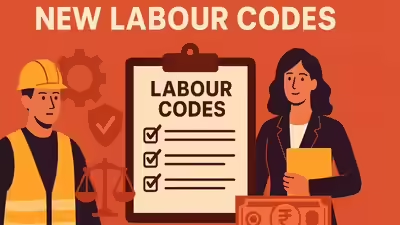

The labour reform backlash around India’s new labour codes has intensified, with trade unions and farmer groups claiming that nearly 30 crore workers are affected. Protesters argue that the changes dilute worker protections, while the government maintains the reforms aim to simplify and modernize labour laws.
The new labour codes consolidate multiple existing labour laws into four broad frameworks covering wages, industrial relations, social security, and occupational safety. While presented as a step toward ease of doing business and formalization of employment, worker organizations say several provisions weaken job security and collective bargaining rights. This article explains what 30 crore workers and farmers are demanding in response to these reforms.
What Are the New Labour Codes
India replaced dozens of central labour laws with four codes. These include the Code on Wages, the Industrial Relations Code, the Social Security Code, and the Occupational Safety, Health and Working Conditions Code.
The stated objective is simplification and uniformity across states. The Code on Wages introduces a statutory minimum wage framework applicable to all workers. The Industrial Relations Code modifies rules around strikes, layoffs, and retrenchment. The Social Security Code seeks to extend benefits to gig and platform workers. The Occupational Safety code consolidates workplace safety norms.
While the reforms were passed by Parliament earlier, full scale implementation has required state level rule framing, which remains ongoing in several states.
Key Concerns Raised by Trade Unions
The labour reform backlash centers largely on the Industrial Relations Code. Trade unions argue that the threshold for prior government approval for layoffs and retrenchment has been raised, allowing larger establishments to reduce workforce without explicit clearance.
Another major concern is the requirement for workers to provide advance notice before going on strike in all establishments, not just public utility services. Unions claim this weakens collective bargaining power and makes organized protest more difficult.
There is also opposition to fixed term employment provisions. While the government says fixed term contracts provide flexibility and parity in benefits, unions fear they may increase contractualization and reduce long term job security.
Demands Around Social Security and Gig Workers
The Social Security Code includes provisions to extend benefits to gig workers and platform workers. However, labour groups argue that the framework lacks clarity on funding mechanisms and employer contributions.
Gig workers such as app based drivers and delivery personnel fall into a grey area between traditional employment and independent contracting. Worker representatives demand stronger guarantees on health insurance, accident coverage, and retirement benefits.
They also seek clear timelines for operationalizing social security funds. Without enforceable rules and budget allocations, unions argue that promises of inclusion remain incomplete.
Farmers and Rural Workforce Concerns
Farmer groups participating in broader protest calls link labour reforms to wider economic concerns. Agricultural workers fear that weakened labour protections could affect rural employment patterns, especially in agro processing units and small scale industries.
There is also anxiety that greater labour flexibility could lead to wage suppression in informal sectors where enforcement is already limited. Rural unions demand strict implementation of minimum wage standards and stronger inspection mechanisms.
Additionally, farmer organizations often combine labour demands with broader economic issues such as procurement policies and input costs, creating overlapping protest platforms.
Government’s Position on Labour Reform
The government has defended the new labour codes as necessary modernization. Officials argue that India’s previous labour law framework was fragmented and complex, discouraging formal employment growth.
According to the official position, the reforms aim to balance worker welfare with industrial growth. Provisions for a universal minimum wage floor, digitized compliance systems, and simplified registration processes are cited as progress.
The government also highlights the inclusion of gig workers in social security provisions as an expansion rather than dilution of rights.
However, full implementation has been delayed in part due to the need for consensus building with states and stakeholders.
What 30 Crore Workers and Farmers Are Demanding
The central demands from protesting groups include rollback or amendment of specific provisions in the Industrial Relations Code, restoration of stricter layoff approval thresholds, and removal of universal strike notice requirements.
They also demand legally enforceable social security guarantees for gig workers, clarity on employer contributions, and effective grievance redressal systems.
Stronger wage protection mechanisms, especially for informal and rural workers, are another key demand. Unions want more transparent inspection and compliance systems to prevent wage violations.
The scale of protest participation reflects the perception that labour reforms affect both organized and unorganized sectors, making it a broad based economic issue.
Takeaways
• The new labour codes consolidate multiple labour laws into four frameworks
• Trade unions oppose changes to strike rules and layoff thresholds
• Gig worker social security provisions lack operational clarity according to critics
• Protests reflect concerns about job security and wage protection across sectors
FAQs
Q1: How many labour laws were replaced by the new labour codes?
Dozens of central labour laws were consolidated into four main codes to simplify compliance and regulation.
Q2: Why are trade unions opposing the Industrial Relations Code?
They argue that higher layoff thresholds and mandatory strike notice requirements weaken worker bargaining power.
Q3: Do the new labour codes cover gig workers?
Yes, the Social Security Code includes provisions for gig and platform workers, though implementation details are still being finalized.
Q4: Have the labour codes been fully implemented across India?
Implementation depends on state level rule notification, and several states are still in the process of finalizing operational rules.