
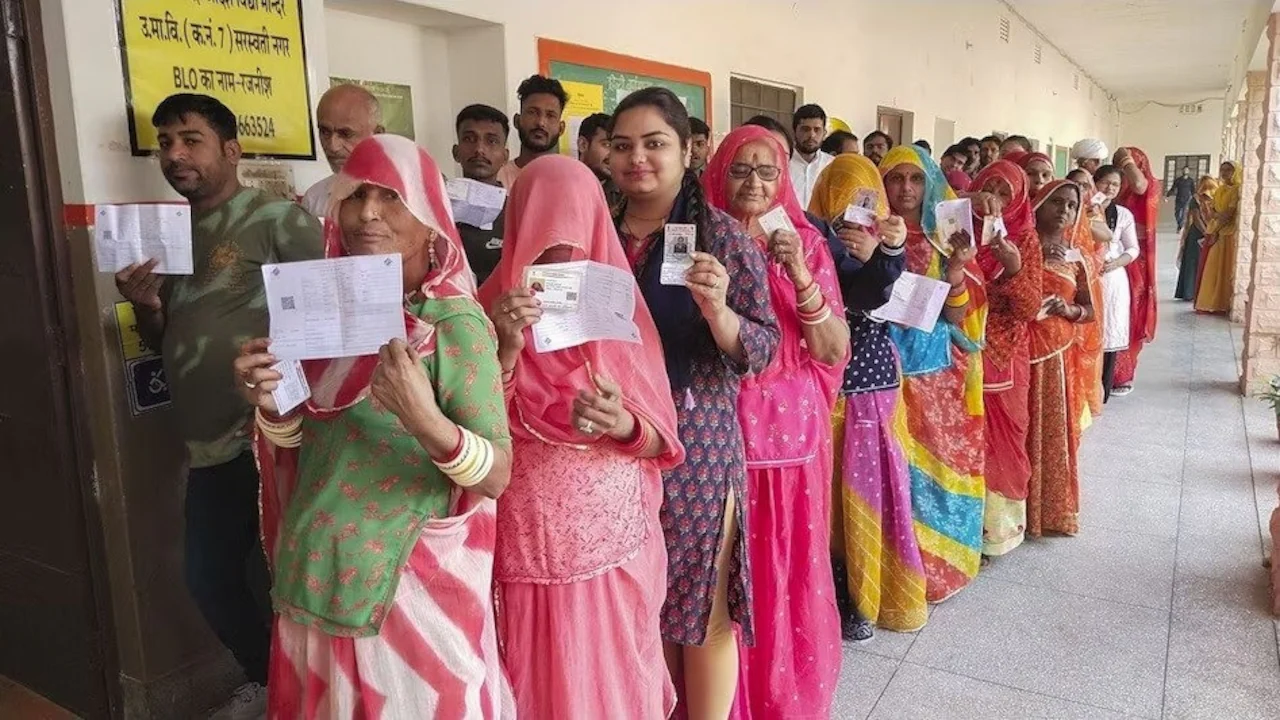

The Rajasthan Panchayat Election Results 2026 are drawing attention as the state counts votes for Zila Parishad and Panchayat Samiti seats. With the BJP and Congress competing for influence in rural areas, the results could offer important insights into local governance, development priorities and political support across Rajasthan.
Rajasthan Panchayat Election Results 2026: Counting Begins
Counting for the Rajasthan Panchayati Raj General Elections 2026 began at 8 AM on Friday, November 20, across 37 districts. The elections cover thousands of seats in Zila Parishads and Panchayat Samitis, making them an important exercise in rural representation.
The counting process includes postal ballots followed by votes recorded through Electronic Voting Machines (EVMs). According to the reported election schedule, results are being declared at district headquarters.
The State Election Commission has organised the counting process across 1,275 Zila Parishad wards and 7,543 Panchayat Samiti wards in the 37 districts participating in the November 20 counting exercise.
These elections are significant because rural local bodies have direct responsibilities involving village-level development, public infrastructure and the implementation of government programmes.
BJP vs Congress: What Early Trends Indicate
The BJP and Congress are the principal political contenders in the Rajasthan Panchayat elections. Initial trends reported by the State Election Commission on November 20 showed the BJP leading in 20 Panchayat seats, while Congress was ahead in 13 seats.
These figures represent early trends and should not be treated as final results or a complete picture of the statewide outcome.
The Rashtriya Loktantrik Party (RLP), led by Hanuman Beniwal, is also participating in the electoral contest. Its performance in selected rural constituencies will be relevant to understanding the political dynamics beyond the two major parties.
For both the BJP and Congress, the results provide an opportunity to assess their organisational presence outside major cities. Rural elections also offer an indication of how local candidates, community relationships and development-related concerns influence voting decisions.
Rajasthan Panchayat Elections 2026: Scale and Participation
The 2026 Panchayati Raj elections covered 41 districts and included elections for 1,403 Zila Parishad wards and 8,245 Panchayat Samiti wards.
According to figures reported by India Today, more than 2.73 crore votes were cast at 45,385 polling stations across the election process. A total of 32,404 candidates contested the elections across the 41 districts.
The voting process was conducted in four phases:
- October 22, 2026: First phase
- October 28, 2026: Second phase
- November 3, 2026: Third phase
- November 14, 2026: Fourth phase
The elections also covered thousands of Panch and Sarpanch positions in rural areas.
The scale of participation highlights the importance of grassroots democracy in Rajasthan. Unlike parliamentary or Assembly elections, Panchayati Raj elections directly determine who represents villages and rural administrative areas in local decision-making institutions.
Why Counting Is Delayed in Four Rajasthan Districts
One important development in the 2026 Rajasthan Panchayat elections is the postponement of counting in four districts.
Kota, Baran, Karauli and Sri Ganganagar will not receive their Panchayat election results on November 20. According to the State Election Commission’s revised schedule, counting in these districts will take place on December 17.
The decision is connected to the tenure of the existing Zila Parishads and Panchayat Samitis, which is scheduled to end in December.
These four districts together account for 128 Zila Parishad wards and 702 Panchayat Samiti wards across 38 Panchayat Samitis.
The decision to align the counting and subsequent formation of local bodies with the end of the existing institutions’ terms is intended to avoid a gap between the outgoing and incoming elected representatives.
As a result, the November 20 results will not represent the complete electoral picture across all 41 districts.
Rural Development Issues That Could Shape the Mandate
The Rajasthan Panchayat Election Results 2026 are not simply a competition between political parties. They also reflect local expectations about development, public services and rural employment.
Water availability remains a major concern in several parts of Rajasthan. The state’s geographical conditions make drinking water supply, irrigation facilities and groundwater management important issues for rural communities.
Road connectivity is another significant factor. Village roads influence access to schools, healthcare facilities, agricultural markets and government services. Residents often evaluate local representatives based on improvements in these essential facilities.
Employment opportunities and the implementation of the Mahatma Gandhi National Rural Employment Guarantee Act (MGNREGA) also remain relevant to rural voters.
For households dependent on agriculture and daily-wage work, employment availability, timely wage payments and access to government benefits can influence their assessment of local administration.
Other concerns include sanitation, drainage, healthcare access, education facilities and the delivery of welfare schemes.
The results may help political parties understand which of these issues require greater attention in different districts. However, election results alone cannot establish why individual voters supported a particular candidate or party.
Political Families and Prominent Candidates in the Contest
The 2026 Panchayat elections have also attracted attention because several candidates belong to politically influential families.
In Churu, Parakram Singh and Kanika Singh, the son and daughter-in-law of former BJP MLA Rajendra Rathore, contested Zila Parishad elections. Kanak Budania, wife of Congress MLA Narendra Budania, was another prominent candidate in the district.
In Sikar’s Shrimadhopur Panchayat Samiti, Shanti Devi, wife of Rajasthan Urban Development and Housing Minister Jhabar Singh Kharra, and their sons Ajay Singh and Durga Singh contested the elections.
Other notable candidates included Nikita Dudi in Bikaner, daughter-in-law of former Congress MP Rameshwar Dudi, and Beena Bairwa in Dausa, wife of Congress MLA D C Bairwa.
The presence of candidates from established political families has brought additional attention to local contests. However, their individual electoral performance needs to be assessed through confirmed ward-level results rather than assumptions based on political connections.
What the Rural Mandate Could Mean for Rajasthan Politics
The Panchayat elections provide political parties with an opportunity to assess their grassroots organisation and local leadership networks.
For the ruling BJP, the results will be an important measure of its ability to maintain support beyond urban constituencies. For Congress, the elections offer an opportunity to evaluate its rural organisational strength and the response to its local leadership.
The performance of regional candidates and independent contestants will also matter, particularly in areas where local issues influence electoral competition.
However, Panchayat elections should not automatically be interpreted as a direct prediction of future Assembly or Lok Sabha results. Local candidates, village-level relationships, community concerns and individual development records can influence these elections differently from state and national contests.
The more meaningful assessment will come from examining confirmed results across districts, the distribution of seats between parties and the subsequent selection of local body heads.
What Happens After the Rajasthan Panchayat Results?
The election process does not end with the declaration of ward-level results. Newly elected members of Zila Parishads and Panchayat Samitis will participate in selecting the heads of these institutions.
According to the announced schedule, elections for Zila Pramukh positions in the 37 districts are scheduled for November 25, followed by Up-Zila Pramukh elections on November 26.
Panchayat Samiti Pradhans will be elected on November 27, while Up-Pradhans will be selected on November 28.
The four districts with postponed counting will follow a separate schedule in December. Their Zila Pramukh elections are scheduled for December 22, followed by Up-Zila Pramukh elections on December 23. Panchayat Samiti Pradhans and Up-Pradhans will be elected on December 24 and 25, respectively.
These appointments will determine the leadership of rural local institutions responsible for coordinating development activities and local administration.
For residents, the effectiveness of these institutions will ultimately depend on how elected representatives address everyday issues involving infrastructure, public services and government scheme implementation.
Key Takeaways
- Rajasthan Panchayat election counting began on November 20, 2026, across 37 districts, covering 1,275 Zila Parishad and 7,543 Panchayat Samiti wards.
- Early trends showed the BJP ahead in 20 seats and Congress in 13, but these figures are not final statewide results.
- Counting in Kota, Baran, Karauli and Sri Ganganagar has been postponed until December 17.
- Water supply, rural employment, roads, sanitation and local development remain important issues for evaluating the rural electoral mandate.
Frequently Asked Questions
1. When were Rajasthan Panchayat Election Results 2026 scheduled to be declared?
Counting began at 8 AM on November 20, 2026, across 37 districts. Results are being declared as counting progresses. Four districts will complete counting on December 17.
2. Which parties are contesting the Rajasthan Panchayat elections?
The BJP and Congress are the main contenders. The Rashtriya Loktantrik Party (RLP), independent candidates and other political contestants are also participating.
3. Why are Rajasthan Panchayat election results delayed in four districts?
Counting in Kota, Baran, Karauli and Sri Ganganagar has been postponed to December 17 because the existing Zila Parishads and Panchayat Samitis complete their terms in December. The revised schedule aligns the results and subsequent formation of new bodies with the end of those terms.
4. How can voters check Rajasthan Panchayat Election Results 2026 online?
Voters can visit the official Rajasthan State Election Commission website at https://sec.rajasthan.gov.in/. They can select the relevant district, election category, Panchayat Samiti or Gram Panchayat and ward number to access available result information.
(Internal Keywords: Rajasthan Panchayat Election Results 2026, Rajasthan Zila Parishad Election Results, Rajasthan Panchayat Samiti Results, Rajasthan rural elections, BJP vs Congress Rajasthan, Rajasthan State Election Commission, Rajasthan Panchayat ward-wise winners, Rajasthan local body elections, Rajasthan rural development, Rajasthan election news)