
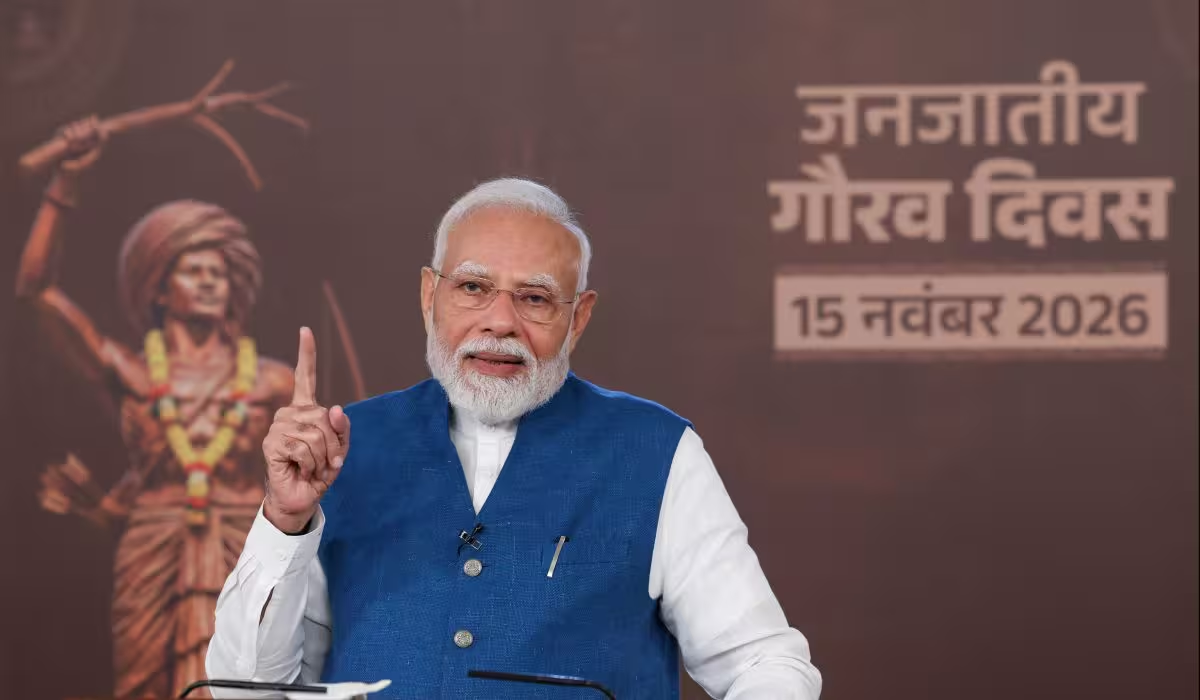

Prime Minister Narendra Modi virtually addressed the National Janjatiya Gaurav Diwas celebrations in Gadchiroli, Maharashtra, on November 15, 2026. Marking the 151st birth anniversary of tribal freedom fighter Bhagwan Birsa Munda, the programme highlighted tribal welfare, education, healthcare and infrastructure, alongside the inauguration of 246 development projects worth approximately ₹3,000 crore.
PM Modi Addresses National Janjatiya Gaurav Diwas Celebrations
Prime Minister Narendra Modi addressed the National Janjatiya Gaurav Diwas celebrations in Gadchiroli through video conferencing on Sunday, November 15. The event was organised to mark the 151st birth anniversary of Dharti Aaba Bhagwan Birsa Munda, whose contribution to India’s tribal freedom movement continues to hold historical significance.
The programme took place at the District Sports Complex in Gadchiroli and brought together tribal community members, public representatives and government officials. Maharashtra Governor Jishnu Dev Varma, Chief Minister Devendra Fadnavis, Deputy Chief Minister Eknath Shinde and Union Tribal Affairs Minister Jual Oram were among those present.
The Prime Minister began his address with the traditional greeting Johar and paid tribute to Bhagwan Birsa Munda. He also acknowledged Gadchiroli’s tribal heritage and remembered regional freedom fighters, including Raghoji Bhangre, Bhagoji Naik and Veer Baburao Shedmake.
246 Development Projects Worth ₹3,000 Crore Announced
A major highlight of the Janjatiya Gaurav Diwas programme was the inauguration and foundation stone laying of 246 development projects across different states. According to the Prime Minister’s Office, the projects represent an investment of approximately ₹3,000 crore and are aimed at improving facilities and opportunities for tribal communities.
More than 170 projects were inaugurated, while foundation stones were laid for over 70 additional projects. The initiatives cover several important areas, including education, healthcare, rural infrastructure and livelihood development.
Among the projects inaugurated were 38 Eklavya Model Residential Schools for tribal students and 100 multipurpose centres under the Pradhan Mantri Janjati Adivasi Nyaya Maha Abhiyan (PM-JANMAN).
The programme also highlighted the inauguration of a museum dedicated to tribal freedom fighter Ropuiliani in Mizoram and a new building for the Tribal Research Institute in Arunachal Pradesh.
These projects are intended to strengthen public infrastructure in regions where geographical challenges and limited facilities have historically affected access to essential services.
Gadchiroli Dedicates 22 Ashram Schools and 51 Hostels
Maharashtra’s Gadchiroli district also witnessed a significant development in tribal education infrastructure during the celebrations.
According to the Maharashtra Lok Bhavan, 22 Ashram Schools and 51 hostels operated under the Tribal Development Department were dedicated to the public during the programme.
Ashram schools play an important role in providing educational facilities to children from tribal and remote communities. For families living in villages located far from established educational institutions, residential schooling can help reduce the difficulties associated with daily travel and access to education.
Hostel facilities can also support students who need accommodation to continue their studies away from their villages.
The dedication of these institutions is particularly relevant for Gadchiroli, where several communities live in geographically remote areas. However, the long-term impact of such facilities will depend on their staffing, educational quality, maintenance and accessibility for students.
The programme also included interactions with three tribal beneficiaries from Maharashtra, Gujarat and Telangana, during which the Prime Minister heard about their experiences with various government welfare schemes.
PM Modi Highlights Tribal Welfare and Poverty Reduction
During his address, Prime Minister Modi discussed poverty reduction and the government’s initiatives aimed at improving living conditions in tribal regions.
He referred to a recent World Bank report and stated that nearly 50 crore people in India had moved out of extreme poverty over the previous 12 to 13 years. He described this as a significant national achievement and acknowledged the contribution of society, citizens and government welfare initiatives.
The Prime Minister also highlighted two major programmes focused on tribal development: PM-JANMAN and the Dharti Aaba Janjatiya Gram Utkarsh Abhiyan.
According to his address, more than ₹1 lakh crore had been allocated for these initiatives. Their focus includes improving access to basic facilities and addressing infrastructure gaps in tribal communities.
PM-JANMAN, or the Pradhan Mantri Janjati Adivasi Nyaya Maha Abhiyan, specifically focuses on Particularly Vulnerable Tribal Groups (PVTGs). It aims to improve access to essential services such as housing, drinking water, education, healthcare, roads and electricity.
The Dharti Aaba Janjatiya Gram Utkarsh Abhiyan focuses on addressing gaps in infrastructure and essential services across tribal-majority villages.
The Prime Minister also referred to housing, electricity, sanitation and healthcare initiatives, including Ayushman Bharat, which provides eligible beneficiaries with health coverage of up to ₹5 lakh per family annually under its hospitalisation benefit framework.
Education, Healthcare and Livelihoods Remain Key Priorities
Access to education, healthcare and sustainable livelihood opportunities remains an important part of tribal development discussions in India.
Many tribal communities live in areas where difficult terrain, limited transportation and distance from major towns can affect access to schools, hospitals and government services.
Residential schools and hostels can help address educational access challenges, while healthcare facilities and outreach programmes can improve the availability of medical services.
During his Gadchiroli address, Modi also highlighted the role of financial assistance and income-generating opportunities in reducing poverty. He referred to the Pradhan Mantri Mudra Yojana, which provides collateral-free loans to eligible non-corporate, non-farm small and micro enterprises.
For tribal entrepreneurs, small business owners and self-employed individuals, access to institutional finance can help support activities such as agriculture-related businesses, local manufacturing, handicrafts and other enterprises.
The Prime Minister also mentioned the development campaigns covering more than 100 Aspirational Districts and over 500 Aspirational Blocks. Many of these regions have significant tribal populations and require focused attention to improve public services.
He further referred to the PM Krishi Dhan Dhanya Yojana, under which attention is being directed towards 100 agriculturally backward districts.
Birsa Munda’s Legacy and the Significance of Janjatiya Gaurav Diwas
Janjatiya Gaurav Diwas is observed every year on November 15 to recognise the contributions of India’s tribal communities and honour their historical leaders.
The date marks the birth anniversary of Bhagwan Birsa Munda, born on November 15, 1875, in the present-day Jharkhand region.
Birsa Munda emerged as an important tribal leader during British rule and led the Ulgulan movement, also known as the Great Tumult. His movement challenged colonial authority, exploitation and the interference of outsiders in tribal land and community systems.
His contribution became an important part of India’s freedom movement and the history of tribal resistance.
The Government of India announced November 15 as Janjatiya Gaurav Diwas in 2021. The observance aims to recognise tribal freedom fighters, preserve indigenous traditions and bring greater attention to the contributions of tribal communities.
In his address, Modi also remembered several other tribal leaders and freedom fighters, including Tirot Sing, Sidho-Kanho, Rani Gaidinliu, Tantya Bhil, Alluri Sitarama Raju and Rani Durgavati.
He noted that the celebrations had expanded since their introduction in 2021, with more than two lakh programmes organised across the country during Birsa Munda’s 150th birth anniversary celebrations in 2025.
Gadchiroli’s Development and the Challenge of Inclusive Growth
Gadchiroli holds particular importance in discussions about tribal development because of its large tribal population, forest-based economy and geographical conditions.
For years, several parts of the district have faced challenges involving road connectivity, healthcare access, educational infrastructure, employment opportunities and basic public services.
The district has also experienced the impact of Left-Wing Extremism, which has affected development activities and public infrastructure in certain areas.
During his address, the Prime Minister discussed the impact of Naxalism and Maoist violence on tribal communities. He referred to the decline of extremist activity and highlighted the importance of improved security, education and employment opportunities in previously affected regions.
He also spoke about the relationship between security and development, arguing that communities affected by violence should have greater access to public services and opportunities.
However, the long-term development of Gadchiroli will depend on more than infrastructure announcements. Effective implementation, regular monitoring, local participation and access to sustainable employment will remain important for improving living conditions.
For residents of remote villages, the actual impact of development programmes will be measured through better schools, functioning healthcare facilities, reliable transport, drinking water and livelihood opportunities.
Focus on Tribal Development Beyond Annual Celebrations
The Janjatiya Gaurav Diwas programme in Gadchiroli brought national attention to tribal heritage and ongoing development initiatives.
The inauguration of projects worth approximately ₹3,000 crore, the dedication of educational institutions in Maharashtra and the discussion around welfare schemes formed the central focus of the event.
While the celebrations recognise the historical contribution of tribal freedom fighters, they also highlight the continuing need to improve access to education, healthcare, infrastructure and economic opportunities.
The effectiveness of these initiatives will ultimately depend on how consistently they reach the communities they are designed to serve.
The programme concluded with the Prime Minister urging citizens to draw inspiration from Bhagwan Birsa Munda and contribute towards the vision of a developed India.
Key Takeaways
- Prime Minister Narendra Modi virtually addressed the National Janjatiya Gaurav Diwas celebrations in Gadchiroli on November 15, 2026.
- A total of 246 development projects worth approximately ₹3,000 crore were inaugurated or had their foundation stones laid across India.
- Gadchiroli dedicated 22 Ashram Schools and 51 hostels under Maharashtra’s Tribal Development Department.
- The address highlighted tribal welfare, education, healthcare, livelihood opportunities and the legacy of Bhagwan Birsa Munda.
Frequently Asked Questions
1. Why did PM Modi address the Janjatiya Gaurav Diwas programme in Gadchiroli?
The programme was organised on November 15, 2026, to mark the 151st birth anniversary of tribal freedom fighter Bhagwan Birsa Munda. Gadchiroli hosted the National Janjatiya Gaurav Diwas celebrations, highlighting tribal heritage and development initiatives.
2. How many development projects were announced during the Gadchiroli programme?
A total of 246 development projects worth approximately ₹3,000 crore were inaugurated or had their foundation stones laid across different states.
3. What educational facilities were dedicated in Gadchiroli?
A total of 22 Ashram Schools and 51 hostels under Maharashtra’s Tribal Development Department were dedicated to the public during the celebrations.
4. What is the significance of Janjatiya Gaurav Diwas?
Janjatiya Gaurav Diwas is observed on November 15 every year to honour Bhagwan Birsa Munda and recognise the contributions, heritage, culture and freedom struggles of India’s tribal communities.
(Internal keywords: PM Modi Gadchiroli speech, Janjatiya Gaurav Diwas 2026, Birsa Munda birth anniversary, Gadchiroli tribal development, Maharashtra tribal schools, PM-JANMAN scheme, Dharti Aaba Janjatiya Gram Utkarsh Abhiyan, tribal welfare schemes in India, Gadchiroli news)