
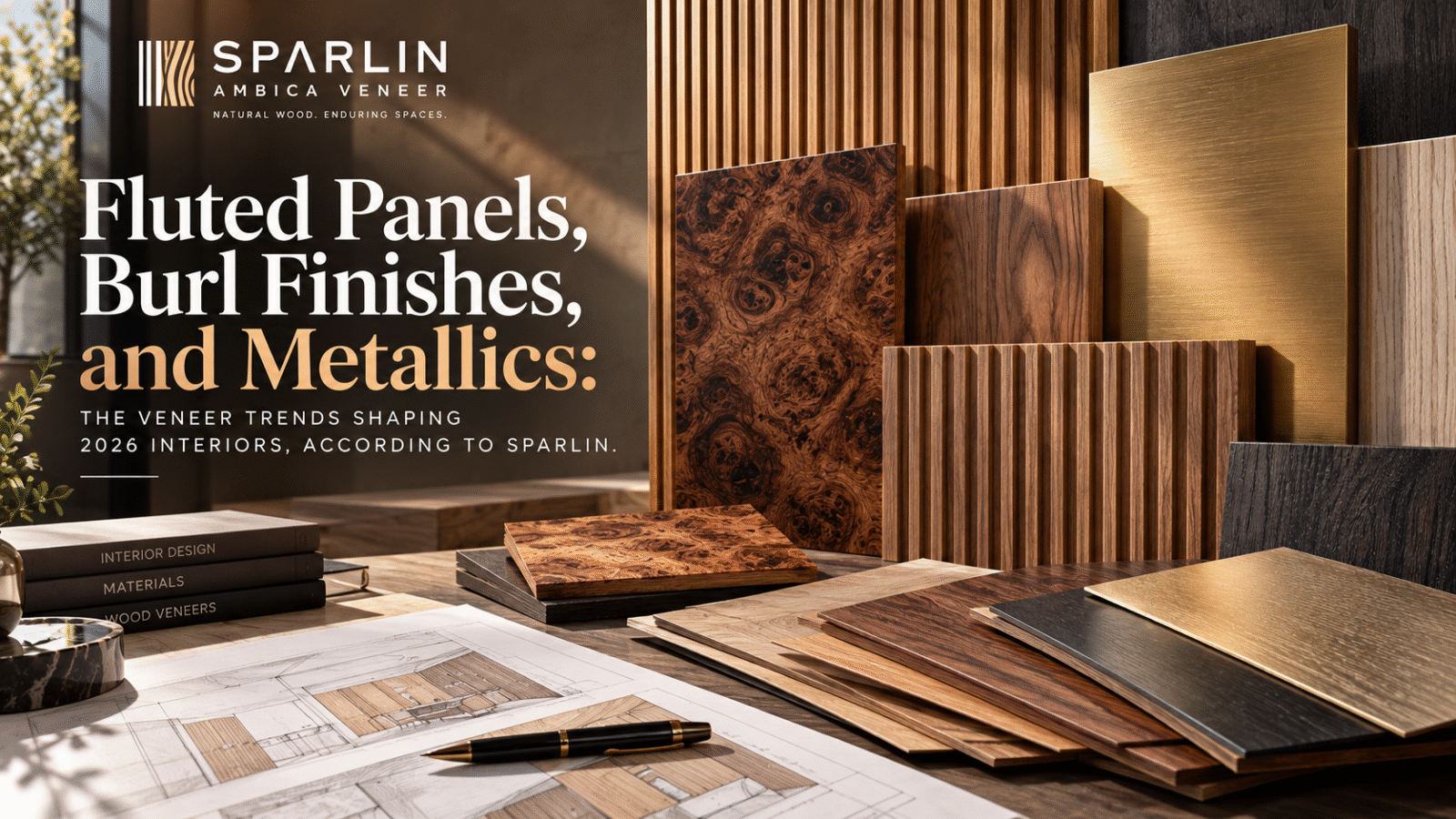

For much of the last decade, laminate ruled cost-conscious interior projects across India. It was cheap, consistent, and forgiving of imperfect substrates. But walk into a newly completed hotel lobby, a design-forward office, or an upscale residential project today, and there’s a good chance the warm, grain-rich surface catching your eye is real wood — specifically, natural wood veneer.
According to Sparlin, the Mumbai-based wholesale veneer supplier that has watched this shift play out across hundreds of client projects since 2011, the comeback isn’t a passing trend. It’s a recalibration of what “premium” means in Indian interiors.
From Cost-Driven to Character-Driven
“For a long time, the conversation with clients was almost entirely about cost per square foot,” the company notes. “Now we’re getting far more briefs where the first question is about grain character — book-matched or slip-matched, quiet grain or something with more figure to it. That’s a different kind of client altogether.”
A few forces appear to be driving the shift:
- A maturing design market. As more Indian architects and interior designers work on internationally benchmarked commercial and hospitality projects, natural materials have become a differentiator rather than a luxury.
- Better substrate technology. Modern engineered cores have made veneer more dimensionally stable and easier to specify at scale than in decades past, reducing the durability concerns that once pushed specifiers toward laminate.
- A sustainability rethink. Veneer uses a fraction of the timber a solid-wood equivalent would require, letting designers specify genuine wood grain — including rare and slow-growing species — without the same environmental cost.
- Social visibility. Interior projects are more photographed and shared than ever, and natural veneer’s grain variation photographs in a way flat laminate finishes struggle to match.
What This Means for Specifiers
For architects and designers navigating the shift, the practical challenge is sourcing: finding a supplier who can deliver enough consistent, well-graded material to execute a project at scale, not just a handful of decorative sample sheets.
That’s the gap Sparlin has built its business around — a catalogue of more than 50 wood variants, from teak and eucalyptus to burl, metallic, and fumed finishes, supplied in the volumes commercial and residential projects actually require. The company’s minimum order structure reflects that trade-volume reality rather than a retail, by-the-sheet model.
A Trend With Staying Power
Design trends come and go, but the underlying economics here look durable. Veneer lets specifiers offer clients the visual and tactile qualities of solid wood — grain, warmth, natural variation — at a material efficiency solid timber simply can’t match, and at a price point that’s increasingly competitive with high-end laminate alternatives.
For suppliers positioned to meet that demand with consistent grading and reliable delivery, the current moment looks less like a trend to ride and more like a market finally catching up to what the material could always do.
The Supply-Side Bottleneck Nobody Talks About
There’s a less-discussed side to this comeback: demand for natural veneer has grown faster in many Indian cities than the trade infrastructure to supply it reliably at scale. Sourcing genuine wood grain consistently — rather than as one-off decorative sheets — requires relationships with timber suppliers, in-house grading discipline, and warehouse capacity that not every trader has built up.
That gap is part of why Sparlin, despite operating in a crowded and largely informal segment of the market, has found steady demand from repeat commercial clients rather than one-off residential orders. A hospitality group planning a multi-property rollout, or an architecture firm executing several floors of the same commercial build, needs a supplier who can deliver the same grade of veneer on the tenth order as the first — a bar that separates an established trade supplier from a trader simply riding the current wave of interest in natural materials.
As more Indian cities follow Mumbai’s lead in specifying natural surfaces over synthetic ones, that supply-side capability — not just design enthusiasm — is likely to determine which suppliers benefit most from the shift.
About Sparlin (Ambica Veneer): Sparlin is a Mumbai-based wholesale supplier of natural wood veneer serving architects, interior designers, and contractors since 2011, with a catalogue spanning more than 50 wood variants. Learn more at sparlinveneer.com.