
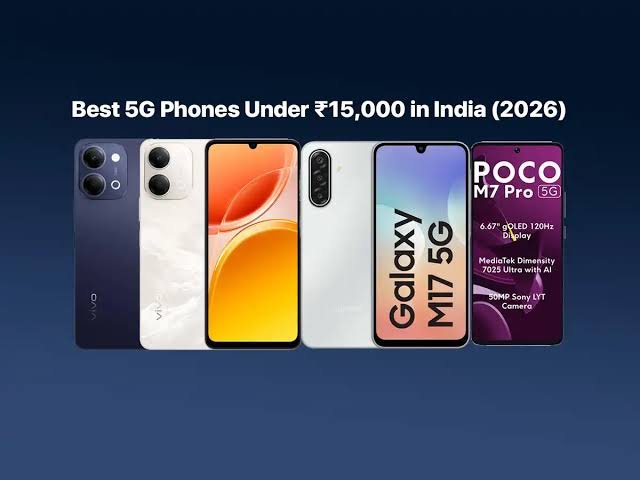

The budget 5G smartphone market in India offers several options for buyers who want to upgrade without spending more than ₹15,000. Price listings updated on 19 October 2026 include models such as the Lava Virat V1 5G, iQOO Z10x and Redmi A7 Pro 5G.
Each model makes different compromises, so buyers should compare specifications rather than selecting a phone based only on its price or advertised camera resolution.
| Smartphone | Indicative listed price | Key consideration |
|---|---|---|
| Lava Virat V1 5G | ₹11,799 | Budget-friendly entry point |
| iQOO Z10x | ₹13,700 | Performance and battery capacity |
| Redmi A7 Pro 5G | ₹14,497 | Large display and battery |
| Lava Bold N4 Pro | ₹14,999 | 6GB RAM and 128GB storage variant |
Prices are indicative listings reported by Indian technology publications in October 2026. They may vary by seller, storage configuration, bank offer and availability. Verify the exact variant and final checkout price before purchasing.
These examples illustrate why a direct comparison matters. A phone with more storage may be useful for someone who records videos, while a model with a stronger processor may be more suitable for gaming or multitasking. Neither choice is automatically best for every user.
Display Quality: Compare AMOLED, LCD and Refresh Rate
The display affects almost every interaction with a smartphone, from reading messages and attending online classes to watching videos and browsing social media.
Budget phones commonly use LCD panels, while some models in higher price brackets offer AMOLED displays. AMOLED screens generally provide deeper blacks and strong contrast, which can make films and photographs look more vivid. LCD screens can still provide a satisfactory experience, depending on panel quality, brightness and resolution.
Refresh rate is another factor. A 90Hz or 120Hz screen can make scrolling and compatible animations appear smoother than a 60Hz display. However, a higher refresh rate does not automatically mean better image quality.
Buyers should also compare screen resolution and outdoor brightness. A large display with relatively low resolution may not look as sharp as a smaller, higher-resolution screen.
For students, commuters and people who spend several hours reading on their phones, display comfort and readability may matter more than a headline specification.
Processor and RAM: Choose Performance for Your Daily Needs
The processor determines how efficiently a smartphone handles apps, games, photography and background tasks. When moving from 4G to 5G, buyers should avoid focusing exclusively on network connectivity while ignoring overall performance.
A phone with a capable processor can handle everyday applications, video calls and multitasking more comfortably. More demanding games and editing apps may require stronger graphics performance and better thermal management.
RAM also matters, but the number alone does not tell the full story. A 4GB RAM phone may handle basic messaging, browsing and video streaming, while users who frequently switch between multiple apps may benefit from 6GB or 8GB. Actual performance also depends on the processor, software optimisation and memory management.
Storage is equally important. A 64GB device can fill up quickly if the user downloads large apps, stores offline videos or records high-resolution footage. A 128GB variant is generally a more practical starting point for long-term use, provided it fits the budget.
Before purchasing, check whether the advertised RAM includes virtual RAM expansion. Virtual RAM uses part of the phone’s internal storage and is not equivalent to physical RAM.
Battery Life and Charging Speed: Look Beyond Capacity
Battery capacity is particularly important for users who rely on their phones for navigation, online classes, video calls and mobile data throughout the day.
Many affordable smartphones now offer batteries around 5,000mAh or larger. Some current budget models offer 6,000mAh or more, but a larger battery does not guarantee proportionately longer usage.
Actual battery life depends on screen brightness, processor efficiency, signal strength, gaming, background applications and network conditions. Using 5G continuously in an area with weak coverage may also consume more power than expected.
Charging speed deserves separate attention. A phone with a large battery and slow charging can take longer to recharge, especially when the user needs to leave home quickly. Check the supported charging wattage and whether a compatible charger is included in the box.
For people who travel frequently or live in areas with unreliable electricity, battery endurance may be more valuable than a premium-looking design or additional camera features.
Camera Quality: Why Megapixels Are Not Enough
A smartphone’s camera is another major consideration when upgrading from 4G. Budget devices often advertise 50MP or higher-resolution main cameras, but megapixels alone cannot predict photographic quality.
Sensor size, lens quality, image processing, stabilisation and software all influence the final photograph. Two phones with similar megapixel counts can produce noticeably different results, especially in low light.
Buyers who regularly photograph family events, festivals, products or social media content should look at actual camera samples and independent reviews. Check how well the phone handles indoor lighting, moving subjects, skin tones and video recording.
Optical image stabilisation, where available, can help reduce blur caused by hand movement. It is not the same as digital stabilisation, and neither guarantees professional-quality footage.
The front camera also deserves attention for video calls and selfies. If recording reels is a priority, confirm the supported video resolution, frame rates and stabilisation options instead of assuming that a high-resolution rear camera guarantees strong video performance.
5G Network Support in India: Check Compatibility Before Buying
A smartphone labelled 5G is not automatically guaranteed to deliver the same network experience everywhere. Compatibility depends on the device’s supported frequency bands, the operator’s network deployment and coverage in the user’s area.
India’s mobile operators, including Reliance Jio and Bharti Airtel, have deployed 5G services in many locations, but availability and performance vary by city, neighbourhood and indoor environment.
Before upgrading, check the exact phone variant’s supported 5G bands against your operator’s requirements. Confirm that the device is compatible with the operator’s network and that 5G service is available where you regularly use your phone.
It is also worth checking the SIM and plan requirements. In some cases, an existing SIM may work with 5G, but eligibility and activation conditions can depend on the operator and account. Confirm the current requirements with your service provider.
Remember that a 5G smartphone can still use 4G when 5G coverage is unavailable. Buyers should therefore consider 4G reception, call quality and network reliability alongside advertised 5G speeds.
Software Updates and Security: Think About Long-Term Value
Software support can determine whether an affordable smartphone remains practical for several years. A low purchase price may become less attractive if the device receives limited security updates or stops receiving major operating system upgrades early.
Before buying, check the manufacturer’s official update policy for the exact model. Look for the number of promised Android version upgrades, the duration of security updates and the date from which that support period is calculated.
Security updates help address vulnerabilities, while operating system upgrades can introduce new features and compatibility changes. The two are related but not interchangeable.
Also consider the manufacturer’s record of delivering updates on time. A long promise is useful, but buyers should understand the terms and confirm them through official product documentation.
For parents buying a phone for a student, or households looking for a device that will last several years, software support should carry meaningful weight in the decision.
When Should You Upgrade From 4G to 5G?
There is no universal deadline for replacing a 4G smartphone. The right time depends on the device’s condition, the user’s needs and local network availability.
An upgrade may make sense if the existing phone has a failing battery, inadequate storage, poor performance or limited compatibility with newer applications. Someone who frequently downloads large files or uses mobile data for work may also benefit from a reliable 5G connection where coverage is strong.
However, a functioning 4G phone may still be sufficient for messaging, calls, browsing and streaming. Buying a new device solely because 5G exists may not provide enough practical value to justify the expense.
Consider the total cost of ownership, including the phone, protective accessories, charging equipment and any change in mobile plan costs. Compare these expenses against the benefits you expect to receive.
The best affordable 5G smartphone is not necessarily the newest or the cheapest. It is the model that meets your daily requirements, offers dependable performance and provides enough software support to remain useful over time.
Key Takeaways
- Compare processor performance, RAM, storage, display quality and battery life instead of choosing a phone based on 5G branding alone.
- Check supported 5G frequency bands and local operator coverage before purchasing a device.
- Evaluate camera samples, charging speed and the manufacturer’s software update policy for long-term value.
- Compare the final price of the exact variant across trusted sellers, and upgrade from 4G when the practical benefits justify the expense.
Frequently Asked Questions
1. Which affordable 5G smartphone should I buy under ₹15,000?
Options listed in October 2026 include the Lava Virat V1 5G, iQOO Z10x and Redmi A7 Pro 5G. Compare their current prices, storage variants, processor performance, battery life and software support before choosing. No single model is ideal for every buyer.
2. Is 5G worth upgrading from 4G in India?
It can be worthwhile if 5G coverage is available in your area and you regularly use mobile data for downloads, streaming or other demanding tasks. If your existing 4G phone meets your needs, upgrading immediately may not be necessary.
3. How much RAM and storage should a budget 5G phone have?
For everyday use, 6GB RAM and 128GB storage can provide a practical balance if the configuration fits your budget. Basic users may manage with less, while gaming and heavy multitasking can benefit from stronger hardware.
4. Does every 5G smartphone support Jio and Airtel 5G?
Not necessarily. Compatibility depends on the exact device variant, supported frequency bands and operator requirements. Verify the specifications and local coverage before buying.