
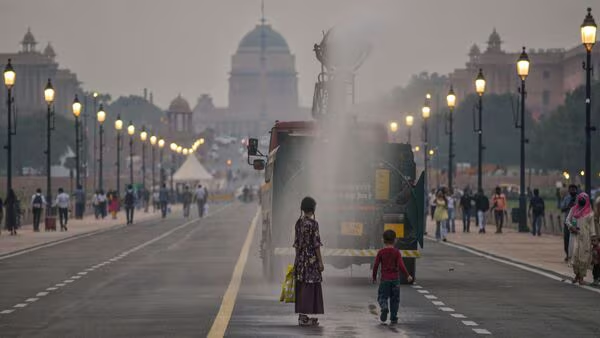

The public holiday in Delhi on 25 November created a ripple effect across NCR fringe towns as businesses, travel networks and local markets adjusted to reduced footfall, altered schedules and shifted demand patterns. This is a time sensitive news topic, and its impact is best understood through economic and mobility factors that shape NCR’s interlinked ecosystem.
The holiday, declared for the 350th martyrdom anniversary of Guru Tegh Bahadur, led to closures of schools, offices and government departments in Delhi. While the holiday formally applied only to the capital, NCR’s surrounding towns such as Noida, Ghaziabad, Gurugram and Faridabad experienced indirect disruptions. These towns depend heavily on Delhi’s daily workforce flow, retail traffic and transport connectivity. Understanding the impact helps local businesses and commuters prepare better for such regional holidays.
How reduced workforce movement affected NCR businesses
A large share of NCR’s workforce travels daily between Delhi and fringe cities. With government offices, many private firms and schools in Delhi shut, cross border movement dropped. NCR towns that rely on Delhi employees or customers saw quieter commercial activity, especially in business districts and office heavy pockets. Cafes, co working spaces and service sector units in Noida and Gurugram reported lighter footfall due to fewer Delhi commuters.
Small businesses in Ghaziabad and Faridabad that depend on morning and evening office crowd observed slower customer traffic. Essential services continued normally, but discretionary spending dipped for the day. For many businesses, the impact resembled a partial weekend, with lower walk ins but steady online sales.
Effect on markets and retail demand in fringe cities
Local markets in NCR fringe towns often see increased footfall when Delhi observes a public holiday, but the effect varies depending on the nature of the holiday. Religious or commemorative events usually result in people staying near local community centers or Gurdwaras rather than traveling for shopping.
In this case, markets in Noida Sector 18, Gurugram’s Sadar Bazaar and Faridabad’s NIT area noticed moderate activity, largely driven by residents rather than Delhi visitors. Delhi shoppers typically travel outward on festive or leisure holidays, but commemorative holidays tend to keep activity closer to home.
Wholesale markets that supply goods to Delhi retailers also reported quieter movement as deliveries slowed. Some distributors scheduled shipments a day earlier to avoid delays connected to altered traffic patterns around Delhi.
Transportation patterns and congestion shifts across NCR
Delhi’s holiday significantly changed mobility patterns. Metro lines connecting to Noida, Gurugram and Ghaziabad saw fewer peak hour travelers. Buses entering and exiting Delhi operated normally but carried reduced passenger load.
Road traffic followed a unique pattern. While arterial roads inside Delhi near commemorative venues experienced slower movement, many peripheral roads were clearer than a typical weekday. Commuters in NCR towns benefited from shorter travel times within their own city limits. Ride hailing demand dipped in the morning and early afternoon but rose again in the evening as families traveled to community events and prayers.
For interstate commercial vehicles, Delhi’s lighter traffic allowed quicker passage through border checkpoints, though some detours near central zones remained due to security arrangements.
Impact on education hubs and coaching clusters
Although the holiday applied only to Delhi, NCR fringe towns witnessed indirect effects. Students who commute daily into Delhi for coaching classes or college lectures had the day off. Coaching hubs in Noida and Ghaziabad saw lower attendance from students who typically connect through Delhi’s public transport network.
Some institutes pre scheduled online classes to avoid disruption. Transport operators working school routes in border areas temporarily adjusted timings or paused specific routes because associated institutions in Delhi remained closed.
Implications for the informal sector and daily wage earners
Daily wage earners such as delivery agents, auto drivers and street vendors in NCR cities depend heavily on Delhi bound commuter flow. With fewer office workers and students crossing borders, earnings dipped for those operating around metro stations and office corridors.
However, areas near religious gatherings in Delhi saw higher demand for food stalls, autos and small vendors. Those positioned near event locations experienced better income opportunities than those operating in commercial belts of NCR fringe towns.
Short term and long term outlook for NCR economies
Short term effects included reduced weekday commercial energy, altered mobility and uneven retail activity. Long term impact is minimal because such commemorative holidays occur infrequently and do not affect structural business patterns.
However, the event reinforces a long standing point: NCR towns are economically interdependent with Delhi. Any administrative or mobility change in the capital influences neighboring cities. Businesses that rely on cross border footfall benefit from forecasting upcoming Delhi specific holidays and adjusting operations, staffing and supply schedules accordingly.
Takeaways
Delhi’s holiday reduced commuter flow and softened business activity in NCR towns
Markets in fringe cities saw moderate footfall mainly from local residents
Transport networks experienced lighter load and shifted congestion patterns
Daily wage earners faced uneven demand depending on location and event proximity
FAQ
Did NCR towns officially declare a holiday too
No. The formal holiday applied to Delhi, but NCR towns experienced indirect effects due to reduced cross border movement.
Why did markets not see a strong surge despite the holiday
Commemorative holidays usually keep people close to community events rather than encouraging retail or leisure travel.
Were metro and bus services disrupted
No. Services operated normally but with lower passenger load during peak hours.
Did schools in NCR towns remain open
Most NCR schools remained open, but attendance dropped in cases where students rely on Delhi based routes or coaching connections.