
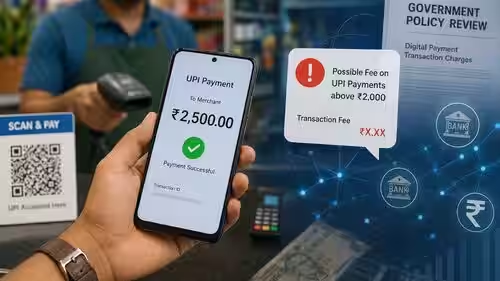

Starting October 15, 2026, certain UPI merchant payments above ₹2,000 will attract a Merchant Discount Rate, or MDR. However, this is a merchant-side payment processing charge, not a new fee that customers are expected to pay. Here is how users can understand the rules before making high-value UPI payments.
What Are the New UPI Charges Above ₹2,000?
The new UPI charges have become a current issue after the National Payments Corporation of India introduced an MDR framework for certain person-to-merchant, or P2M, transactions above ₹2,000.
Under the framework taking effect on October 15, eligible P2M transactions above ₹2,000 will generally attract an MDR of 0.4%. The charge is capped at ₹300 for transactions of ₹75,000 and above. Certain sectors have separate rates, including a flat ₹5 MDR for specified essential categories, while capital-market transactions have a separate rate.
The important point for customers is that MDR is not supposed to appear as an additional UPI usage fee on their bill. The government has instructed banks and payment ecosystem participants not to pass the MDR directly to consumers.
For people in Tier-2 and Tier-3 cities, this distinction matters because UPI is widely used for everything from shopping and restaurant payments to school fees, utility bills and other everyday expenses.
First Check Whether You Are Paying a Merchant
Before worrying about the ₹2,000 threshold, identify the type of UPI payment you are making.
UPI transactions between two individuals, commonly called person-to-person or P2P payments, remain free regardless of the transaction amount under the new framework. Therefore, transferring ₹5,000 to a family member or friend does not automatically become chargeable simply because the amount exceeds ₹2,000.
The new MDR framework concerns eligible person-to-merchant transactions.
For example, paying ₹5,000 to a shop’s UPI QR code is different from sending ₹5,000 to another individual’s bank account.
This is the first check users should make before assuming that a large UPI payment will attract a charge.
Check the Amount Before Scanning the QR Code
The ₹2,000 threshold is important for eligible merchant transactions.
Merchant payments up to ₹2,000 continue to have zero MDR under the new framework. Payments above ₹2,000 can fall under the MDR structure depending on the merchant category and other applicable conditions.
Suppose you are buying a refrigerator for ₹30,000 and paying a merchant through UPI. The transaction is above the threshold, so it falls into the category that needs to be checked under the new MDR rules.
On the other hand, paying ₹1,500 at a local store remains below the threshold.
The threshold should therefore be treated as a starting point for checking the transaction, not as proof that the customer personally owes a UPI fee.
Understand How 0.4% MDR Works
For an eligible transaction, 0.4% of the payment amount would be the standard MDR rate under the new framework, subject to applicable exemptions and caps.
For example, on an eligible ₹10,000 merchant transaction:
₹10,000 × 0.4% = ₹40 MDR
This ₹40 is a merchant-side payment processing cost. It is not supposed to be added separately to the customer’s UPI payment as a UPI convenience fee.
GST treatment is also relevant for merchants. Reports on the new framework state that the 18% GST applies to the MDR amount rather than the full value of the UPI transaction. In the ₹10,000 example, 18% GST on ₹40 would be ₹7.20.
Consumers therefore should not calculate 0.4% plus GST and assume that amount must be paid on top of their purchase.
Check the Payment Screen Before Confirming
The safest habit remains checking the final amount displayed in your UPI application before entering your PIN.
Look at:
- Merchant name
- Payment amount
- Any additional fee shown by the payment platform
- Bank account being debited
- Final amount before confirmation
If a merchant tells you that you must pay an additional amount specifically because of UPI MDR, ask for clarification rather than immediately assuming that the charge is legitimate.
The government has said MDR should not be passed on to consumers. Banks and trader associations have also been asked to ensure that customers are protected from such charges.
Small Merchants Have Separate Protection
The new rules are particularly relevant to India’s large merchant ecosystem because a significant portion of small businesses generally handles lower-value transactions.
NPCI CEO Dilip Asbe has said that approximately 75% of merchants accepting digital payments are not expected to be affected because they typically do not process transactions above ₹2,000. He also said 96% of transaction volume and 75% of transaction value fall outside the MDR framework.
This is important for Tier-2 and Tier-3 cities, where QR-based payments are common among neighbourhood retailers, food vendors, service providers and small businesses.
The government has also maintained protections for eligible small merchants under the zero-MDR framework.
Do Not Assume Every ₹2,000-Plus Payment Is the Same
Another important point is that the MDR framework does not apply identically to every payment above ₹2,000.
Certain categories have separate treatment. Reports on the framework identify specified sectors such as railways, fuel and telecom for a flat ₹5 MDR, while capital-market payments have a separate 0.02% rate subject to the applicable cap.
This means users should avoid relying on a simple rule such as UPI above ₹2,000 equals a 0.4% customer fee.
That interpretation is incorrect.
The type of transaction, merchant category and applicable exemption determine how the MDR framework works.
What If a Merchant Adds a UPI Fee?
If a merchant asks you to pay an additional amount specifically described as a UPI MDR or UPI processing fee, do not assume that it is an official customer charge.
The government’s stated position is that the MDR should not be passed on to consumers. The Supreme Court on September 28 also declined to stay the implementation of the new MDR framework while seeking responses from the Centre and other parties in a challenge to the policy.
The legal and regulatory position can still develop because the matter is before the court.
For customers, the practical approach is simple: check the displayed amount, retain the payment receipt and seek clarification from the merchant or payment provider if an unexplained fee appears.
Should You Split a Large Payment Into ₹2,000 Parts?
Customers may wonder whether a ₹6,000 purchase can simply be divided into three separate ₹2,000 UPI payments.
While such a split may technically produce individual transactions at or below the threshold, deliberately fragmenting payments to avoid applicable MDR is not an approach consumers should rely on. Payment systems have fraud and transaction-monitoring mechanisms, and merchants can also decide how they accept payments.
The better approach is to make the payment according to the actual purchase and understand whether the transaction falls within the applicable MDR category.
The threshold is a regulatory criterion, not an invitation to restructure genuine purchases artificially.
What UPI Users Should Remember From October 15
The new framework changes the payment ecosystem, but it does not mean customers will suddenly start paying a UPI fee every time they make a payment above ₹2,000.
P2P transfers remain free, merchant payments up to ₹2,000 remain at zero MDR, and eligible small merchants continue to receive protection under the framework. The new MDR primarily affects specified higher-value merchant transactions.
For users, the most useful habit is to distinguish between a merchant-side MDR and a customer-facing fee. That distinction will help prevent confusion as the new rules come into effect during the festive shopping season.
Key Takeaways
- From October 15, 2026, eligible UPI merchant transactions above ₹2,000 will generally attract a 0.4% MDR, subject to applicable rules and caps.
- MDR is a merchant-side payment processing charge and should not be directly passed on to customers.
- Person-to-person UPI transfers remain free, while eligible merchant payments up to ₹2,000 continue at zero MDR.
- Always check the merchant name, payment amount and final amount shown on your UPI app before entering your UPI PIN.
FAQ
Will I have to pay a UPI charge for payments above ₹2,000?
Not as a general customer fee. The new MDR applies to specified merchant transactions and is a merchant-side charge. The government has stated that it should not be passed on to consumers.
Is UPI still free for payments below ₹2,000?
Eligible merchant payments up to ₹2,000 continue to attract zero MDR. Person-to-person UPI transfers also remain free under the framework.
What is the MDR on a ₹10,000 eligible UPI merchant payment?
At the standard 0.4% rate, the MDR would be ₹40. This is a merchant-side charge, not an additional ₹40 that the customer is supposed to pay as a UPI fee.
Can a shop charge me extra for paying through UPI?
The government has directed banks and relevant trade bodies to ensure that MDR is not passed on to consumers. If a merchant adds an unexplained UPI fee, customers should ask for clarification and retain the transaction receipt.